





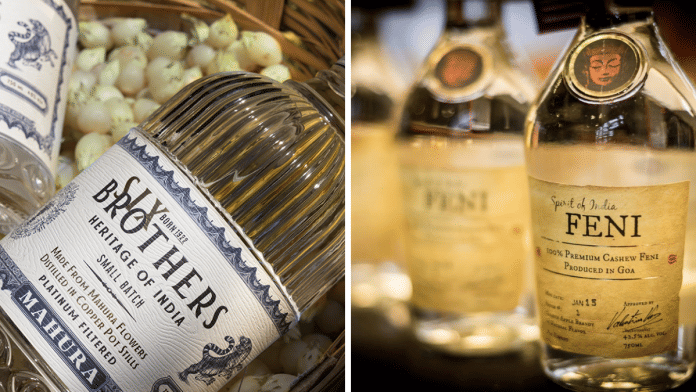


New Delhi: India’s original spirits, mahua and cashew feni, are showing the world that desi can also be world-class. According to the Godrej Food Trends Report 2026, once poured in roadside bars and Goan homes, these indigenous liquors are now walking into luxury lounges and cocktail menus across the country.
For centuries, mahua and feni have been deeply rooted in the tribal cultures and local ecosystems of central and coastal India.
Now, brands such as Cazulo, Aani Ek, Goenchi, Sentari, Kantala Spirits and Tinto are giving feni a polished new identity, while Desmondji and Six Brothers Mahura are proving that mahua can be both rooted and refined. Both mahua and feni are shedding the “local liquor hidden in plain sight” image and are being repositioned as a “heritage alcohol” of India.
“For the longest time, spirits like mahua, feni, toddy, and arrack were treated as deeply regional, something consumed locally but rarely given space in mainstream bar culture. That’s changing quite visibly now.You have places like Quinta Cantina building an entire identity around feni, with dedicated menus where the spirit is very much the hero. Similarly, Bandra Born has a special Mahua menu,” Vikram Achanta, Founder & CEO of Tulleeho and Co-Founder of 30BestBarsIndia and India Bartender Show, told ThePrint.
He calls it an “exciting” moment as India’s native spirits are finally being looked at with “more intent, by producers, bartenders, and consumers alike.”
“What was once seen as hyperlocal is slowly becoming part of the urban Indian drinking repertoire, and increasingly, something the world is beginning to pay attention to as well,” Achanta added.
“India’s heritage spirits like feni and mahua are finally being appreciated for what they truly are—terroir-driven craft spirits with deep cultural roots and generations of indigenous knowledge behind them,” Suzann Homan, founder-director of Kantala Spirits, told ThePrint.
The price for branded feni and mahua ranges from roughly Rs 550 to Rs 3,000 for a standard 740ml bottle in India. In the global market, like the United States, a 750 ml bottle of Kafi or Kazkar cashew feni typically ranges from $30 to $45. In Australia, local distilleries, such as Royal Travancore Spirits, produce similar cashew apple spirits that cost around $50 to $70 AUD. Premium Mahua spirits, such as Six Brothers Mahura, are available in the USA for around $110 to $120, and in Australia for about $120 AUD.
Homan said that her effort is to preserve the soul of traditional Goan cashew feni while presenting it in a refined, contemporary format for a global audience.
She explained that consumers around the world are increasingly seeking authenticity, provenance and storytelling in what they drink, and Indian spirits are beginning to command that same respect alongside global artisanal spirits like mezcal and grappa.
Their rise is not just limited to Indian bars. In September 2025, at the 27th edition of Spirits Selection by Concours Mondial de Bruxelles (CMB) held in Tequila, Jalisco, Mexico, India had a major moment, as the Godrej report highlights.
The competition featured 2,598 spirit samples from 70 countries, judged blind by 140 international experts. Competing across categories like whisky, rum, gin, brandy, liqueurs, and ready-to-drink cocktails, India returned with a record haul of 14 silver and six gold medals, even bagging a Grand Gold Medal or “Revelation” title for the very first time.
But the biggest flex for India’s alco-bev landscape was mahua and feni brands bagging silver medals, as it put India’s indigenous spirits on the global map.
“The winning brands, from startups to mid-sized and large legacy companies, represented a true cross-section of India’s current alco-bev landscape,” the Godrej report read.
(Edited by Insha Jalil Waziri)