





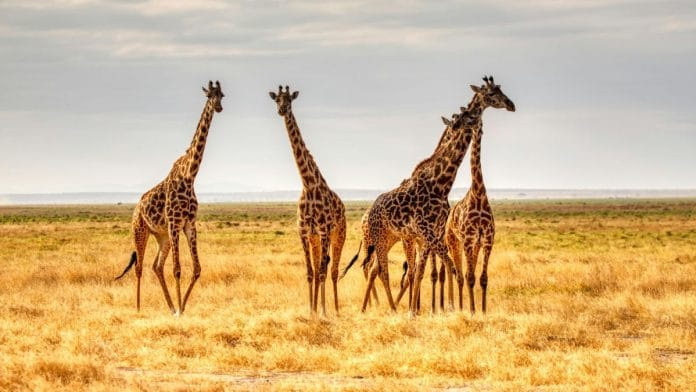


New Delhi: Some giraffes can mentally combine hidden quantities of food, performing a basic cognitive process similar to simple addition. At the Barcelona Zoo, certain giraffes successfully tracked and chose containers holding larger combined amounts of carrots, according to a recent study.
The study, ‘Assessing quantity combination and dissociation in giraffes’, was published in Scientific Reports. It was led by researchers Iker Loidi and Jordi Galbany from the University of Barcelona and was conducted in collaboration with the UB Institute of Neurosciences (UBneuro).
“The animals could only see the initial quantities and the items moved, but not the final amounts. Results revealed that giraffes performed above chance in the Combination task (where food was combined to one of two covered quantities). However, they performed at chance level in both the Dissociation task (where food was removed from one of two covered quantities) and the Subsequent Events task (where food was transferred from one of the two quantities to the other one),” states the study.
Also read: Gyan Bharatam needs tech overhaul. Scanning manuscripts not enough, says committee report
‘Subtraction more difficult than addition’
Four captive giraffes were used in the experiment. They were provided with hidden quantities of food. In the experimental tasks, scientists placed carrot pieces into two containers, then added extra pieces into one or both containers while they were hidden from the animal’s view.
Two of the four giraffes consistently picked the container with the higher total amount, proving they could mentally update and add up the hidden quantities. However, when tests involved removing pieces or mixing addition and subtraction, the giraffes could not solve the tasks, showing that subtraction is much harder for them.
“These results are consistent with what we observe in humans: there are individual differences in numerical problem-solving and, in general, subtraction is more difficult than addition. Furthermore, subtraction activates areas of the brain specializing in complex, controlled processing that addition does not stimulate,” said Loidi.
The numerical abilities of giraffes can be attributed to the challenges they face in the wild. Giraffe communities naturally break apart, and they regroup depending on the environment. Their primary food source, acacia trees, grows far apart across the plains.
“(This) could encourage the need to estimate where, when and in what quantities these resources are available in order to optimize foraging decisions”, said Loidi. “These findings highlight the importance of studying a wider diversity of groups and species in order to better understand the evolution of the animal mind.”
From Elephants to Wolves
Numerical ability, or a “number sense,” is a widespread evolutionary trait found across the animal kingdom. According to another study, animals utilise two primary cognitive systems to process quantities and navigate in the wild.
“Extensive evidence across species demonstrates that numerical cognition is a ubiquitous cognitive trait that enhances fitness by supporting critical behaviors such as foraging, hunting, and intergroup conflict,” states the study.
A few animals that carry a “number sense” are chimpanzees, elephants and wolves.