





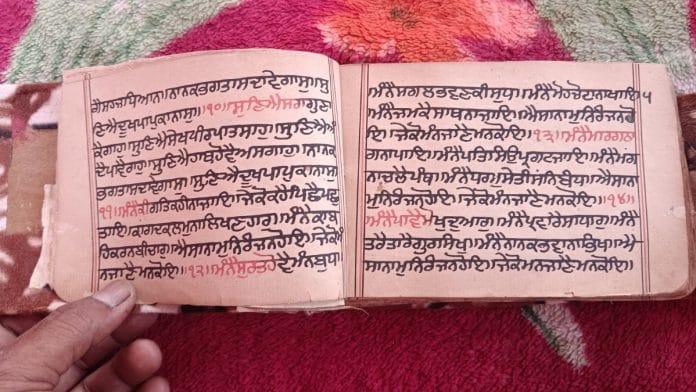


New Delhi: Nearly a year after the Gyan Bharatam Mission launched to digitise manuscripts spread across India, a parliamentary committee is calling for an urgent technological overhaul.
“Enlarge the digitisation standard into a complete capture standard, settled in consultation with scholars, scientists and custodians and in force before the contracts reach full scale,” reads the committee’s report.
Rajya Sabha MP Sanjay Jha chaired the Standing Committee on Transport, Tourism and Culture and submitted the report titled From Manuscript to Mission: Preserving, Mapping and Sustaining India’s Cultural Heritage in the Age of Artificial Intelligence.
In the 2025-26 budget, the Narendra Modi government allocated Rs 491.66 crore for five years, aiming to digitise one crore manuscripts under the Gyan Bharatam Mission.
According to the report, a national manuscript survey conducted between March and June 2026 recorded 2.25 crore manuscripts, of which 1.16 crore were verified and added to the national database.
For centuries, India’s knowledge has survived in fragile palm-leaf bundles, handwritten books and manuscripts tucked away in libraries, monasteries, temples, private collections and homes. Many are now too delicate to be handled frequently, while some remain scattered across the country, known only to the people who guard them.
The government’s Gyan Bharatam Mission was meant to bring this vast, dispersed inheritance into the digital age. But nearly a year after the mission was launched, a parliamentary committee warned that simply scanning manuscripts will not be enough.
Committee recommendations
The standing committee proposes 12 recommendations for the Manuscript mission.
The committee recommends that the Ministry of Culture institute a national scientific department with facilities to scan and digitise documents.
It also recommends that the culture ministry build the national reading workforce in three limbs—a citizen transcription platform, a standing compact with universities under which departments adopt unedited manuscripts as dissertation projects, and published priority lists, drawn first from analysis of the national catalogue.
The Committee recommends making every page image and verified transcription created with public money freely available as a national training library.
The Ministry of Culture has been recommended to commission the national scientific agencies to extract astronomical and weather observations and publish them as open national datasets.
The committee also recommends a joint programme between the Ministry of Culture and the Ministry of Ayush.
“To build a concordance connecting the medical formulations in the corpus to the standardised national terminologies and the statutory pharmacopoeia so that manuscript variants are presented for study, the approved formulation governs practice and the corpus becomes a research engine for the medicine of the future,” reads the report.
Also Read: Nearly 35% of ASI posts are vacant across departments
Programme for living inheritance
The committee report says India’s inheritance is not only written but exists in oral traditions and languages spoken by only a handful of people.
The committee recommends a programme to preserve this living inheritance. It also recommends the extension of Mission’s pipeline to oral heritage by using speech recognition systems designed for Indian languages.
It also pushes for a single guardianship framework for both physical and digital, including the survey’s photographs and publicly available list of manuscripts that are at risk, identified by using machine-based classification.
“Publish the open index of persons, places and works of the corpus, the time-layered atlas of Indian knowledge built upon it, and the register of scribal hands,” says the report.
(Edited by Ratan Priya)