



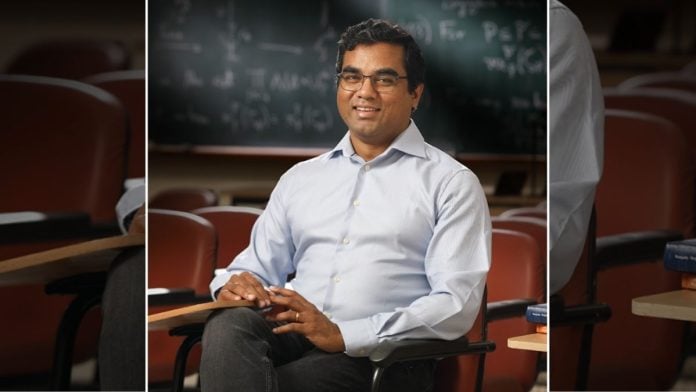
New Delhi: Mahesh Kakde, a professor at the Indian Institute of Science, received the 2026 Ramanujan Prize for Young Mathematicians on 30 September, becoming the fifth Indian to get the award.
Abdus Salam International Centre for Theoretical Physics (ICTP), the Department of Science and Technology (DST), and the International Mathematical Union (IMU), in collaboration with the Indian government, give this award.
Ramanujan Award is given to mathematicians under 40 from a developing economy for outstanding contributions to mathematics. Kakde’s work in algebraic number theory was recognised by the prestigious platform.
His theory focuses on solving problems and on how mathematical structures are different yet connected.
How do numbers behave
Kakde was a former student at the Indian Institute of Science (IISC), Bengaluru. He later moved to the University of Cambridge to pursue a master’s and subsequently a PhD in pure maths. Before joining IISc in 2019, he taught in King’s College London, Princeton University and University College London.
Kakde has several awards and fellowships in his list of achievements. He received the Frontiers of Science Award from ICBS Beijing. Kakde is also a visiting researcher at the Tata Institute of Fundamental Research, Mumbai. He was also awarded the Infosys Prize in mathematical science.
Kakde’s Algebraic number theory found further hidden patterns and structure that explained the way numbers behave.
He came up with the Iwasawa theory, where he studied the changes in mathematical patterns when subjected to increasingly complicated systems. His findings helped to understand the ever-changing nature of numbers.
Also read: Kashmiri filmmaker Arfat Sheikh detained by ICE in US. Friends say ‘he had valid papers’
Four more Indians with Ramanujan Prize
The prestigious award was established in 2005 to celebrate the maths and contributions made in this field. The winner gets a 10,000-dollar cash prize.
Before Kakde, four people had been awarded.
Sujatha Ramdorai’s work from the Tata Institute of Fundamental Research was recognised in arithmetic of algebraic varieties in 2006. She made contributions to “non-commutative Iwasawa theory”.
Almost a decade later, Amalendu Krishna won the award in 2015 for his work in algebraic K-theory, algebraic cycles and the theory of motives. Next year, Krishna was recognised on the list of Asian Scientist 100.
Three years later, Ritabrata Munshi won the award for his work in Number Theory. A professor at the Indian Statistical Institute, Kolkata, and the Tata Institute of Fundamental Research, Mumbai, studied the “analytic properties of L-functions and automorphic forms”.
Neena Gupta became the second Indian woman who was awarded for her contribution to “affine algebraic geometry and commutative algebra” in 2021. The Ramanujan Prize committee observed that Gupta’s work “shows impressive algebraic skill and inventiveness” about Gupta’s work.
(Edited by Saptak Datta)