






Singhadurbar: The Nepal government plans to continue search-and-rescue operations in the flooded hydropower tunnels for at least two more weeks, hoping to find survivors trapped inside.
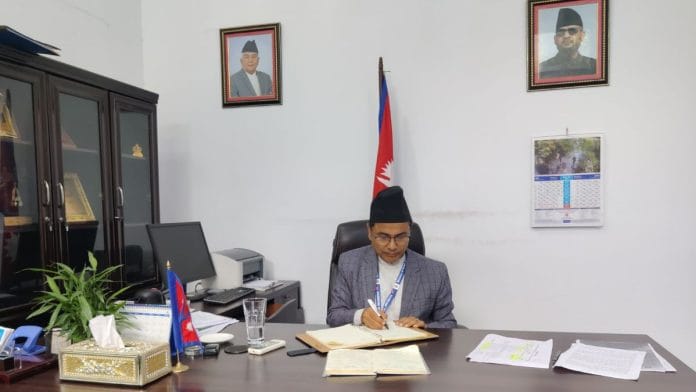
In an interview with ThePrint, Dharmaraj Upreti, Chief Executive of the National Disaster Risk Reduction and Management Authority of Nepal, said the government’s main focus was rescuing over 900 people feared trapped in 12 hydropower tunnels along the Trishuli River, after floods struck the region in Northern Nepal on 26 August.
“We won’t give up on the tunnel rescues; it will go on for likely one or two more weeks. We have seen experiences around the globe, and we still expect survival (from people inside),” said Upreti. “Let us keep hoping for that.”
He also spoke about the recovery and reconstruction process after the floods, where over 1,200 people are confirmed dead and over 4,000 are still missing, and how Nepal views the disaster as a climate crisis.
On 1 September, Nepal’s foreign minister Shisir Khanal told The Kathmandu Post that the country had officially asked for justice and compensation under the United Nations’ Framework Convention on Climate Change (UNFCCC) from developed countries.
“This isn’t an ordinary disaster. Based on the evidence we have gathered, this is part of the larger climate crisis, because of changing landscapes and cryospheric systems,” said Upreti. “So our damage assessment too will take into account UNFCCC processes, in terms of loss and damages.”
On 31 August, Nepal’s minister for finance Swarnim Wagle and minister for agriculture, forests and environment Gita Chaudhary, wrote to The Fund for responding to Loss and Damages (TFLD), an international entity formed under the UNFCCC at the 28th Conference of the Parties in Dubai, 2023.
“As a least developed and highly climate-vulnerable mountainous country, Nepal contributes negligibly to global greenhouse gas emissions yet continues to bear disproportionate and escalating climate impacts,” said the letter, a copy of which was accessed by ThePrint. “The Government of Nepal respectfully requests the board to take a special decision to respond rapidly, directly and effectively in accordance with its Governing Instrument.”
According to Upreti, Nepal has received some initial green signals from TFLD and is hopeful that they will address this issue promptly. In the meantime, the NDRRMA, along with other departments within the Nepal government, is conducting initial damage assessments to understand exactly how much financial support reconstruction would require.
“We need to identify all sectors affected, and the post-disaster recovery needs of each of them. This should be ready within a week or so, and then we will disclose it,” said Upreti.
Rescue and relief efforts
At the NDRRMA headquarters in Singhadurbar, right behind the Nepal Prime Minister’s Office, Upreti also shed light on the current rescue and recovery operations in Nuwakot, Rasuwa, and Dhading districts—the hardest hit areas.
Originating from a glacial rock collapse in Tibet, the floods travelled through the Lhende Khola River and entered Nepal through the Bhote Koshi River in the Timure region of Rasuwa district, the border between the two countries. Many people impacted by the floods in Timure were foreign pilgrims on their way to Mount Kailash and Mansarovar Lake in Tibet, including Indians. The flood then travelled downstream when the Bhote Koshi joined the Trishuli River, wreaking havoc in Dhunche, Bidur, Devighat, Betrawati, and other districts.
As of 3 September, 1,252 bodies had been recovered from the flooded areas, and 4,216 are reported missing. The Nepal Army, Armed Police, and Nepal Police have together deployed 21,402 personnel for rescue and relief operations, and 11,993 people have been rescued.
Around 4,000 of those rescured are in holding centres in upstream areas of Nuwakot and Rasuwa districts, in temporary shelters and schools converted into evacuation centres.
“By next week, we will start relocating the people who are living in the risk zone currently, as there is still a possibility of floods and we don’t want them to be pushed into disaster again,” said Upreti. “We are identifying feasible locations with the help of the local government.”
Apart from providing immediate relief materials such as food, water, clothes, and mattresses with the help of local and international NGOs, the government is also accounting for other risks in relief centres: health epidemics, infections, and women and children’s safety. Upreti said the NDRRMA has deployed teams from the National Child Rights Council (NCRC) to the affected areas to protect children from safety risks such as trafficking.
Also read: A year before Nepal floods, Trump cut funding for disaster-monitoring project by NASA, ICIMOD, USAID
Why this crisis is different
The NDRRMA, formed after the 2015 Nepal earthquake, is the nodal agency responsible for managing disaster risk and post-disaster efforts across the country. The 36-member staff has handled the country’s response to numerous crises, including the 2025 Rasuwa GLOF, the 2024 Kathmandu floods, and other natural disasters.
Yet, Upreti stressed that this disaster is not like the others—and it needs to be seen in the larger atmosphere of Himalayan ecology and climate change-led catastrophe. He pointed out that in the last six years, there have been 9 extreme climate events in Nepal alone, and many more in the larger Himalayas.
“If you look at the evidence, be it the Pakistan avalanche in July, or the Dharali floods a few years ago, or even the Sikkim GLOF event, you see the pattern,” said Upreti. “In this context, we don’t want mercy. We want justice.”
(Edited by Prasanna Bachchhav)