



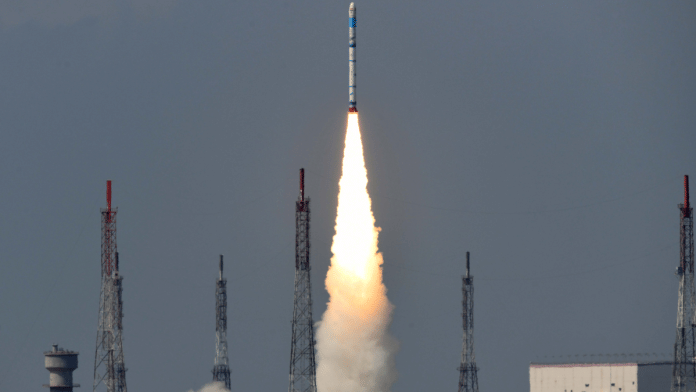
Bengaluru: After a hiatus of nearly seven months, the Indian Space Research Organisation (ISRO) is finally ready to fly its next space mission. The space agency is preparing to launch its NVS-03 mission — part of India’s navigational satellite series NavIC — in the first week of September, senior officials from ISRO said.
A top ISRO official told ThePrint that the launch window will open in the first week of September.
“The NVS-03 is already ready for launch at the Sriharikota spaceport. The final date will be announced soon, but we are aiming for the first week of September,” the official said.
The official added, “ISRO has had a tough year, but we plan to redeem ourselves with this launch.”
In a written reply at Lok Sabha early this month, Jitendra Singh, Union Minister of Science and Technology and Space, also confirmed that NVS-03 was ready for launch. The minister also said that after the third of the NavIC series, ISRO will also be launching its subsequent satellites, NVS-04 and NVS-05, in close succession.
The official also confirmed that ISRO will also be launching GISAT-1A or EOS-05 satellite, which is an advanced geo-imaging technology capable of real time monitoring of the Indian territory, in a few weeks after NVS-03.
Dysfunctional NavIC
NavIC, which was planned to be India’s version of the US’s GPS, Russia’s Glonass, Europe’s Galileo and China’s BeiDou, is currently dysfunctional because of ageing satellites and ISRO’s failure to replace them with new ones.
One of the biggest setbacks that NavIC faced this year was the “partial failure” of the NVS-02 mission in January last year.
But even before this, multiple hurdles have plagued NavIC. In 2016, the atomic clocks on the Indian Regional Navigation Satellite System (IRNSS) 1A — the first generation of navigational satellites before it was renamed NavIC — had become dysfunctional.
While the space agency stressed that the remaining six satellites that were placed in orbit by then were functional, they admitted that some hardware issues were detected in the rubidium atomic clocks in some of them.
Since then, more satellites have met with some problem or the other.
The IRNSS 1H, launched on August 31, 2017, to replace 1A, could not be inserted into the desired orbit. According to ISRO, a heat shield, which protects the satellite, could not be detached on time during the launch.
In a Parliament response from March, Singh said that out of 11 satellites launched under NavIC, eight were functional. Five of these were capable of broadcasting signals for one-way messaging, and three were broadcasting navigation signals.
No successful launches in 2026
The NVS-03 launch will also be in focus because this will only be the second launch this year. The first launch, attempted in January this year, failed to place the satellites in orbit.
“ISRO has had a rough year, but we have a few launches planned for the year. Ups and downs are part of space operations,” a senior ISRO official said.
(Edited by Aakriti Handa)
India technology is development iam very happy 🔥🔥🔥🔥🔥