



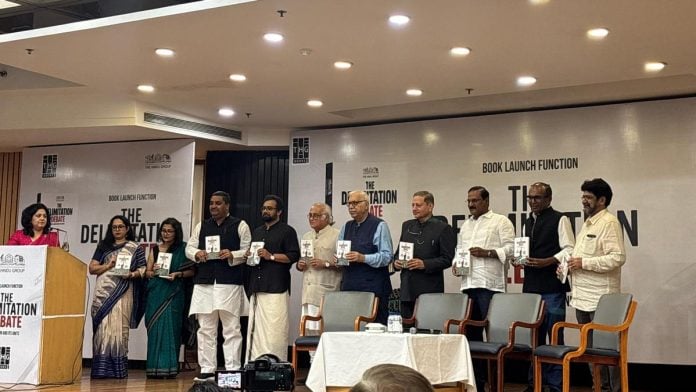
New Delhi: Opposition MPs, a former chief election commissioner and retired civil servants wrestled with a fraught question on Wednesday — what India’s upcoming delimitation exercise will mean for the political power of states.
At Delhi’s India International Centre, The Hindu Group launched The Delimitation Debate: The Union and its Units, against the backdrop of a political map that has remained largely frozen for more than five decades even as India’s population has exploded. The delimitation exercise, expected after Census 2027, could alter the number of Lok Sabha seats allocated to states. It has left many asking: how do you give greater weight to population without penalising states that have successfully controlled population growth?
Former chief election commissioner SY Quraishi, former civil servants Sanjeev Chopra and Raja Sekhar Vundru, and Opposition MPs Jairam Ramesh, John Brittas and Javed Ali Khan debated whether India’s First-Past-the-Post system still adequately represents voters, whether Parliament needs more seats, and whether the country needs to rethink the way states and constituencies themselves are organised. What delimitation could mean for next year’s Assembly election in Uttar Pradesh, India’s most populous state, also came up.
The book—a collection of essays by constitutional scholars, political scientists, former civil servants and journalists—uses the lens of delimitation to examine the relationship between the Union and states, electoral systems, the Census and fiscal federalism. Its launch was followed by two panel discussions.
The first was ‘Has India’s Representation System Failed Us?’, moderated by The Hindu’s political editor Nistula Hebbar.
Quraishi questioned whether the First-Past-the-Post system still delivers representative democracy. He recalled the 2014 Lok Sabha election in Uttar Pradesh, where the Bahujan Samaj Party secured around 20 percent of the vote but did not win a seat.
“That is not representative democracy,” Quraishi said, arguing that India should at least debate a mixed electoral system, combining First-Past-the-Post with proportional representation as in Germany or New Zealand. Quraishi also criticised the ongoing Special Intensive Revision of electoral rolls, questioning both its necessity and the way it has been carried out.
Raja Sekhar Vundru, former additional chief secretary of Haryana, also pointed out that in the present system, candidates can win constituencies without securing a majority of votes. He advocated a two-round system, in which a candidate would need more than 50 percent of the vote to win.
“The core principle of democracy, first of all, is a representative has to truly represent all his constituency,” Vundru said, arguing that political parties would also campaign differently if they knew candidates had to secure a majority.
For Chopra, former director of the Lal Bahadur Shastri National Academy of Administration, the answer lay in creating more states through a second State Reorganisation Commission.
“I am a firm believer in the fact that India needs more states,” Chopra said. “The possibility of representation, the possibility of development, would become much better.”
Also Read: Porridge, fried fish, golgappas— what India’s PMs ate and served
What will delimitation mean for UP?
The political battle over delimitation took centre stage during the second panel discussion, ‘Building Political Consensus on Representation’, moderated by The Hindu’s senior deputy editor Sobhana Nair.
Congress leader Jairam Ramesh questioned the top-down manner in which proposed constitutional changes had been brought before Parliament.
“Have a debate, have a discussion with political parties. Have a discussion with experts,” Ramesh said. “And then come up with your proposals.”
CPI(M) MP John Brittas cautioned against reducing the delimitation debate to “one vote, one value” or framing it simply as a North-South contest. Federalism, transparency and the broader structure of representation, he said, also needed to be considered.
“There are other fundamental aspects which are much more important,” Brittas said, calling for “much more discussion, debate, with many stakeholders”.
The discussion ranged from broad questions of federalism and representation to the more immediate political consequences of delimitation, including what a rise in Uttar Pradesh’s Lok Sabha seats could mean for the BJP and the Opposition. Samajwadi Party MP Javed Ali Khan argued that this could backfire on the BJP.
“The BJP is not in a position to reduce the increasing rate of opposition.
In 2027, as a result of Uttar Pradesh, they will once again testify to this,” he said.
“As far as the question of 120 seats in Uttar Pradesh is concerned, if we look at it in detail, then we should not have any objection to this. Our seats will increase. Most of our workers will be accommodated in it.”