





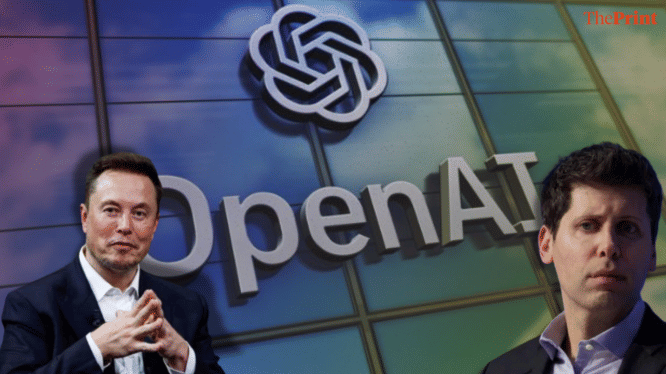


New Delhi: Elon Musk is suing ChatGPT’s parent company, OpenAI, and its CEO, Sam Altman, arguing that the company has moved away from its founding principles.
The lawsuit was first filed in 2024 and is set for another hearing on 29 April in the San Francisco division of the United States District Court for the Northern District of California. Hearings began this week, and Musk testified on 28 April. The Tesla CEO is seeking damages and structural changes, including a return to a non-profit model. The case also names OpenAI’s President Greg Brockman and focuses on decisions taken after Musk’s exit from the company.
In court, Musk said that OpenAI was meant to be a public-interest organisation.
“If we make it okay to loot a charity, the entire foundation of charitable giving in America will be destroyed,” Musk said during his testimony.
OpenAI, an American artificial intelligence research organisation, was founded in 2015 as a non-profit research lab by Musk, Altman, Brockman, Ilya Sutskever, John Schulman and others. At its launch, the organisation said that its goal was to develop AI that would “benefit humanity” and would not be driven by financial returns.
Musk played an active role in the early years as a co-chair and investor before stepping down from the board in 2018 amid differences over the company’s direction.
What Musk said…..
The current dispute centres on what happened next. In 2019, a little over a year after Musk left, OpenAI created a for-profit arm to raise investment. It has since raised billions of dollars, including from Microsoft, which integrated OpenAI’s technology into products, such as Azure and Copilot.
The company operates on a capped-profit model, under which investors can earn returns up to a fixed limit. OpenAI has said returns for early investors are capped at 100 times their investment, after which additional returns go back into the organisation’s mission.
Musk says this shift broke the original understanding on which OpenAI was founded.
“I came up with the idea, the name, recruited the key people and provided a large amount of the initial funding,” Musk said, describing OpenAI as his “brainchild.”
In earlier remarks cited in coverage of the case, Musk has also said, “It’s not okay to steal a charity.”
Also Read: Elon Musk fulfils the last wish of a 15-yr-old cancer patient. Answers 8 questions
What OpenAI said….
OpenAI, however, disputes that account. Its lawyers claim that there was no binding agreement requiring the company to remain a non-profit. They argued that the change in structure reflected the scale of resources needed to build advanced AI systems, including computing infrastructure, talent and research capacity.
In court, OpenAI’s lawyer William Savitt said that Musk’s claims were about control rather than principle.
“We are here because Mr Musk did not get his way,” he told the court, adding that Musk had earlier pushed for greater control over the company and had proposed alternative structures during his time there.
Altman’s position was presented through the company’s legal arguments and prior public statements.
“Training frontier models requires billions of dollars,” he said.
Altman has previously said that building advanced AI systems could require “more capital than any non-profit has ever raised”, pointing to the scale of investment needed.
Adding: “Our mission is to ensure that artificial general intelligence benefits all of humanity,”
Altman’s position was presented through OpenAI’s legal arguments and prior public statements. OpenAI’s 2019 announcement said the structure was designed to attract investment while keeping the non-profit parent in control.
The dispute is also unfolding alongside a growing rivalry between OpenAI and Musk’s own artificial intelligence company, xAI. Musk founded xAI in 2023, and its chatbot, Grok, is positioned as a competitor to ChatGPT and is integrated into his social platform X.
OpenAI’s lawyers have pointed to this in court, arguing that the lawsuit came as Musk’s own AI business entered the market. Musk has denied that competition is driving the case.
Musk is asking the court to award damages upto 134 billion dollars and order changes to OpenAI’s structure, including a return to a non-profit model and leadership changes. OpenAI said the case misrepresented both its founding and the practical realities of building AI at scale.
The trial is expected to run for several weeks.
(Edited by Insha Jalil Waziri)