


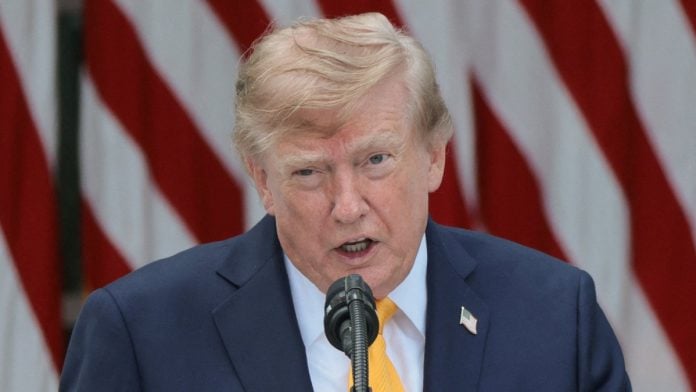
New Delhi: US President Donald Trump has announced that Washington will end its nearly $4 billion in annual military assistance to Israel by the end of 2026, potentially marking a significant shift in the two countries’ longstanding military relationship. The announcement has raised questions about how the proposed change would be implemented, particularly because the current aid agreement runs until 2028.
Trump made the announcement in a phone interview with Fox News’ Fox & Friends on 3 November, as Americans voted in the midterm elections. Claiming that he had reached an agreement with Israeli Prime Minister Benjamin Netanyahu, Trump said: “We’ve already agreed that by the end of this year we won’t be paying Israel. Now we’ll help Israel if they need it.”
He argued that Israel no longer needed the financial assistance and suggested that the arrangement would be replaced by arms sales. Neither the White House nor Netanyahu’s office had officially confirmed the agreement when reached out to by other news outlets for comment.
What does the existing aid arrangement involve?
The US has been one of Israel’s principal military partners for decades. Under a 10-year memorandum of understanding signed in 2016, Washington committed to providing Israel with $38 billion in military assistance between 2018 and 2028.
The arrangement provides approximately $3.3 billion annually in Foreign Military Financing grants, which Israel uses to purchase American military equipment, alongside $500 million for joint missile defence programmes. The funding has supported purchases of weapons systems including F-35 fighter jets.
Trump’s announcement does not explain how this agreement would end early. Congress also plays a significant role: although legislation authorises assistance, the House and Senate must pass annual appropriations bills to release the funds. The precise mechanism for stopping the payments therefore remains unclear.
Also read: Why are young adults suffering stroke cases? US study says it has doubled in 3 decades
Why announce the decision now?
The timing is significant because the announcement came on Election Day for the 2026 midterms, where US support for Israel has become an increasingly contentious issue.
Public opinion has shifted considerably, particularly among Democratic voters, following Israel’s military campaign in Gaza after the Hamas-led attacks of October 2023. A Quinnipiac University poll found that 48 per cent of American voters and 66 per cent of Democrats believed Washington was too supportive of Israel.
Trump specifically mentioned Abdul El-Sayed, a Democratic Senate candidate in Michigan who has opposed unconditional military assistance to Israel. He described criticism of the funding as a “bad talking point” for Republicans and asked: “Why should we suffer the slings from (people) like an El-Sayed when they don’t need it?”
The announcement also comes amid criticism from parts of Trump’s own political movement over US involvement in the conflict with Iran. Analysts and prominent opposition figures like El-Sayed have questioned whether the decision was intended partly to appeal to voters opposed to continued foreign military commitments.
Also read: Why Delhi’s pollution is rising ahead of Diwali
What does this mean for Israel?
The announcement appears to accelerate a gradual reduction in American assistance that Netanyahu had previously discussed. In October, he acknowledged that Israel should prepare for a future without the same level of US financial support.
However, the abrupt announcement reportedly caught Israeli officials by surprise. Opposition leader Gadi Eisenkot criticised Netanyahu for allowing the change to emerge through the media, arguing that the country could no longer rely on his leadership. Another opposition figure, Yair Golan, said a responsible prime minister would have fought to increase American aid rather than dismantle it.
The US-Israel relationship is unlikely to end with the funding arrangement. Trump has indicated that Washington would continue selling weapons to Israel and provide assistance if necessary. Nevertheless, ending the annual grants would represent a major change in how the two countries finance their military partnership, with consequences for Israel’s defence planning and the broader power balance of the Middle East.
(Edited by Saptak Datta)