





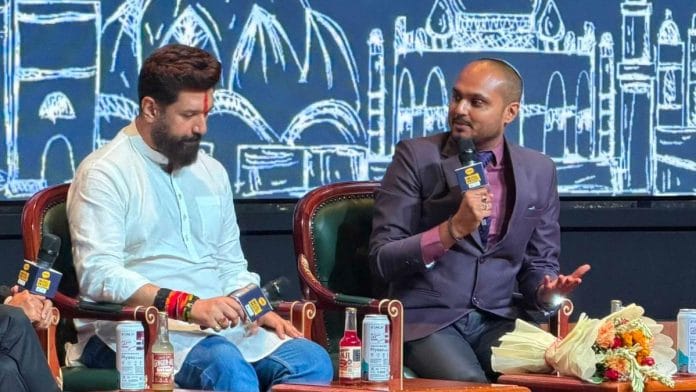


New Delhi: Food Processing Minister and Lok Janshakti Party (Ram Vilas) chief Chirag Paswan is happy that makhanas, or foxnuts, are having a moment not only in India but outside as well.
“Makhanas are becoming increasingly popular across the world. As a Bihari, mujhe bahut achha lagta hai (I like it very much),” Paswan said at Farmley’s Indian Healthy Snacking Summit at Bharat Mandapam on 3 July.
In the 2026 Union Budget, the central government allocated Rs 90 crore for the development of makhana.
The minister said that the government’s long-term vision is to make India a global food basket. In fact, he added, the goal is to make sure there is “no dining table in the world where at least one Indian food product is not present.”
A fitness enthusiast himself, Paswan said he swears by foxnuts but muri is another healthy snack he munches on.
“Our Prime minister has made jhal muri popular, but there is a Bihari muri which is made with onions and green chillies. I like that,” he said.
‘The need of the hour’
Paswan began his address, to an auditorium packed with around 250-300 founders and executives from healthy snack brands, with an apology. He apologised for “arriving before time”, joking that unlike many politicians, he had reached the venue early.
Paswan said there could not have been a better time to discuss India’s healthy snacking boom, as consumers are becoming increasingly conscious about fitness, nutrition, and lifestyle-related diseases.
“It is the need of the hour. The kind of obesity we are seeing among children pains me. In the coming years, it can become a serious problem,” he said.
India is witnessing a sharp rise in childhood obesity, driven by increasing consumption of calorie-dense foods, sedentary lifestyles, and reduced physical activity. Public health experts have repeatedly warned that this trend could lead to an increase in diabetes, heart diseases, and other non-communicable diseases at a much younger age.
Paswan described healthy snacking as an important vertical of the food processing sector that deserves far greater attention.
According to him, processed food suffers from an unfair perception problem.
“There is a myth that food processing is bad. There is a negative image associated with it. Anyone with a mic and a camera becomes an expert on food. People without any scientific backing make sweeping statements about processed food. This is the narrative we have to fight,” he said.
“For us, processing isn’t bad. It is a value addition.”
Farmley co-founder Akash Sharma echoed the point, arguing that processing itself should not be viewed negatively, as it plays a fundamental role in making snacks palatable and convenient.
“Even the roti you make at home can become a snack. But snacks have to be tasty, and that involves some level of processing. Traditionally, people consume foods like samosas, but technically, a samosa is also a processed food because it isn’t a whole or raw ingredient. The same goes for bhujia, which is made from besan, oil and other ingredients,” Sharma told ThePrint.
“But yes, one shouldn’t compromise on the quality of the ingredients, hygiene and machinery.”
Also read: India’s healthy snacks market growing faster than global average, says FoodIntellé CEO
Food processing and farmers
Nutrition experts often distinguish between minimally processed foods, processed foods, and ultra-processed foods.
While ultra-processed foods have drawn criticism for being linked to poor health outcomes when consumed excessively, processing itself — including cleaning, roasting, drying, milling and packaging — can improve food safety, extend shelf life, reduce wastage, and increase accessibility.
Paswan also spoke about how farmers stand to benefit from the growing healthy snacking industry.
He said farmers often fail to get the full value of their produce because fruits, vegetables and several other agricultural commodities are highly perishable. Food processing, he argued, can improve shelf life, reduce post-harvest losses and enable farmers to earn better prices through value addition.
The minister also called for greater crop diversification.
“We are still clinging to anaj (foodgrains). There was a time when India faced shortages of foodgrains. That is no longer the case,” Paswan said.
He added that India continues to import several ingredients that can be cultivated domestically if farmers are encouraged to adopt multiple cropping and diversify beyond conventional cereals.
According to him, that transition will happen only when the food processing industry builds stronger partnerships with farmers and gives them the confidence of assured demand.
Paswan concluded the conversation with a request to all entrepreneurs: “Don’t compromise on quality for easy profits and gains.”
(Edited by Aamaan Alam Khan)