





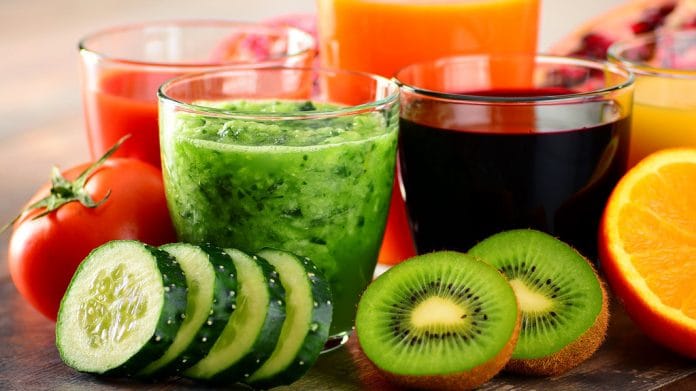


New Delhi: A small randomised controlled trial by researchers at Newcastle University found that adults encouraged to increase their fruit and vegetable intake recorded lower depression symptom scores when they also consumed a daily serving of 100% fruit juice or a smoothie.
The four-week study involved 42 adults who initially ate two or fewer portions of fruit and vegetables a day. Those who combined whole fruit and vegetables with fruit juice or smoothies had depression scores 2.52 points lower than the control group on a 27-point depression scale.
The difference was statistically significant, but the study does not prove that fruit juice itself prevents or treats depression.
The findings were published online in the British Journal of Nutrition on 22 May 2026. The paper was authored by Courtney Neal, Georg Lietz, Kirsten Brandt, Anthony William Watson and Oliver Michael Shannon. Neal conducted the study at Newcastle University and is now affiliated with the University of Liverpool.
How the trial was structured
Participants were randomly assigned to three groups of 14. One group continued their usual diet. A second group received financial and educational support to increase their intake to five portions of fruit and vegetables a day, using whole produce. The third group received the same support, but was also asked to include one serving of fruit juice or a smoothie a day.
All three groups received £10 a week, and the two intervention groups (group 2 and 3) were given educational materials and guidance to help them increase their fruit and vegetable intake.
Changes in fruit and vegetable intake
Both intervention groups reported significantly greater fruit and vegetable intake than the control group at four weeks. The whole-fruit-and-vegetable group consumed an estimated 8.9 portions per day, and the group that also included juice or smoothies reached 6.6 portions, compared with 2.45 portions in the control group.
Mood and other outcomes
Mood was measured using the PHQ-9 questionnaire for depression symptoms and the GAD-7 questionnaire for anxiety. The fruit juice and smoothie group had significantly lower depression scores than the control group. The average adjusted PHQ-9 score was 2.93 in the juice/smoothie group versus 5.45 in the control group.
There was no significant difference between groups in anxiety or gut symptoms, and researchers found no differences in the metabolic biomarkers they measured.
Study limitations
The study also found that participants in both diet intervention groups increased their intake of fibre. However, the researchers cautioned that the trial lasted only four weeks and involved a small number of participants, so the results cannot be widely generalised.
The study was funded by the Fruit Juice Science Centre. Courtney Neal said the findings suggest that helping people overcome barriers to eating more fruits and vegetables could have potential benefits for their mental well-being.
The researchers noted that the link between fruit juice and lower depression scores warrants further investigation, particularly in people with poor mental well-being. The results, however, are best viewed as an early finding rather than evidence that fruit juice is a treatment for depression.
(Edited by Maryam Hassan)