



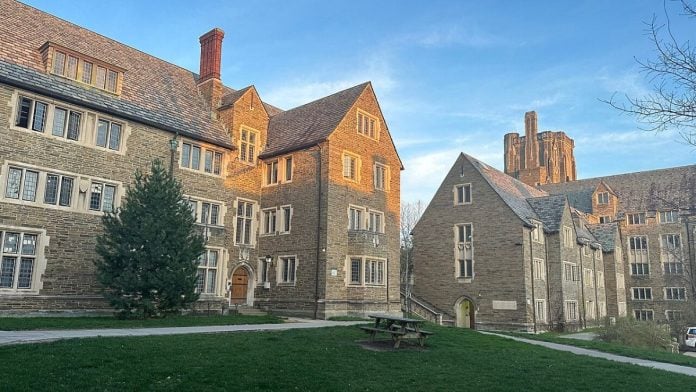
New Delhi: A Snapchat message saying “free p***y upstairs” allegedly turned a Cornell University fraternity house into the site of an alleged sexual assault that has now come to the spotlight. Nearly two years after a 20-year-old student reported the alleged assault, prosecutors in New York have reopened their investigation into seven Chi Phi fraternity members. The former student has also filed a civil lawsuit accusing the men of drugging and sexually assaulting her, and Cornell University and fraternity organisations of failing to protect her or prevent the alleged assault.
According to the lawsuit, the student was at the fraternity house in October 2024 when two men allegedly pressured her to consume ketamine. The complaint says one fraternity member then sent the Snapchat message to a group of Chi Phi members, after which more men allegedly entered the room. The allegations have not been proven in court. The Tompkins County district attorney has said the new complaint describes events “dramatically different” from the student’s original account to police and that prosecutors are examining whether new evidence could support criminal charges.
Cornell is not the first elite university where an incident of campus sexual assault has been reported. Over the years, cases across the globe have triggered protests, outrage and questions about athlete privilege, fraternity culture and how universities respond to sexual violence. A few have resulted in convictions and long prison sentences. Others collapsed in court or ended with university disciplinary action.
Stanford University, US
In 2015, Stanford swimmer Brock Turner sexually assaulted an unconscious woman outside a fraternity party. A jury convicted him in 2016 on three felony counts. He was sentenced to six months in county jail and served three. The sentence triggered widespread outrage, with the survivor’s court statement becoming a defining moment in the debate over sexual violence and privilege. In 2019, the victim, Chanel Miller, once known as Jane Doe, came out with her memoir “Know My Name,” which discusses the assault.
University College London
Zhenhao Zou, a PhD student at University College London, was convicted in 2025 of drugging and raping 10 women in the UK and China, in what was noted as one of the most horrid serial rape cases in recent British history. Prosecutors said he used drugs to incapacitate women, many of them fellow students, and secretly filmed attacks. Zou was sentenced to life imprisonment, with a minimum term of 24 years. The case drew renewed attention after more victims came forward following his conviction.
Also read: Russia has shut nearly half its schools in 25 years. Rural areas hit hardest
Oxford Brookes University, UK
In 2018, a 19-year-old student alleged that four male students had gang-raped her. Police investigated but said there was insufficient evidence to take the criminal case forward. Oxford Brookes conducted its own disciplinary proceedings: two students were expelled, while another had his expulsion reduced on appeal and a fourth received a written warning. The case became part of a wider debate over what universities should do when sexual-assault allegations do not result in criminal prosecution.
McGill University, Canada
In April 2012, three McGill football players were charged after a Concordia University student alleged they had sexually assaulted and forcibly confined her in an apartment in September 2011. The case generated controversy after the players were allowed to remain enrolled and continue playing for the university team. They quit the squad only after media reports made the charges public in 2013. In November 2014, prosecutors withdrew all charges after receiving new evidence. None of the three was convicted.
Vanderbilt University, US
In 2013, an unconscious female student was sexually assaulted in a Vanderbilt dorm room by members of the university’s football team. Three of the rapists were convicted and received prison sentences ranging from 15 to 17 years. The fourth player accepted a plea deal which included 10 years of probation and did not receive any jail time. The evidence, which included photographs and a video of the assault, made the case a flashpoint over college athletics and sexual violence.
University of Melbourne, Australia
Anthony Brooks was reportedly a registered sex offender when he enrolled in an honours course at the University of Melbourne. Between 2024 and 2026, he has been charged with multiple offences, including rape, “sexual fraud”, and allegedly raping a vulnerable man multiple times in April 2024. After media exposure, Brooks lost his scholarship and was banned from campus; he faced dozens of sex‑offence charges, including child‑abuse. The fairly recent case brought into question how universities screen and monitor students with prior sex offence histories.
(Edited by Saptak Datta)