



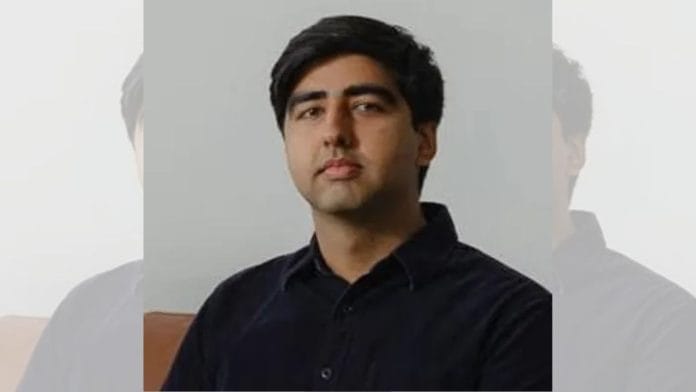

New Delhi: In less than three years, Indian-origin entrepreneur Surya Midha went from a Georgetown University dropout to one of the youngest self-made billionaires in the world. The turning point came when Mercor — the AI hiring startup he co-founded with two of his friends in 2023 — reportedly reached $10 billion in valuation after a late-2025 funding round, putting Midha on the Forbes’ 2026 World’s Billionaires List at just 22 years old.
As investors poured money into AI, Mercor positioned itself as a company that could automate hiring, from screening candidates to matching talent with employers. According to Forbes and multiple business outlets, Midha’s stake in Mercor was estimated at roughly $2.2 billion. In less than two years, the startup grew into one of Silicon Valley’s most closely watched AI hiring companies. All three cofounders were 22 at the time, but Midha is the youngest by roughly two months.
Several reports framed his Forbes billionaire debut as surpassing milestones that were once associated with founders like Mark Zuckerberg.
“The way Surya Midha has challenged the records of giants like Mark Zuckerberg at the age of 22 proves that in today’s times, your ‘speed’ and ‘vision’ matter more than ‘experience’,” a user wrote on X.
As Mercor scaled, Midha’s own role inside the company evolved. According to some reports, he transitioned away from day-to-day operational responsibilities and became the chairman of the board during the later phase of the company’s expansion.
From academia to entrepreneurship
Midha was born in Mountain View, California, and grew up in San Jose in a family with roots in Delhi, India. He attended Bellarmine College Preparatory, where he competed in policy debates alongside future Mercor co-founder Adarsh Hiremath. They competed nationally before eventually building a company together.
“My partner and I were the first team in history to win all three national tournaments in policy debate: the Tournament of Champions (TOC), the National Debate Coaches Association Tournament (NDCA), and the National Speech and Debate Association Tournament (NSDA),” Midha said in one of his blogs.
He later enrolled at Georgetown University in Washington, DC, studying international relations, mathematics, and economics. But by 2023, his trajectory had shifted away from academia and toward entrepreneurship. He took leave from Georgetown to launch Mercor with Hiremath and Brendan Foody, who became the company’s CEO.
Mercor initially emerged as a freelance talent-matching platform before evolving into a broader AI-driven recruiting and workforce infrastructure company. Company descriptions and media coverage say the platform automates resume screening, interviewing, candidate ranking, and talent matching for AI labs and technology firms. As the market for AI talent accelerated, Mercor expanded quickly.
Midha’s rise also attracted backing from some of Silicon Valley’s biggest investors, including General Catalyst, Benchmark, Felicis, DST Global, and Menlo Ventures. In March 2024, he also received a Thiel Fellowship, a programme that supports young founders who leave college to build startups full-time.
Also read: Why are millions fleeing the world’s richest nations? It’s the new great migration
A meteoric rise
Midha’s public emergence came through Mercor’s rapid fundraising cycle between 2024 and 2025. In less than two years, the startup went through a series of major funding rounds that sharply increased its valuation.
Mercor first raised a $30-million Series A funding, followed by a $100-million Series B funding that valued the company at about $2 billion. Later funding of more than $350 million reportedly pushed Mercor’s valuation to $10 billion. That jump helped place Midha and his co-founders among the world’s youngest self-made billionaires in the world.
Much of Mercor’s public positioning centres on the idea that hiring itself can be automated and optimised using AI systems. Company materials and press descriptions portray the platform as both a recruiting company and a labour aggregation network capable of screening and ranking workers at scale.
At the same time, many of the company’s specific operational details remain difficult to independently verify. While funding announcements, investor participation, and valuation figures have been widely reported, fewer public disclosures exist regarding customer contracts, ownership structures or exact enterprise deployments.
(Edited by Aamaan Alam Khan)