



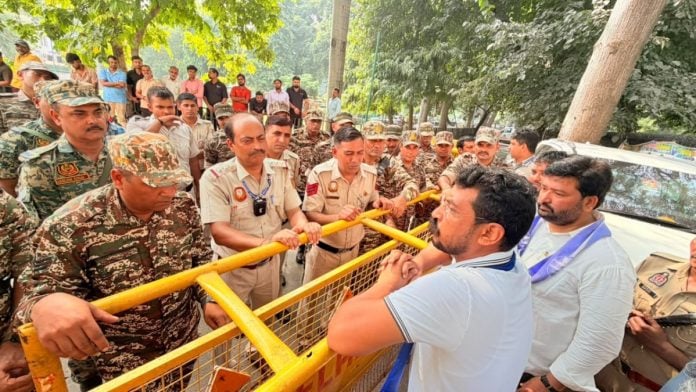
New Delhi: In the sea of placards and party flags at the Jantar Mantar protests this week, the colour blue — widely associated with BR Ambedkar and anti-caste protesters — was missing. Turns out, the absence was the result of a deliberate call taken by Bhim Army founder and Aazad Samaj Party chief Chandrashekhar Azad.
The MP from Nagina in Uttar Pradesh, who has emerged as a prominent figure in Dalit politics over the past decade, told ThePrint he wasn’t going to let his people face police lathis when upper-caste leaders, political parties and the public often remain silent when Dalits are attacked.
“When we enter the field, the protection of our workers is our responsibility. No other party or organisation will take responsibility if our workers are attacked. Whatever we do, we will do it on our own terms and take responsibility for our own people,” he said.
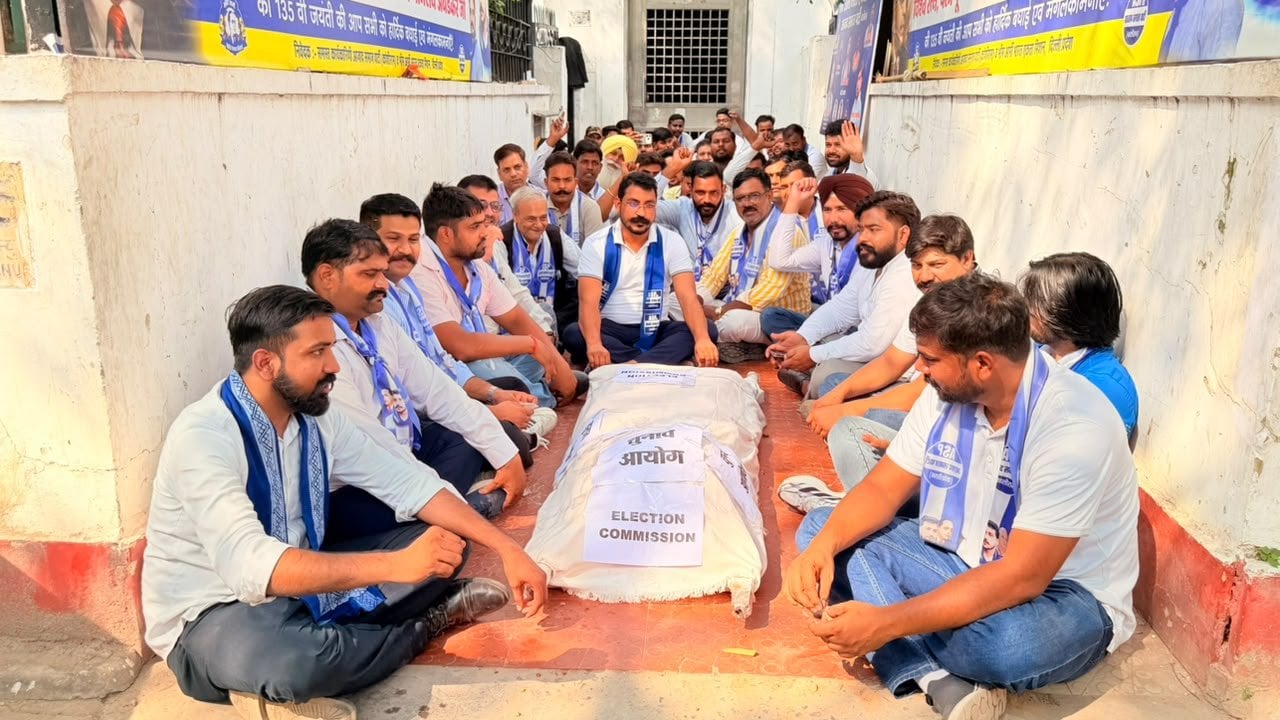
Azad did, however, show his support for the protesters’ cause. He and his party members performed the symbolic last rites of the Election Commission at his MP residence in Delhi. In a Facebook post, Azad shared a video with a Hindi caption that read: “A dacoity on votes, a guard on the streets; what kind of democracy’s face is this? The public asks, give us an answer; give an account of our right to vote!”
The Cockroach Janata Party (CJP)-led protests drew thousands to the streets of central Delhi on 10 October. For Azad, the issue was the way Dalit protests are treated differently than other protests.
“We have protested against the SIR and Chief Election Commissioner Gyanesh Kumar,” Azad said. But he questioned whether the Opposition and student organisations showed the same urgency when it came to Dalit rights.
“What are they doing about caste-based atrocities and the land being taken away from the poor? What are they doing to stop these killings and crimes?” he asked.
Azad said he was open to working with other groups on common ground. But unity could not come at the cost of sidelining Dalit concerns.
“It cannot be that only the issues you raise are discussed. The biggest issue right now is whether people will survive to claim their rights,” he told ThePrint.
Missing Bhim Army
On 10 October, following a call by CJP founder Abhijeet Dipke, protesters converged on Jantar Mantar to demand CEC Gyanesh Kumar’s resignation. Thousands were detained during the protests. Dipke, along with CJP spokesperson Saurav Das and Ashutosh Ranka, was detained by Delhi Police at the airport.
As images of protesters being dragged away and bundled into buses circulated, Azad said he intervened by calling senior police officers and asking them to act against those who had assaulted protesters.
“When I saw that protesters were being attacked, I told the Bhim Army to go there and help change the atmosphere. People needed to understand that assaulting protesters was wrong and that this kind of behaviour could not be accepted,” he said.
But sending his supporters to the protest site was a different matter. For Azad, the responsibility he bears towards his workers dictates when and how the organisation mobilises.
“I cannot become part of a movement where I have no role in deciding the strategy or what needs to be done,” he said.
Founded in 2015 in Saharanpur, the Bhim Army quickly emerged as one of the most influential Dalit groups in Uttar Pradesh and has since expanded its presence to several other states. Azad later founded the Aazad Samaj Party and won the 2024 Lok Sabha election from Nagina, a victory he has always credited to party workers and community supporters.
While he decided to stay away from the latest protests, Azad led the mobilisation during the Jantar Mantar protests in July, when the CJP approached him over the NEET paper leak and demands for Union Education Minister Dharmendra Pradhan’s resignation.
Azad said he had agreed to join those protests because of the importance Ambedkar attached to education.
“Following Babasaheb Ambedkar, we believe every child must have access to quality education. Education is essential for people to understand their rights and build a better future,” he said.
The Bhim Army has also mobilised in response to caste-based discrimination and violence. In 2020, Azad and his supporters were at the forefront of protests over the rape and death of a Dalit woman in Hathras, Uttar Pradesh.
For Azad, such cases show why Dalits need to build their own political strength.
“There have been several incidents against us, and we have to fight those battles ourselves. We will fight them with our own strength and with our own organisation. We do not need somebody else’s help to fight a cause that is ours,” he said.
He cited the death by suicide of Sahil Wakode, a Dalit student at IIT Bombay, as another example of the discrimination that needed greater attention. Azad said the Bhim Army and the Aazad Samaj Party would continue their campaigns against EVMs and the Election Commission while strengthening “our own
“People want everyone to come together when the issue is a general political question. But when it comes to our issues, if they do not stand with us, how can we trust that the common programme will represent us? If our concerns are absent from that programme, what is the point of joining it?” he asked.
Azad said he remained hopeful that political parties, student groups and Dalit organisations could eventually come together on a common platform to discuss shared concerns. For now, however, he was certain that “they cannot be together”.
Protests alone cannot win elections
Protests have long been central to Azad’s politics. From caste atrocities to other forms of injustice, he has repeatedly hit the streets, arguing that demonstrations are an essential part of a democracy.
Even as protesters gathered at Jantar Mantar, Azad was at the Parliament grounds, demanding the resignation of Dharmendra Pradhan. But he argued that the impact of a protest depended on whether its organisers had a clear purpose and a strategy to achieve it.
“You may organise a demonstration against an injustice, but why are you opposing it? What is the basic reason for the protest? What do you hope to achieve, and what will happen if you do not succeed? If you cannot take these questions to people on the ground, how will your movement succeed?” he asked.
For Azad, the answer lies in sustained grassroots work rather than one-off demonstrations.
Azad has been organising protests in Uttar Pradesh and Uttarakhand, both of which are due to hold Assembly elections next year.
“Somebody has to do the groundwork,” he said, arguing that a single day’s protest would not be enough to counter the BJP’s organisational machinery.
“If you want to challenge that, you need an organisation that can work at every polling booth. You need people who can protect every vote, ensure that voters reach the polling station and counter the government’s narrative,” he added.
He also stressed the need to educate voters about the Special Intensive Revision (SIR) of electoral rolls and the consequences of having their names deleted.
“People need to be made aware of SIR, and the repercussions of deletion of their names from the list. They need to be told to come out and vote,” he said.
Azad claimed he could mobilise a larger crowd than the recent Jantar Mantar protests if given 72 hours’ notice. But he argued that the number of people at a demonstration was not the right way to measure an organisation’s strength.
“The question is not simply how many people you can gather. The question is whether you have built an organisation that can work consistently and deliver results,” he said.
CJP and the need for unity
The Jantar Mantar 1.0 protests in July were among the largest student-led demonstrations India had witnessed in recent years. But the latest protests also highlighted divisions among Opposition parties and groups campaigning against CEC Gyanesh Kumar.
Azad pointed to the divisions among political groups. Rahul Gandhi’s call brought leaders such as Akhilesh Yadav and Tejashwi Yadav to the march towards the Supreme Court, while the Aam Aadmi Party (AAP) was absent.
Azad argued that competing political ambitions often prevented groups from working together.
“When one person organises a protest, others try to bring that person into their own camp. If that does not happen, they try to build a separate platform. Everybody wants to demonstrate their own strength and show that they are leading the movement.
“That is precisely why the movement is failing to achieve the unity it needs,” he said.
Azad expressed solidarity with Dipke as a member of the Dalit community but stopped short of commenting on the CJP’s ideology, a question that has followed the satirical party since its inception. He did, however, praise the party’s School Thik Karo campaign.
“I cannot tell another party what it should do. I cannot advise its leaders on every decision. They have to decide what they believe in and what kind of politics they want to pursue.
“My responsibility is to be clear about my own politics and my own organisation. I cannot take responsibility for another party’s ideology or its decisions,” he said.
While continuing his separate campaign against EVMs and the Election Commission, Azad is also preparing for the Uttar Pradesh Assembly election.
“The important thing is that we are continuing to expand our organisation and strengthen our presence. That is what will determine how far we can go in the next election,” he said.
(Edited by Prashant Dixit)