


An ‘undruggable’ disease is now treatable with targeted therapy. After 40 years of development, a pancreatic cancer treatment is hitting its stride.
As survival curves flashed across giant screens at the 2026 American Society of Clinical Oncology conference in Chicago, oncologists rose to their feet.
A video of the standing ovation was later shared on X by doctors and scientists across the world, showing an unusual sight for a medical conference: researchers applauding a graph by Brian M Wolpin of Dana-Farber Cancer Institute, Boston, who led a landmark trial in pancreatic cancer treatment.
Revolution Medicines’ pancreatic cancer drug, daraxonrasib, had just delivered the kind of result scientists have chased for decades—doubling survival in patients suffering from one of medicine’s deadliest cancers.
“This is the end of the ‘undruggable KRAS era’,” said Rachna Shroff, associate director of clinical investigations and co-leader of the Gastrointestinal Clinical Research team at the University of Arizona Comprehensive Cancer Centre, in an online interview. Shroff was not involved with the study.
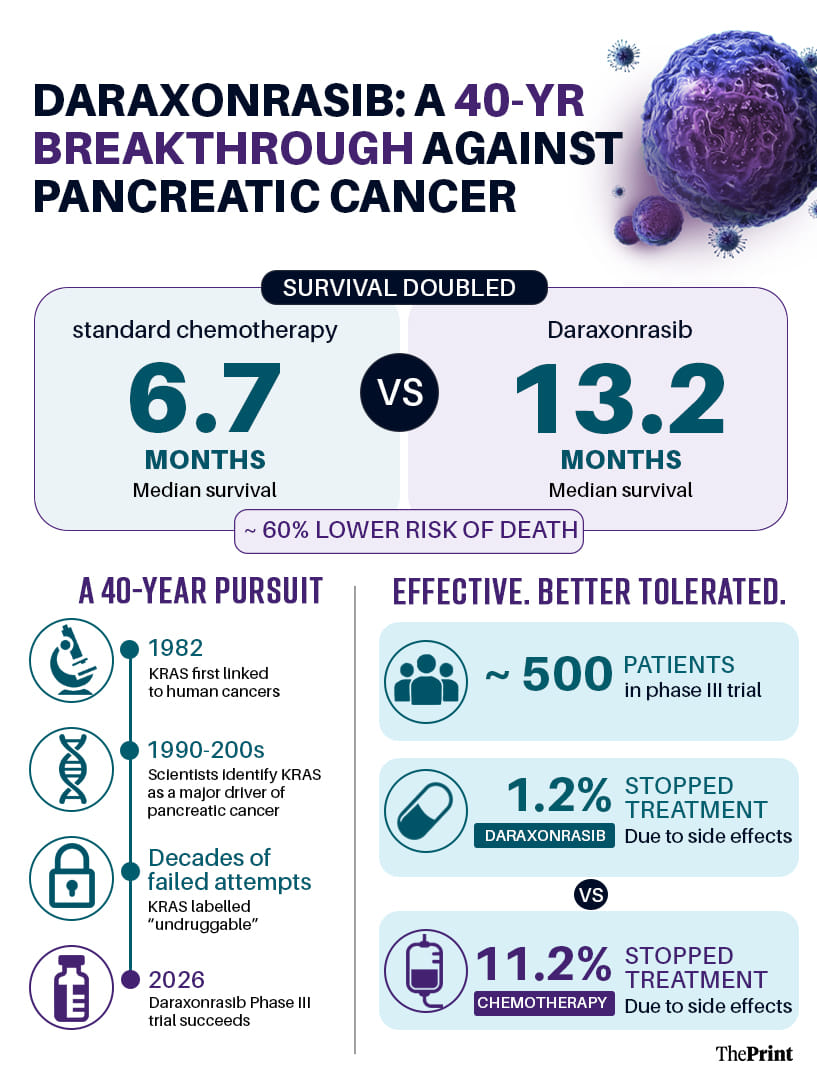
In a Phase 3 clinical trial involving nearly 500 patients with metastatic pancreatic cancer, daraxonrasib nearly doubled overall survival compared with standard chemotherapy — extending survival from 6.7 months to 13.2 months and reducing the risk of death by about 60 per cent.
Daraxonrasib is the latest breakthrough in one of cancer research’s longest-running pursuits. First linked to human tumours in 1982, KRAS became one of oncology’s most notorious targets. Throughout the 1990s and 2000s, scientists knew it sat at the centre of tumour growth in pancreatic cancers, yet every attempt to target it failed.
Decades of academic research into KRAS chemistry eventually paved the way for a new molecular strategy to shut down the protein. A US-based biotech company, Revolution Medicines, transformed that scientific insight into daraxonrasib, which has produced the most promising results ever seen in pancreatic cancer.
It is now available for patients whose cancers have progressed after chemotherapy.
There are no early signs of the disease. By the time patients experience clinical symptoms like jaundice or abdominal pain, the disease has already spread to other organs.
This means surgery is not an option for most patients. And even when surgery is possible, it is often not curative, said Stephanie Dougan in an email. She is an associate professor of immunology at Dana-Farber Cancer Institute, Boston, where Wolpin led the daraxonrasib study.
Much of this unchecked cell growth seen in pancreatic, colorectal and lung cancers is driven by mutations in a gene called KRAS. Normally, KRAS acts like a molecular switch, turning cell growth signals on and off when needed. But when mutated, the switch gets permanently jammed in the ‘on’ position, sending constant signals that cause cells to grow. Unlike many proteins with pockets on their surface, KRAS is relatively smooth, giving drugs little to hold onto with which to turn the multiplication switch off.
This is where daraxonrasib comes in. Instead of binding to KRAS, it binds to a molecule called cyclophilin A inside cells, which helps proteins fold into their 3D shapes. Together, they latch onto the active KRAS protein and block the signals that tell cancer cells to keep multiplying.
“The idea of targeting KRAS has always been the holy grail for cancers, but specifically in pancreatic cancer,” said Shroff.
Also read: How a vaccine made from a patient’s own tumour can help keep skin cancer from returning
Beyond the survival curve
For patients with advanced pancreatic cancer, the standard treatment has been chemotherapy, which has physically and emotionally gruelling side-effects, such as hair loss, nausea and insomnia.
Jewel Mary, a Malayalam actress and TV host, underwent surgery in 2023 to treat thyroid cancer and lost her voice and left arm function.
“Recovery took six months, and it was a considerable break in my career,” she said over a phone call. “I hope there was a better way to manage post-surgery pain.”
Similarly, for Swapna Sreenivasan from Kerala, now 48, life after thyroid cancer treatment changed in ways she had not anticipated.
“After radiotherapy, I was restricted from touching or seeing my two-year-old son for the sake of his health,” she said. “I was in isolation, miles away from my son. Because I stopped breastfeeding, I developed inflammation and a high fever. My husband went off to work, and there was nobody to talk to.” She still visits hospitals for follow-ups a decade later.
Advances in cancer treatment, therefore, mean more than just survival for patients; they mean holding onto everyday life during and after treatment with less burden on their caregivers.
Even daraxonrasib comes with its own set of challenges, including skin rash and painful mouth sores. Yet, in trials, only 1.2 per cent discontinued daraxonrasib treatment, compared with 11.2 per cent who stopped chemotherapy.
“A possible outcome from the ongoing trials is that we stop using chemotherapy as first-line treatment for patients with pancreatic cancer,” said Dougan.
Moving beyond one-size-fits-all treatment
Daraxonrasib is part of a larger shift under way in cancer care. Researchers are moving beyond one-size-fits-all approaches toward more personalised treatments, longer disease remission periods, and less taxing therapies.
“The last decade has seen one of the most significant transformations in cancer care,” said Shawn T Joseph, program director, Aster Head and Neck Oncology Network, Kerala cluster, Aster MedCity, Kochi. “Many of these newer therapies are associated with a different and often more manageable side-effect profile compared to conventional chemotherapy.”
This move toward personalised treatment is also reshaping care for common cancers such as breast cancer.
Recently, Roche, the world’s largest biotechnology company, received priority review status for giredestrant, a new breast cancer drug that reduces recurrence risk by 30 per cent compared with standard hormonal therapy.
Breast cancer remains the most commonly diagnosed cancer worldwide, affecting around 2.3 million women every year. About 70 per cent of these cases are estrogen receptor (ER)-positive and are detected at an early stage. Yet up to one-third of patients experience recurrence during or after chemotherapy, while others discontinue treatment because of intolerable side effects.
“After almost 25 years, a new medicine – giredestrant – has demonstrated superiority over existing endocrine therapies in the curative setting, highlighting its potential as a new standard-of-care endocrine therapy for patients with breast cancer,” said Aditya Bardia, Director of Breast Oncology Program and Professor of Medicine at the University of California, Los Angeles, in a press release. He is the principal investigator of the giredestrant drug trials.
Rare cancers are receiving attention
As efforts continue to make cancer treatments kinder to patients, researchers are also making headway in rare cancer types, reaching smaller patient groups who previously had limited treatment options.
In April, sevabertinib, an oral drug designed to target HER2 protein — a key marker used to classify and treat certain tumours — was approved for treatment in the UK and is now under fast-track approval from the US Food and Drug Administration.
In clinical trials led by researchers at the University of Texas MD Anderson Cancer Centre, around 70 per cent of patients treated with sevabertinib saw their tumours shrink or disappear. This targeted oral therapy developed by Bayer is available to patients who, for years, have relied on chemotherapy or immunotherapy, which either failed to work or eventually stopped working.
“If we go back to the year 2000, there were really no medical treatment options for patients with metastatic lung cancer,” said Matthew Meyerson, professor of pathology at Harvard Medical School and a senior associate member at the Broad Institute.
What appears to patients as a sudden breakthrough is often the culmination of years of work.
Sevabertinib’s approval is based on nearly two decades of collaborative research led by teams at Dana-Farber and the Broad Institute. In 2005, researchers led by Matthew Meyerson and Heidi Greulich identified a specific genetic alteration in the EGFR gene that helped explain why some lung cancers resist treatment.
“Heidi and I have been working together on EGFR and HER2 for 22 years now, and we’ve developed a lot of knowledge of these molecules and how they behave,” said Meyerson.
Their discovery helped shape efforts to develop drugs targeting similar activating mutations in HER2.
The most meaningful clinical translation comes from partnerships between academia and industry.
Fundamental discoveries often emerge from academics, but turning those findings into medicines requires years of drug development, clinical testing and regulatory review.
Over the following years, scientists focused on turning sevabertinib from a laboratory concept into an approved therapy.
The collaboration that eventually led to the development of drugs such as sevabertinib began in 2015 through a research alliance between Bayer and the Broad Institute. More than a decade later, patients have hopes of better treatment and quality of life.
“We’re entering a new era of drug development. I think we’ll be hearing more and more announcements about highly targeted ‘designer drugs’ that are both more effective and less toxic than traditional therapies,” said Brennan Spiegel, Professor of Medicine, Public Health, and Biomedical Sciences and Director of the Cedars-Sinai Centre for Virtual Medicine and Health System Transformation in Los Angeles, in an email. Spiegel was not associated with the study.
Making existing treatments work more effectively
Alongside developing new precise drugs, scientists are also focused on making existing treatments work better.
One of the biggest successes in modern cancer treatment is immunotherapy. It involves collecting specific immune cells from a patient’s blood, reprogramming them in the lab to hunt down cancer cells, then returning these engineered cells to the body to better recognise and attack tumours. The approach has shown success in certain blood cancers. Yet scientists have struggled to make it work against solid tumours such as lung or colon cancer. Benefits remain uneven, with only 20-40 per cent of patients responding to the therapy.
For researchers, improving those odds may be just as important as developing entirely new drugs.
There are many reasons why immunotherapy might not work for every patient. Some tumours recruit immunosuppressive cells that actively dampen immune responses or hide themselves from the immune system, explained Stefan N Symeonides, consultant medical oncologist at the Edinburgh Cancer Centre.
Symeonides is among the investigators testing GreyWolf Therapeutics’ experimental drug GRWD5769, which could improve the effectiveness of the immunotherapy drug cemiplimab in patients with cervical, bladder, liver, bowel, lung, and head and neck cancers.
GRWD5769 is designed to address this problem by inhibiting a molecule called ERAP1 that helps cancer cells remain hidden from the immune system. This makes the cancer cells more visible to the immune system, allowing cemiplimab to locate and destroy them.
Early results from the trial showed tumours shrinking by at least 30 per cent in six of the world’s most common cancers.
In an email conversation, Tom Lillie, chief medical officer at GreyWolf Therapeutics, said drug development is a long journey with multiple steps along the way.
“When we started seeing multiple, durable responses across many different tumour types in our expansion cohorts, that was the moment I thought, ‘this really looks like a drug!’”
Yet researchers do not see drugs such as GRWD5769 as replacements for immunotherapy. What they hope for is that such treatments would make existing immunotherapies work better and for more patients.
“Immunotherapy has been a revolutionary shift in cancer care,” said Symeonides. “We hope to improve current immunotherapy to be more active, for longer, and for more patients,” he said in an email interview.
Lillie shares that vision.
“We think our recent Phase 1 data suggests that we might be able to do both of these. That would really be a second immunotherapy revolution!”
Catching it early means early intervention
Beyond better treatments, researchers are getting ahead of cancer itself—detecting it earlier, sometimes before symptoms even appear. Evidence increasingly shows that detecting cancer earlier can dramatically improve survival.
According to 2023 NHS Digital data, in England, 63 per cent of people with lung cancer survive for five years or more if diagnosed at the earliest stage. This falls to less than 4 per cent at the most advanced stage.
“The stage at which a cancer is diagnosed impacts treatment outcomes. Early-stage requires less intensive treatment, fewer treatment cycles, and has a much higher chance of cure. Once a cancer has spread (Stage IV), despite the remarkable advances in cancer treatments, the goal of treatment often shifts from cure to controlling the disease, prolonging survival, relieving symptoms, and maintaining quality of life,” said Satish Kumar A, a Senior Consultant, Clinical Haematologist, Hemato-Oncologist and SCT physician at Manipal Hospitals, Bangalore.
It is this reality that is driving a growing effort to detect cancer long before it becomes visible on a scan or causes symptoms.
A team of 80 researchers working across different countries has now identified a set of proteins in the blood that may be able to predict lung cancer more than five years before diagnosis, giving doctors a much earlier window to intervene.
The work builds on more than a decade of research from the TRACERx (Tracking Cancer Evolution through Therapy) lung cancer study, a £14 million programme funded by Cancer Research UK and the European Research Council.
TRACERx was launched in 2014 and led by Charles Swanton at the Francis Crick Institute, who is the senior author of the new study published in the journal Cell on 4 June. TRACERx has followed hundreds of patients over time, collecting tumour samples, blood samples and clinical data to understand how cancers evolve, spread and develop resistance to treatment.
Over the years, Swanton’s research has shown that air pollution can trigger cancer through the release of inflammatory signalling molecules in the body.
“The biggest gap in lung cancer screening today is reach. Low-dose CT scan is largely offered to older, heavy smokers, which misses a substantial number of cases, including most lung cancers in never-smokers,” said Tej Pandya of the Francis Crick Institute in London, who is also an author of the study.
The team validated the 14-protein signature in eight datasets from around the world, including people who had never smoked. Further lab experiments showed that these proteins increased when a specific inflammatory pathway was activated—one that can be triggered by smoking and air pollution.
“It was genuinely exciting to see that there was a signal well before any clinical diagnosis,” said Pandya in an email interview.
Pandya and his team were careful not to get carried away by the initial findings.
“So we deliberately held back from getting too excited and instead spent a long time testing whether the signal held up,” he said.
The researchers validated the findings across eight independent datasets from the UK, United States, Iceland and China. They also tracked how the proteins changed over time in people who later developed cancer.
“Only when we kept seeing the same pattern across very different populations did we feel we had found something worth pursuing.”
They also found that an existing anti-inflammatory drug, canakinumab, could reduce lung cancer risk in people with high levels of these proteins.
The findings hint at a future in which doctors may not only detect cancer earlier but intervene before it develops.
Though it is a promising start, more research is needed before a blood test based on these proteins could be used in patients. Researchers would also need to carry out randomised clinical trials to confirm whether the drug prevents lung cancer.
“The longer-term shift it points toward, though, is from early detection to interception: identifying people whose lungs are in a high-risk state before a tumour forms, and whether we can intervene at that stage,” said Pandya.
Interception is one goal of the future of cancer care; another is ensuring that cancers which have already been treated can be detected before they return.
Catching recurrence in advance
More than 50 per cent of bladder cancer patients develop tumours within five years of treatment. Massachusetts Institute of Technology (MIT) researchers have developed a new method to regularly monitor patients after surgery.
In a study published in Nature Nanotechnology on 27 May, researchers used a catheter coated with specialised nanosensors to detect tiny amounts of a protein produced by cancer cells and map where it was located in tissue. These sensors can detect cancer signals in the bladder before they get diluted by urine and slip through detection.
This method uses carbon nanotubes, which naturally glow under laser light. Over the past decade, Michael Strano, Professor of Chemical Engineering at MIT, and his team have been developing and refining ways to coat these nanotubes with specially designed polymers, often described as synthetic antibodies, enabling them to detect specific molecules.
In the presence of target molecules, the nanotubes produce detectable optical signals.
Carbon nanotubes are tiny cylinders made of carbon atoms that have unique mechanical, thermal and electrical properties, making them ideal for sensing applications. They can be engineered in a variety of sizes and chemically altered to bind to antibodies, proteins or even DNA molecules.
Michael Strano’s lab has been at the forefront of this effort.
Since 2008, his group has focused on improving patient outcomes through innovative sensing technology. One of their earliest breakthroughs was developing a sensor to monitor glucose levels. Since 2013, they have engineered about two dozen sensors leveraging carbon nanotubes that can be used in the body to measure different biological molecules in real time.
Bladder cancer sensors are another advanced application of this work. The technology is nearly 50,000 times more sensitive than conventional urine tests currently used to monitor bladder cancer recurrence.
The team is now working on a smaller, more practical version of the imaging system that could eventually be used more easily in doctors’ offices.
In the future, such sensors could offer a more cost-effective and less invasive way to monitor cancer recurrence, potentially reducing the need for repeated biopsies and cystoscopies during follow-up care.
From breakthroughs to bedside
Clinicians are optimistic about the direction cancer care is heading, anticipating a future in which cancers are diagnosed earlier, treatments are more personalised, and care is less disruptive to patients’ lives.
Artificial intelligence and machine learning are helping with complex data analysis, identifying biological vulnerabilities, and targeting them based on the precise molecular pathways that drive disease.
“This could help clinicians with diagnosis, pathology, radiology interpretation, and treatment planning, enabling more transparent decision-making and better prediction of patient outcomes,” said Joseph.
While there is growing excitement around these advances, developing new drugs and treatments often takes more than a decade, and many promising therapies and detection tools still require larger trials and stronger evidence before they become routine care.
“Not every breakthrough is a cure. Despite significant progress, most stage IV solid cancers remain difficult to cure,” said Kumar.
“Newer approaches, such as cellular therapies, have shown remarkable results, particularly in some blood cancers, but they are currently expensive, technically complex, and not widely accessible.”
Though only a fraction of discoveries ultimately make it into clinical practice, researchers say the way cancer treatments are being developed is fundamentally changing.
“Scientists are increasingly designing therapies with the same intentionality that engineers use to design bridges, aircraft, or computer chips,” said Spiegel.
“It’s an incredible time in oncology and hopefully will lead to cures for previously incurable diseases.”
(Edited by Prashant Dixit)