


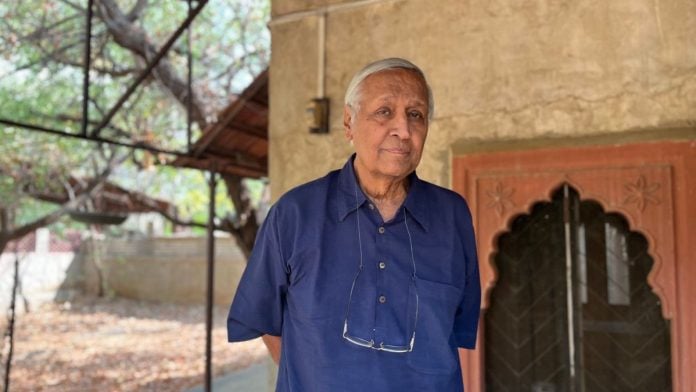
New Delhi: Bunker Roy, who died in Tilonia, Rajasthan, on Tuesday aged 81, built his life around a proposition that official India found difficult to accept — an illiterate grandmother could become a solar engineer, and that the people closest to rural poverty were often best equipped to solve it.
Roy was the founder of the Barefoot College in Tilonia, the institution that turned “Solar Mamas” into a global idea. Women from villages in India, Africa and beyond were trained to install, repair and maintain solar lighting systems, then returned home to electrify their communities.
“They leave as grandmothers and come back tigers,” Roy had said in a Ted Talk.
It was an unlikely legacy for a man whose early life seemed designed for privilege. Educated at the Doon School and St Stephen’s College, Roy was a national squash champion and appeared destined for the conventional corridors of Indian power. Instead, he went to Bihar during the famine of the mid-1960s and came back changed.
“I went to the wrong school, wrong college and came back with a lot of arrogance,” he later said.
The experience produced a man who stood against the assumption that expertise flowed from cities to villages, from the credentialed to the unschooled, from experts to beneficiaries. In Tilonia, he began working on wells and rural development before establishing the Social Work and Research Centre in 1972, the organisation that became the Barefoot College.
Also read: Sonia and Rajiv Gandhi: The romance India watched, mourned and mythologised
A unique college
Roy’s college had no entrance examinations, no degrees and little patience for the usual vocabulary of development. It trained rural women and men as solar engineers, hand-pump mechanics, health workers, teachers and artisans. Its central belief was that skill, common sense and community knowledge mattered more than a certificate.
The most famous experiment was the Solar Mamas programme. Older women, many of whom had never been to school, learned to assemble solar circuits and returned to their villages as engineers. The programme spread beyond India, bringing women from Africa, Latin America and Asia to Tilonia for training.
Roy was often asked why he chose grandmothers rather than younger men. His answer was practical: older women had families, standing and roots in their villages; they were less likely to leave for urban employment. The choice was also ideological. He wanted to prove that women excluded by formal education could master sophisticated technology and become agents of change in their own communities.
“There is no urban solution to a rural problem,” he said repeatedly. It was more than a slogan, a critique of development models that treated villages as problems to be fixed from outside, rather than communities with their own knowledge, institutions and capacity.
Roy’s work was inseparable from that of his wife, Aruna Roy, the former IAS officer who became one of India’s foremost rights activists and a central figure in the campaign for the Right to Information Act. Roy admired her combative public style.
“She is a street fighter,” he once said. “She fights Goliaths and seems to win.
He died as he appears to have wanted to live, at home in Tilonia, surrounded by people who had shared his work and his convictions.
Roy leaves behind more than an institution. He leaves an argument—that development fails when it mistakes literacy for intelligence, infrastructure for empowerment, and outside expertise for local knowledge.
He was 81. He is survived by Aruna Roy and by a global community of women who can now wire a solar panel, light a village and teach someone else to do the same.
(Edited by Janaki Pande)