



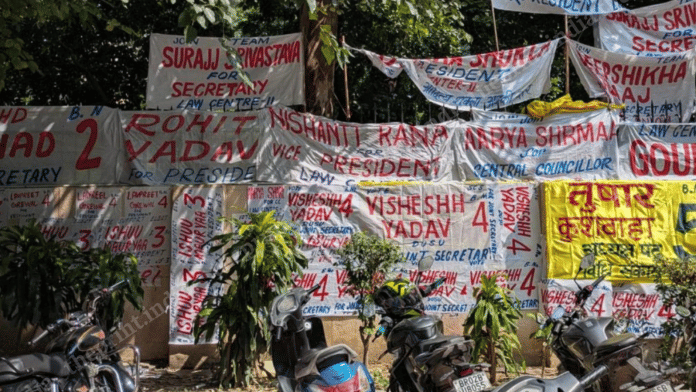
New Delhi: At Delhi University, Buddhist Studies has become an unlikely pipeline to the top of student politics. This year, seven of the 10 candidates contesting the four posts on the DUSU central panel came from the department, including both presidential nominees—Yash Dabas of the ABVP and Vijay Shankar Meena of the NSUI.
Deepanshu Shokeen, an independent candidate who won the vice-president’s post, is also enrolled in the course.
The department’s relatively accessible admissions and large intake have made it a particularly convenient option for students who want to spend time organising politically without giving up their postgraduate degrees. In the past 10 years, at least six DUSU presidents have come from the Department of Buddhist Studies.
“There are only a few MA courses from which you can contest elections, and Buddhist Studies is one of them, so it remains easy,” Shokeen told ThePrint. “Hence the choice.”
Only a limited number of postgraduate departments, including Law and Library Science are affiliated to DUSU, making them the front-runners for student political leaders.
Other factors add to making Buddhist Studies particularly attractive to those involved in student politics.
“I chose this subject because Buddhism teaches us many things about living a good life,” said Kunal Chaudhary, ABVP’s DUSU secretary last year and a second-year master’s student of Buddhist Studies.
There is another tempting reason.
“The second reason is that the cut-off for the course is low,” Chaudhary added candidly. “Student leaders often opt for it because they can neither focus on studies nor give time during the entrance. The cut-off is a bit low, so admission is easily available.”
The minimum allocation score—or cut-off—for Buddhist Studies stood between zero and 10 marks in the first cut-off list this year. Other departments such as Political Science, Economics, and Psychology required significantly higher scores, going well over 200.
Admission for the course is conducted through CUET, and the programme accepts students from any undergraduate stream. Further, the department has a relatively large intake, historically cited at around 200-300 seats.
Department head and professor Kamakhiya Narain Tiwary has noted that the openness of the course, rather than any political design, accounts for the high numbers.
“That may have happened earlier, but it is not the current trend,” he told news agency PTI, rejecting the idea that students choose the subject for an easy entry into politics. “Students now complete their MA. Some of those who were student leaders have even gone on to pursue PhDs.”
Also read: Inside Haryanvi gangster groom’s wedding with Cambodian girlfriend
A long tradition
The number of student leaders from the course has remained consistently high.
In 2025, three of the four people on the panel came from Buddhist Studies—including vice-president Rahul Jhansla, secretary Kunal Choudhary, and joint secretary Deepika Jha. The joint secretary in 2024, Lokesh Choudhary, was also a student of Buddhist Studies. In 2023, all four winners, including president Tushar Dedha, were MA Buddhist Studies students.
In 2011, it was reported that the department was emerging as a preferred entry point for student leaders.
“Many students from the department have gone to DUSU from here,” Bhikshu Satyapala, a professor at the department, told The Indian Express. “But they do nothing for the department. We have serious space issues, and we are unable to admit students to all seats because of it.”
The same pattern was noted in 2023, when all four top candidates of ABVP were pursuing a master’s in Buddhist Studies.
“Majority of the DUSU candidates every year are either from the law faculty or from my department. DU has now nothing to do with the admissions,” Professor Indra Narain Singh, former head of the Buddhist Studies department, told The New Indian Express. “Meritorious students coming here with philosophy or history backgrounds through the NTA exam. I can’t stop them from taking admission here.”
Earlier DUSU presidents from Buddhist Studies include Aman Awana (2013), Mohit Nagar (2014), Satender Awana (2015), Ankiv Baisoya (2018), and Tushar Dedha (2023).
The number is higher still for the other posts, such as vice-president, secretary, and joint secretary.
(Edited by Prasanna Bachchhav)