


New Delhi: Researchers have developed an experimental biocomputer that uses bacteria to explore multiple possible solutions to mathematical problems simultaneously.
The system, described in a study published in Microsystems & Nanoengineering, uses the bacteria’s ability to move through tiny interconnected channels and multiply, potentially increasing its computing power as a problem becomes more complex.
The study, titled ‘Amplification of computational power by the multiplication of bacteria exploring microfluidic networks encoding mathematical problems’, was conducted by an international team led by researchers at McGill University. It builds on a 20-year collaboration involving scientists from Canada, Europe, the UK and Australia.
How does the bacterial computer work?
The researchers designed a network of microscopic channels that encodes the mathematical problem being solved. Each possible route through the network represents a potential solution, while junctions act as decision points. Bacteria move through these channels, exploring different routes in parallel.
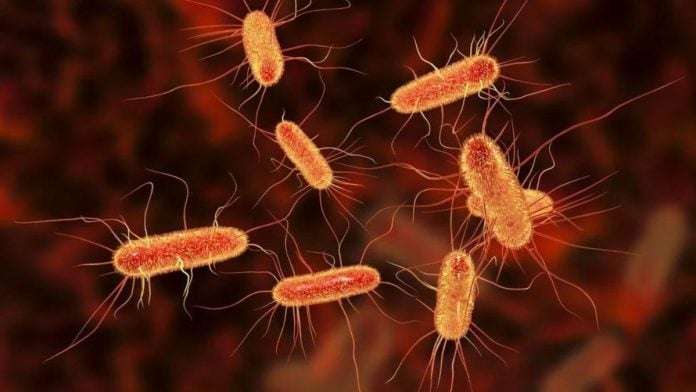
The team used two bacterial species, Escherichia coli and Vibrio natriegens. The latter was particularly useful because of its rapid rate of reproduction. As bacteria divide while moving through the network, they create additional biological computing units, allowing more routes to be explored simultaneously.
“Modern electronic computers make millions of operations per second using one chip,” said Dan Nicolau, the study’s senior author and a professor of bioengineering at McGill University. “With bacterial division, we have 1 million chips working at the same time. More chips mean you can resolve the problem faster, even if for each ‘processor,’ the number of operations per second is slower.”
The researchers tested the system using the Subset Sum Problem, a classic computational problem in which a computer must determine whether a particular combination of numbers in a set can add up to a specified target. The number of possible combinations increases exponentially as more numbers are added, making it difficult for conventional computers to solve larger instances.
The team identified successful routes by observing where bacteria travelled and using automated image analysis to trace their movements.
Also read: Chernobyl’s dogs have changed genetically. Scientists are still asking why
What could it be used for?
The researchers suggest that bacterial computing could eventually help tackle problems in areas such as cryptography, molecular biology and protein structure research. However, the current system remains a proof of concept rather than a practical alternative to electronic computers.
The experiments demonstrated that bacteria could solve certain test problems, while larger-scale tests explored networks representing problems with up to 100 numbers. The researchers also identified limitations, including errors at channel junctions and the risk of overcrowding as bacterial populations multiply.
Nicolau said the technology is intended for problems that conventional electronic computers are not designed to solve.
“We propose this technology to solve problems, not estimate based on past information,” he said.
Bacterial computing is only one of several approaches being explored. Researchers have also developed DNA-based circuits that process information through molecular interactions, with potential applications in biomedical research.
Another emerging field, organoid intelligence, uses lab-grown brain-cell structures to investigate learning and information processing. These systems remain experimental, but demonstrate how biological materials could be adapted for different forms of computation.
(Edited by Saptak Datta)