





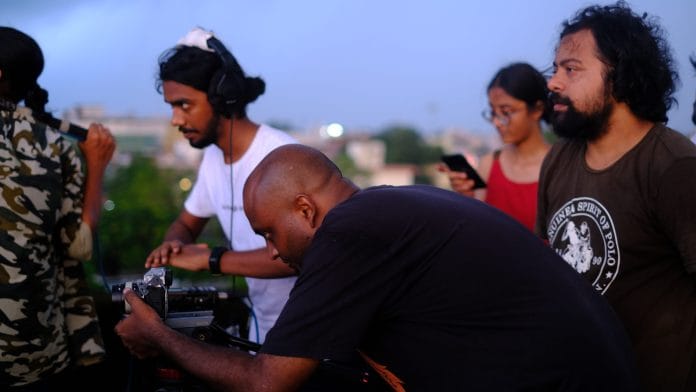


New Delhi: Prashant Nagendra left his high-paying job as an investment banker at Bank of New York Mellon and returned to Bihar to pursue his passion for filmmaking. But he didn’t want to make the next big masala action movie. For over a decade, he has worked to revive the Maithili film industry that went silent nearly 50 years ago. His 2015 film Lalka Paag marked the return of socially rooted storytelling to Bihar’s cinematic space.
“I put in some of my own money, took some from friends, some from my network, and made a film,” he told ThePrint.
Produced by Ratnesh N Shah and based on Rajkamal Chaudhary’s Maithili short story of the same name, Lalka Paag tells the story of Tiru, an uneducated rural woman and Radhakant, a highly educated man, who are forced into an arranged marriage. The seemingly simple story shows Tiru’s emotional journey as she tries to live up to society’s expectations while facing betrayal and heartbreak.

Bihar’s cinematic identity has long been shaped by Bhojpuri films with loud action, item songs, misogynistic characters, and larger-than-life heroes. While these films dominate theatres and local streaming platforms, only a handful of directors over the decades have challenged the formula by making films rooted in Bihar’s culture, language, and the everyday struggles of its people.
It began in 1965, when filmmaker Phani Majumdar released Kanyadan, a Maithili-language film based on Hari Mohan Jha’s novel of the same name. The film explored the condition of women, and more like it soon followed.
Despite these early milestones, grounded stories failed to become the norm. For decades, regional cinema from Bihar remained largely absent from theatres, with few films carrying forward that legacy.
The rise of New Darbhanga Wave
The next major milestone came with filmmaker Nitin Chandra, brother of actor Neetu Chandra. Through films such as Mithila Makhaan (2020), he brought Maithili cinema to the national stage. The film became the first Maithili-language feature to win the National Film Award. He later directed Jackson Halt (2023), a psychological crime thriller, and established Champaran Talkies, along with the regional OTT platform Bejod. The effort was to create an ecosystem for independent cinema from Bihar.
But the ‘New Darbhanga Wave’ first started in 2019 with filmmaker Achal Mishra, director-writer Parth Saurabh, and actor-writer Abhinav Jha. Together, they have collaborated on several films while attempting to build a sustainable ecosystem that can launch more filmmakers from the region.
The first major film was Gamak Ghar (2019), written and directed by Mishra. He conceived the film after dropping out of King’s College London in his first year.
Recalling the making of the film, Abhinav Jha, who played the protagonist, told ThePrint that both he and Achal were barely in their early 20s when they started. Their only ambition was to make honest cinema—not to react against mainstream Bhojpuri films.
“There was nowhere any feeling that we have a rebellion or that we have to show Bhojpuri cinema. All these thoughts were never there,” Jha said.
If the work has sparked a revival of regional cinema, Jha and Mishra see it as a by-product of making good cinema and telling authentic stories.
This continued with Dhuin in 2022. Directed by Mishra and written by Saurabh, the film starred Jha as a struggling theatre artist who accompanies his father to another city for a job interview. The film embraces a neo-realist approach and is based on the life of a real theatre artist named Prashant, whose own experiences became the foundation of the story.
While shooting the film, the makers blurred the line between fiction and reality. In several scenes, they swapped the character in the film with real-life Prashant, while everyone else around him remained the same. Jha recalled that the street play featured in the film was performed three times a day. Since the team could not shoot the morning performance, they filmed the evening one by swapping the real Prashant with the actor.
The film was shot in Prashant’s actual house and features a mix of professional actors and non-actors, many drawn from local theatre groups.
Then, in 2022, Shishir came up with his own film, Tortoise Under the Earth (2022), which is often described as the third film of the New Darbhanga Wave.
While Gamak Ghar, Dhuin, and Tortoise Under the Earth travelled to several international film festivals and earned critical acclaim, the biggest hurdle remained the same one Nagendra had faced years earlier: distribution.
The directors and actors from the New Darbhanga Wave are trying to make their films financially sustainable.
“I feel filmmaking is a process where maybe three or four films get sacrificed before you can reach a point,” he said.
He explained that every stage of filmmaking demands resources, with distribution often becoming the most expensive challenge.
“To release in theatres costs a lot of money. For that too, you’ll have to pay, or a big producer has to come,” he said. “Then there’s the fight for screens, that we need this many screens. If a big film is releasing that month, you won’t get screens at all.”
Limited distribution ultimately means fewer people watch the films, defeating the purpose of telling stories rooted in the region’s culture.
Also read: Singles are done with dating apps. Welcome to the era of photobooths and pickleball
Actors drawn from theatre groups
The third force driving the new wave of Maithili cinema is filmmaker Parth Saurabh. His directorial debut, Pokhar Ke Dunu Paar (2022), was produced by Mishra and starred Jha in the lead role. The film follows an eloped couple who are forced to return to their hometown after facing financial hardship during the Covid-19 pandemic. It explores how love is shaped by socio-political realities.
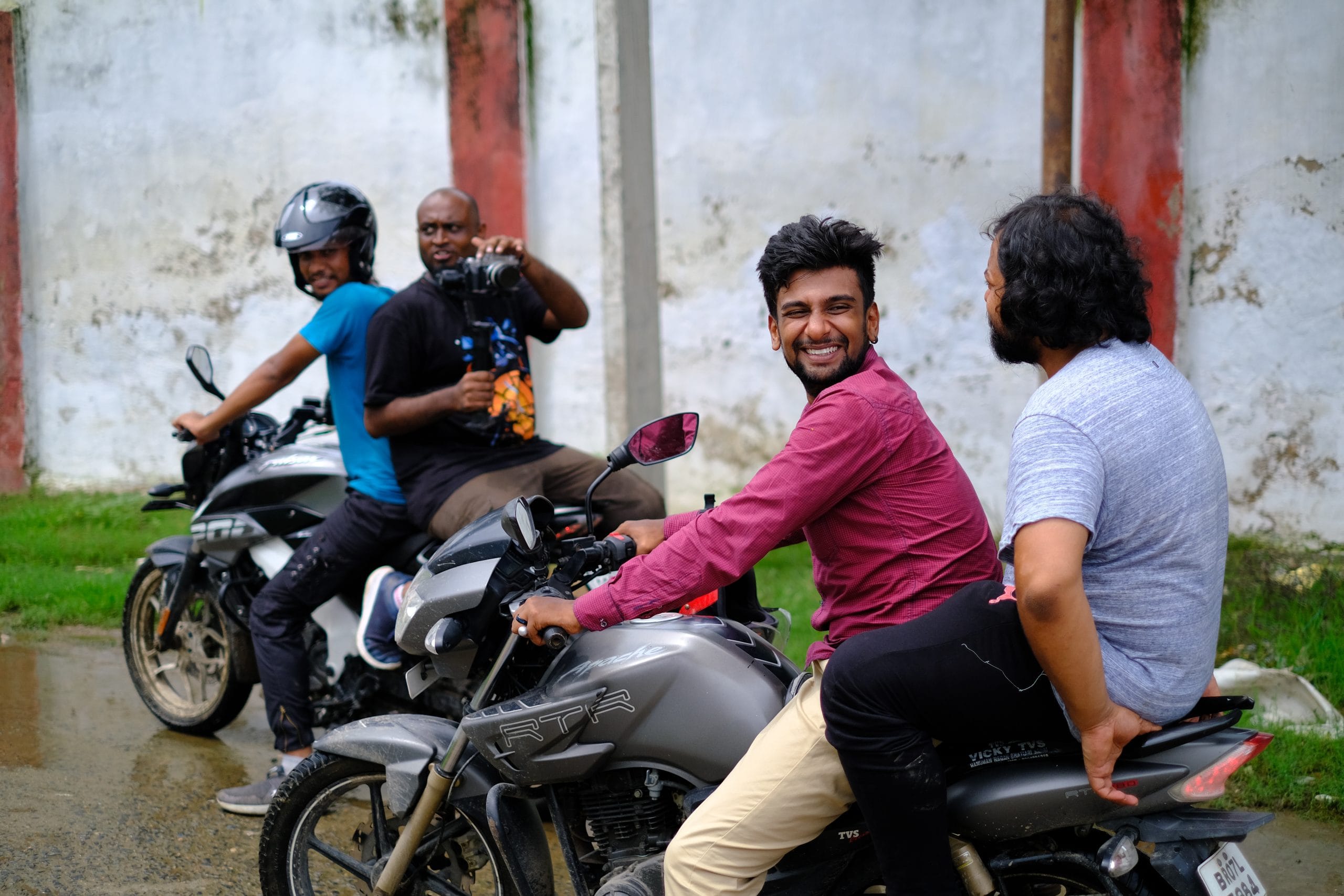
Speaking about the process, he said that growing up in Darbhanga naturally shaped the stories he wanted to tell. His intention has always been to document the city and its people through the lens of those who belong there.
According to Saurabh, regional cinema can thrive only when audiences begin valuing the stories that reflect their own lives.
“The shift will happen only when people ask why they should watch a film made in Bombay about something that has nothing to do with them, instead of watching and valuing their local cinema. That intention has to come from the audience,” he said.
For that shift to happen, however, more films need to be made, which requires financial support. Although the Bihar government has announced subsidies for regional films, Saurabh said the assistance comes only after a film is released, whereas the biggest challenge is arranging funds to make the film in the first place. The filmmakers find they cannot celebrate this policy.
Saurabh’s films have travelled to international festivals such as the New York India Film Festival and the International Film Festival Pame. They’ve found a home on platforms Mubi and Brew TV. But reaching the regional audience remains his toughest battle.
The distribution costs more than the production of the film, and the shutting down of single-screen theatres has stolen any chance for these films to reach theatres. Multiplexes are geared toward films with big budgets for both production and marketing.
“It doesn’t make sense to me to spend Rs 30 lakh on the release of a Rs 15 lakh film,” Saurabh said.
Like many filmmakers from the Darbhanga Wave, Saurabh frequently casts actors from local theatre groups. He believes the collaboration benefits both sides, where actors receive exposure and filmmakers work with performers who understand the region’s language, customs, and culture.
“Many actors do one thing very well, but aren’t necessarily versatile. Playing to their strengths and tweaking the script slightly helps make the film richer,” he said.
Saurabh discovered filmmaking while he was studying engineering, a passion that eventually drew him toward cinema. He is now working on his next feature, Bajrangi, once again starring Jha. The film follows a strongman working for a village head and has been shot across Darbhanga, Madhubani, and Samastipur over three different seasons to capture the passage of time in the protagonist’s life.
“The film captures a full year in the protagonist’s life, so we shot across three seasons, summer, monsoon and winter,” Saurabh said.
Also read: CJP protest is incomplete without discussions on ideology, says artist Siddhesh Gautam
A word of caution
Lalka Paag remains Nagendra’s last feature film, released nearly a decade ago. Since then, he has worked on documentaries, but has now returned to his job in the finance industry.
While working on a documentary on mental health, he conceived the idea for his next feature, Green. Although the film has been completed, its release remains uncertain. Originally scheduled for release in 2021, it was derailed by the Covid-19 lockdown.
After making his first film, Nagendra asked himself, “How much more of my own money can I keep pumping in?”
Although Lalka Paag never received a wide theatrical release, filmmaker Prakash Jha extended his support by helping the film secure a week-long screening at Cinepolis in Patna.
For aspiring regional filmmakers, Prashant offered a word of caution.
“Don’t jump in recklessly. It’s a brutal industry.”
(Edited by Prasanna Bachchhav)