








New Delhi: With the aim to offer a wider range of resources, more opportunities, and a new web platform, Bengaluru’s MAP Academy has been rebranded as Impart.
Launched as a digital book on art, photography, and culture in 2022, MAP Academy, now Impart, is an institutional partner of Museum of Art & Photography, Bengaluru, founded by collector and philanthropist Abhishek Poddar. It is aimed at preserving and promoting South Asian, including Indian, cultural heritage by connecting arts to the community.
In the last four years, the platform expanded its initiative — editorially, technologically, and geographically. It presented art through diverse interviews, videos, and online tours, while taking a jargon-free approach. While the platform grew to over 1.5 million annual visitors, the name ‘MAP Academy’ gave the impression of a narrowly defined academic programme or a physical institution.
Impart is the more comprehensive version of MAP Academy.
“At Impart, we are united by the belief that the story of art across South Asia needs to be told in more comprehensive and nuanced ways, and that access to these histories should be free and public,” said Varun Nayar, director of Impart.
With the transition to Impart, the platform now offers a wider range of resources and more opportunities to engage with the arts from the Indian subcontinent. Two new sections — Journeys and Timelines — have been added to the website which, through interactive visuals, tell the audience about artwork and artists.
Writers, researchers, editors, and creative practitioners from South Asian countries are brought together under one umbrella to foster greater public engagement with art and cultural histories.
“We have designed the platform so that users can engage deeply, even if they do not want to sit through a full lecture, they can learn through transcripts, image credits, and modular content,” said Nayar.
Also read: The Golden Age of Hollywood comes alive in Delhi—Chaplin, Caligari, & Gujarati Captain Marvel
Immersive visual journey
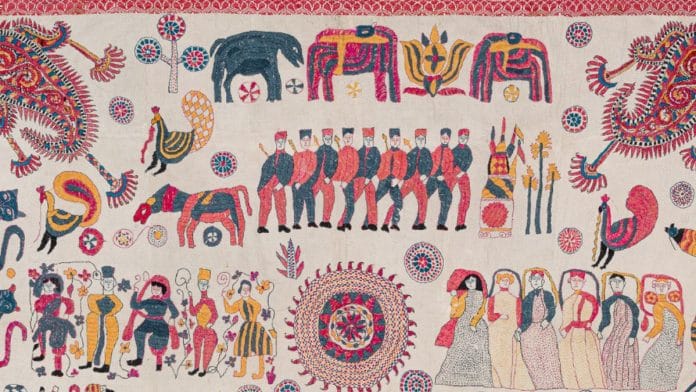
On the website’s homepage, under Journeys, Impact brings in interactive timelines that trace “evolutions, networks and connections” from Afghanistan, Bangladesh, Bhutan, India, Maldives, Nepal, Pakistan, and Sri Lanka. The section is dedicated to visually immersive short-form essays. One of the essays, titled ‘Kantha O Kahini’, traces historic Kanthas of Karun Thakar. Art historian Pika Ghosh, with her keen eyes on Thakar’s work, finds out what the textiles tell about women’s domestic lives, world views, and narrative imagination.
Journey is a digital series, with photos and texts placed to provide an in-depth analysis of the subject.
While Journey traces art and history through the amalgamation of texts and images, the other new section, Timelines, highlights key moments in South Asia’s art histories. Under this section, the stories trace how a region’s art evolved over time. It places the subject and artistic development within the broader context of religion, politics, technology, and trade. With annotations, citations and images, Timelines allows readers and viewers to explore the subject more deeply.
With the introduction of these two sections, Impact seeks to offer more collaborative research and multimedia storytelling on its platform.
“Formats like immersive journeys allow us to combine high-resolution imagery with scholarly annotation, offering new ways to experience art histories online,” said Nayar.
(Edited by Aamaan Alam Khan)