





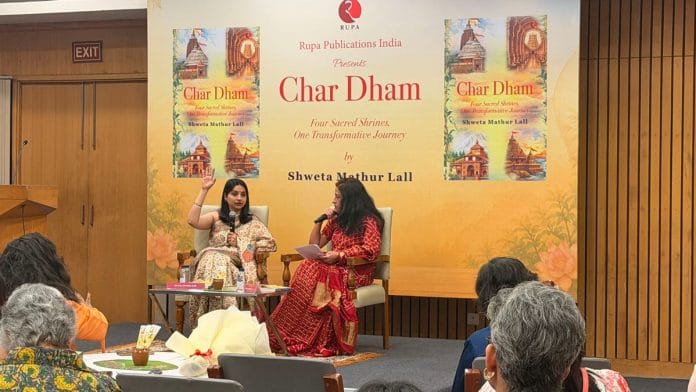


New Delhi: Dentist and author Shweta Mathur Lall visited the Char Dham shrines as a child with her father, travelling by train and soaking in the local rhythms of each site. But at India International Centre on Sunday, she said that she experienced a more profound pilgrimage much later.
“My real Char Dham happened in the last three years,” said Lall at a book discussion of Char Dham: Four Sacred Shrines, One Transformative Journey. “It was when I went back after researching for my book in libraries.”
The book, her debut, has made the Amazon bestseller list in its category. About 100 people, from college students to retirees, crowded the room in IIC’s Kamaladevi Block.
Lall was in conversation with Captain Yamini Chaudhary (Retd), who steered the evening through a series of questions. Among them was how a practising dentist came to write her first book on spirituality.
Lall replied spirituality had been beaded into her existence long before dental college. Not just during her trips with her father to Rameshwaram and Jagannath Puri but even when she was in her “mother’s womb”.
The author pointed out that she was more spiritual than religious, but also gave the caveat that one flowed from the other for her.
“Religion refers to the more physical parts of our faith. There is nothing wrong with religion. It is because of religion that we become spiritual. If religion is not there, how can one achieve that state of higher consciousness?” Lall said. “By studying religion and by attaining my own light, I have now become spiritual.”
Also Read: What are the consequences of moving away from Nehru? A Delhi panel answers
Dhams across divides
The book frames the four dhams as stages in a spiritual arc.
Jagannath Puri is the dham of celebration and fervour, where the deity is offered chappan bhog and belongs as much to the people as to the temple. Rameshwaram is for atonement, where Ram is said to have performed penance to Shiva for killing Ravan. Dwarka is the seat of power where God chose to leave the earth and rest. Badrinath, alone and high in the mountains, is where the Lord—and by extension, the pilgrim—strips everything away.
“In Badrinath I realised nothing is required,” Lall said. “It’s just you and your Lord.”
She also spoke about Adi Shankaracharya, whom she described as “a management guru”, and his role in linking the four cardinal centres of Hinduism in a way that allowed faith to cross the barriers of regions, castes, and traditions. The Nambudiri Brahmins of Kerala manage Badrinath, a Maharashtrian priesthood presides at Rameshwaram, and the Sabar tribe, an Adivasi community of Odisha, are the original custodians of Jagannath. This, she argued, was not accidental but part of his design.
Also Read: Two journalists spent a decade in Rajasthan. What they found about caste, feudalism & RSS
‘Hinduism is not in any danger’
The research exacted its own emotional toll.
“There were certain stories I dug into so deeply that I cried,” Lall said. “I have done this from my heart.”
That emotional honesty surfaced again when she spoke about the book’s larger ambition—to show that devotion does not belong to any one tradition.
“Consistent efforts from people like us will make others understand that it is not about religion—it is about attaining your higher self,” she said. “Different religions have so much faith attached to our temples. I have written small stories about this in the book.”
Lall peppered her conversation with stories and anecdotes that are not widely known. She recounted that the third step at Jagannath temple — called the Yamshila — is the stone on which Yamraj took up residence after the Lord made Puri a place of guaranteed moksha, rendering the god of death effectively unemployed. Pilgrims step on it going in so their sins are absorbed, and are urged to jump over it on the way out.
“Hinduism is not in any danger. A religion that encompasses, that accepts, that embraces — how can you deplete that? Hinduism does not force you to worship a particular deity,” she said. “You will still be a Hindu if you are following the basic thirty rules of Sanatan: be kind to others, be truthful, do your karma according to your dharma.”
The last question of the evening came from an audience member who asked whether an atheist could meaningfully read the book. Lall did not miss a beat.
“You are my target audience because you will read it with a critical mind,” she said. “I am not going to impose on you to believe what I believe.”
(Edited by Asavari Singh)