



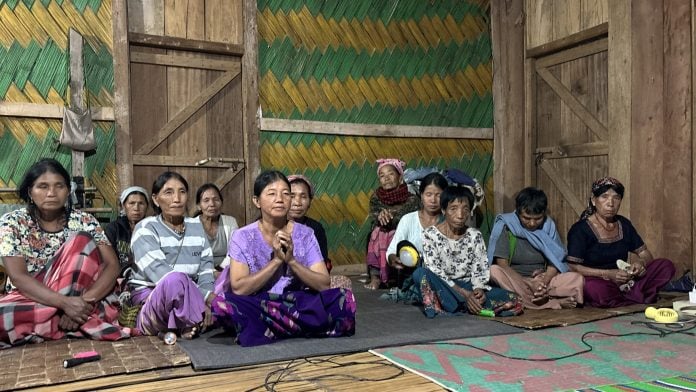
Geku, Upper Siang: Sitting with a group of women in Geku, Noom Pania speaks about the Siang River and the land along its banks. For her, the proposed 11,200-MW Siang Upper Multipurpose Project is not an abstract infrastructure project. It is a threat to the place her family has inhabited for generations.
“This is our ancestors’ land. We will never let this vanish,” she said. “The BJP government, the Pema Khandu government, is forcefully removing us from our ancestral homes. All of our land will get submerged under the Siang.”
Pania is among the women from Geku who have become visible faces of the resistance to the proposed dam and the Pre-Feasibility Report (PFR) survey. The protest, led largely by members of the Adi community, has intensified over the past month as villagers have blocked roads, opposed the movement of survey machinery, and demanded the withdrawal of security forces from the Siang Valley.
Tensions escalated on 23 October, when protesters from Geku and nearby Komkar gathered at Dite-Dime during a 12-hour bandh against the project. At least four women were injured after clashes broke out between police and protesters, when security forces fired tear-gas shells to disperse the crowd, according to media reports. Women were at the forefront of the demonstration, removing their clothes at a police barricade in a dramatic expression of opposition to the project and the security deployment.
“We had protested for our land, and during that they used tear gas on us,” Pania said. “That’s why we are angry. Because of the tear gas, people got injured and were admitted to hospital as well. The tear gas made it difficult to breathe.”
She blamed the state government for the escalation. “All of this is being done by the BJP, by the Pema Khandu government,” she said. “Us women will never let this happen. No dam, no PFR.”
Also read: Siang Dam survey hits a wall. Villagers block drilling at 3 sites
‘We are not criminals’
The detentions of four Upper Siang residents under the Arunachal Pradesh Unlawful Activities (Prevention) Act (APUAPA), 2014, have further fuelled anger among villagers. Adum Tayom, Omak Paron, Okut Paloh, and Oson Paron were detained earlier this month.
“They have even put APUAPA, which should be taken back,” Pania said. “We are not thieves or murderers. We have just raised our voice to protect our land. Anybody who raises their voice is put in jail. The police are trying to scare us.”
Biben Pania, another woman from Geku, said the community would escalate its protest if it felt pushed further.
“We will not let our land be submerged underwater,” she said. “This is not just about Pangin. If they force us, we will increase the scale of our protests. If they do this, we will also not back down. We are not afraid of them.”
She said the detentions had deepened the sense of persecution among villagers. “They are putting us in jail without any reason. We have not done anything wrong,” she said.
For many women in Geku, the presence of security forces has also changed everyday life. One woman, who did not wish to be named, said the deployment had made even a trip to the fields feel unsafe.
“They have put so much armed force in Geku that we are afraid to even go to our farms,” she said. “They don’t even let us take our dao. For what reason are they putting this much police? We are not criminals.”
The dao, a traditional utility blade, is used by farmers in the region to clear vegetation and harvest crops. Residents say frequent checks and the heavy presence of security forces have turned a routine part of agricultural life into a source of anxiety.
The Upper Siang district administration has maintained that the PFR is only an initial feasibility study and that no decision has been taken to construct the dam. Deputy Commissioner Ashok Tajo told ThePrint that no PFR work had begun in Upper Siang and that the administration was trying to create a platform for dialogue between villagers, NHPC and the government.
However, the administration’s assurances have done little to assuage villagers, who have questioned the lack of clarity around proposed livelihood schemes.
For the women of Geku, the debate over the Siang project is not limited to whether a dam will eventually be built. It is also about who gets to decide what happens to the land they have lived on for generations.
“They should come and talk to us,” Pania said. “But until then, our demand is clear: no dam, no PFR.”
(Edited by Prasanna Bachchhav)