





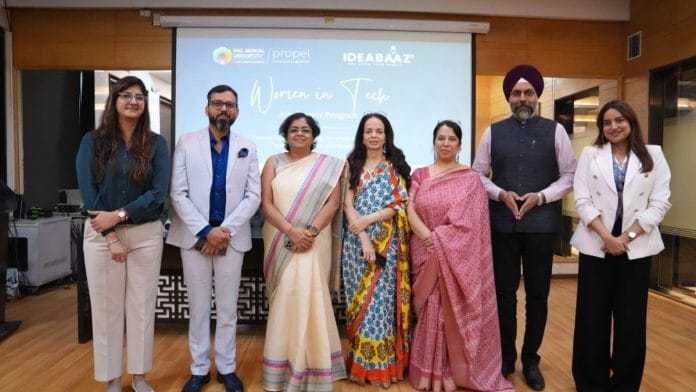


New Delhi: Women founders who had gathered at the Constitution Club of India on Wednesday afternoon shared more than business cards and phone numbers. They shared the stories of how they launched their startups.
The dozen founders, handful of investors, and mediapersons had come together for the launch of the ‘Women in Tech Accelerator Program’ by the BML Munjal University’s Propel Incubator in collaboration with Ideabaaz, a Shark Tank-like national stage for Indian startups.
“The core job of every CEO is not to manage businesses, it’s to manage people. And who can do that better than women? Every daily activity that we do in our lives, as mothers, sisters, daughters—it’s a training field to become CEOs,” said Pooja Nerurkar, finance professional and creator of the Ideabaaz podcast.
Startup incubators exclusively for women are an upcoming phenomenon in India. Several speakers at the launch highlighted that the challenge for women is no longer an entry into the startup world, but rather visibility and access.
Anna Roy, chief guest and principal economic advisor at NITI Aayog, echoed this sentiment.
“Tech is the easier part. Deployment and adoption and the hard parts. We may have wonderful ideas and tech solutions, but we get stuck. Access to markets is one of the basic sticking points. Once you are able to figure all that out, access to finance, in my view, is not that big a problem,” said Roy.
Also read: Women are moving from unpaid family work to self-employment. Why that’s not enough
‘Don’t care’ attitude
The 12-week initiative is designed to mentor women entrepreneurs, give them national visibility, access to the industry experts, and the support necessary to get investor-ready. The selected founders will also have a chance to appear in Season 2 of Ideabaaz, which showcased 86 start ups and facilitated deals worth Rs 41 crore in its first season in 2025.
The first cohort of women chosen for the program are driving innovation through nanotechnology in skincare, EV batteries, period care for teenagers, sign-language gloves, and AI in the field of dairy.
Aishwarya Karnataki’s journey to her startup began as a friendship with a young deaf student when she was in school. It turned into an engineering project and eventually a startup, Glovatric, that focuses on building products that translate sign language into speech.
When Karnataki wore the specially designed black gloves, and the audience heard sign language being translated into English and other languages, the crowd applauded.
Across the room, women founders from the first season of Ideabaaz, highlighted that the journey for women in the startup ecosystem remains an uphill climb.
“I was told so many times that I should make my husband the CEO because fundraising would get easier,” Ria Rustogi, founder of Sychedelic, a neuro-technology startup, told ThePrint.
Right around the time when Rustogi was meeting big investors, she found out that she was pregnant. She recalls hesitating telling investors about the pregnancy but even before she could mention it herself, the misogynistic comments started coming in.
“I hope you’re not planning a baby, because couple founders with a baby is a nightmare in building,” a senior investor told Rustogi.
Everyone around her was telling her to quit. She had studied in Singapore, worked for seven years in Germany as an engineer, and many of the people close to her were telling her to return to a comfortable life in Europe.
“You shouldn’t listen to your parents, you shouldn’t listen to your in-laws, you shouldn’t listen to investors and crappy men in the industry. You shouldn’t listen to crappy women in the industry either,” said Rustogi.
According to her, all women need to survive as founders is a “don’t care attitude”.
For Karnataki, success is synonymous with accessibility.
“The true measure of success would be when a deaf entrepreneur is standing here delivering their pitch in sign language, while our gloves and technology do the translation,” she said.
(Edited by Theres Sudeep)