








India’s employment story is often framed through simple categories such as employment versus unemployment or formal versus informal work. But these broad distinctions miss a quieter and more meaningful transformation underway, particularly for women. Evidence from the latest Periodic Labour Force Survey 2025, compared with 2023–24 data, suggests that a large number of women are moving out of unpaid family work and into self-employment. This is a significant but complicated shift.
At first glance, the transition appears positive. Unpaid family work involves contributing labour without direct earnings or recognition, while self-employment implies some degree of independent economic identity. The critical question is whether this shift reflects genuine economic empowerment or merely a movement from invisible labour into visible but still precarious work.
The decline in unpaid family labour
One of the clearest patterns in recent data is the fall in women’s participation in unpaid family work across age groups.
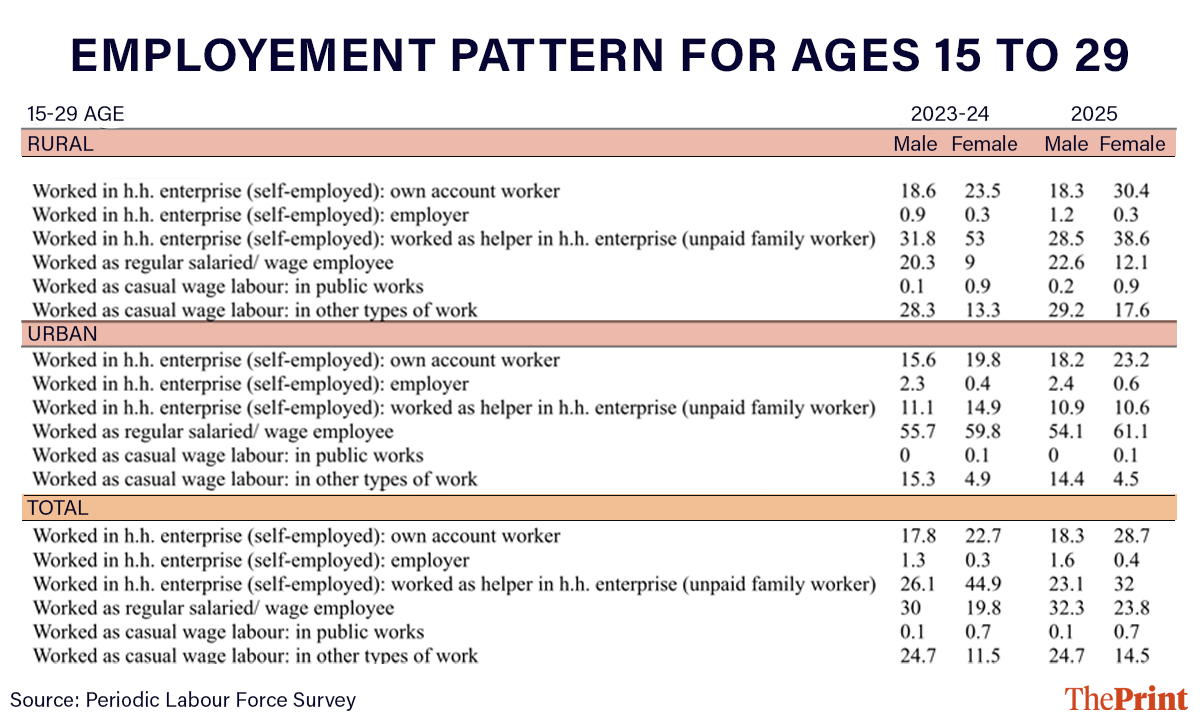
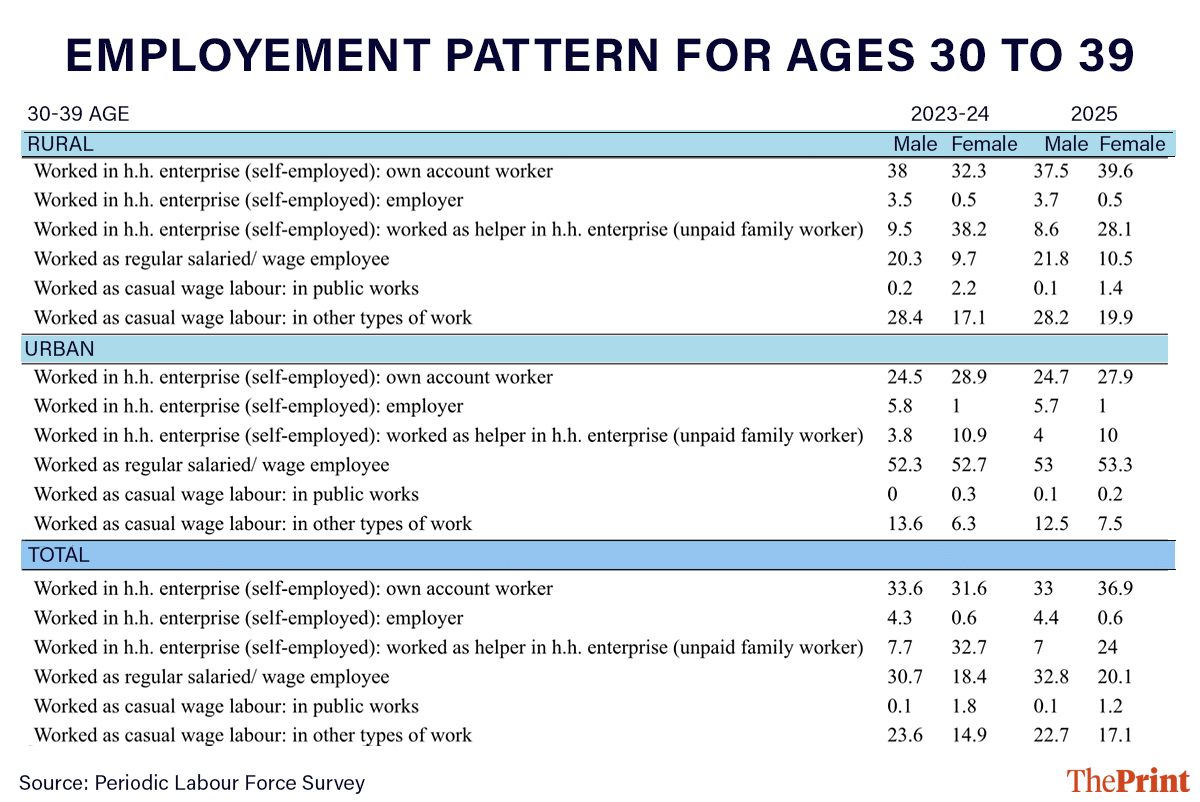
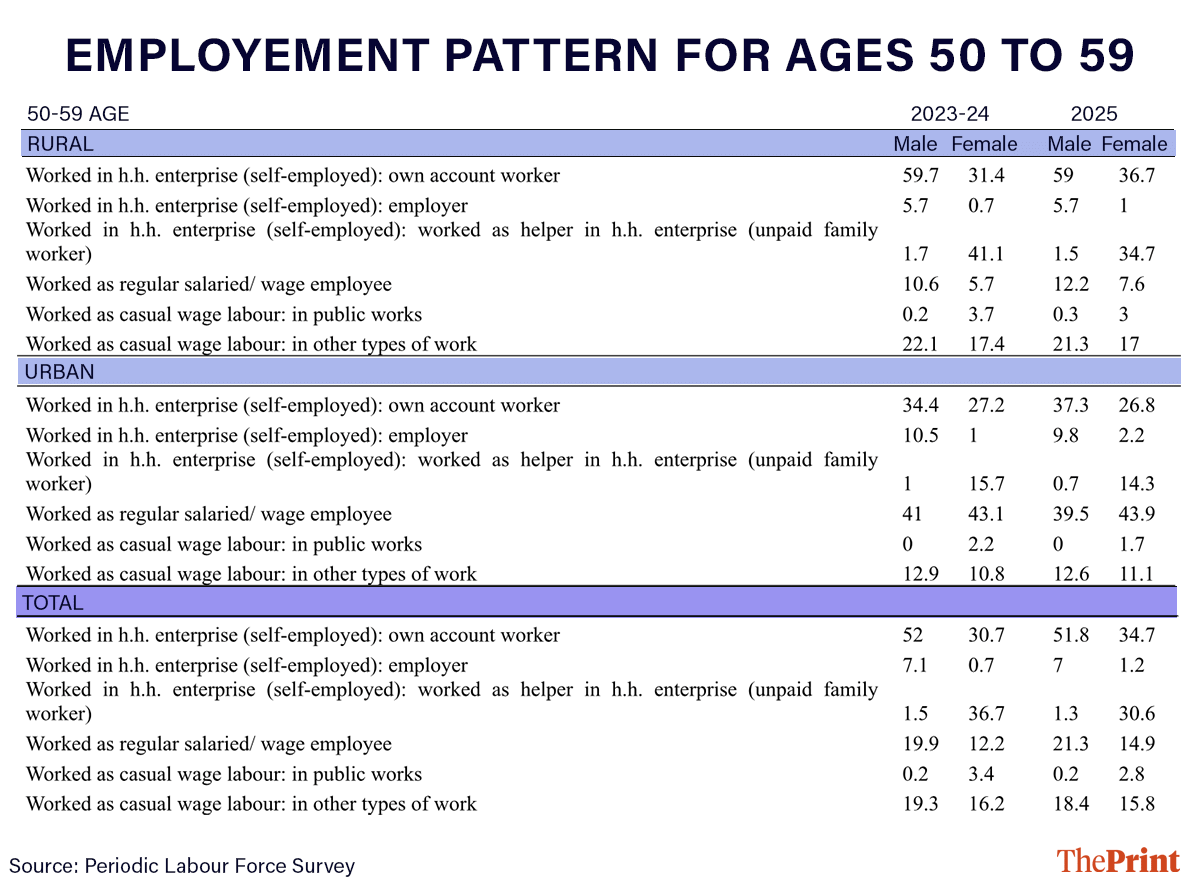
Among women aged 15 to 29, the share engaged in unpaid work declined sharply from 44.9 per cent in 2023–24 to 32 per cent in 2025. A similar decline is visible among women aged 30 to 39, from 32.7 per cent to 24 per cent, and among those aged 40 to 49, from 33.2 per cent to 25.7 per cent. Even in the 50 to 59 age group, unpaid labour fell from 36.7 per cent to 30.6 per cent.
This represents a substantial structural shift. Unpaid family work has historically been one of the least visible forms of labour, particularly in rural India, where women contribute extensively to agriculture, livestock, and household enterprises without being recognised as independent workers.
The decline in this category therefore signals a movement away from economic invisibility.
This decline is closely mirrored by an increase in women’s own-account work, that is, self-employment without hired workers.
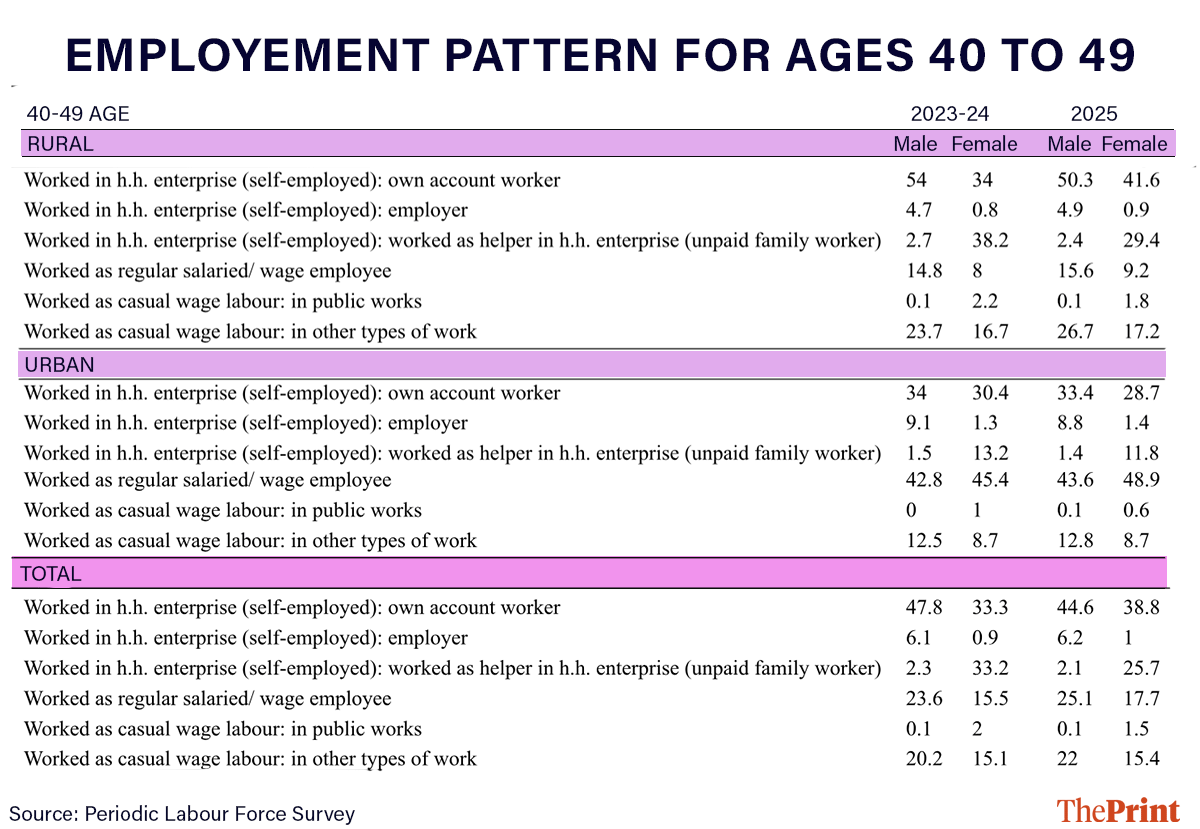
Among women aged 15 to 29, self-employment rose from 22.7 per cent to 28.7 per cent. Among those aged 30 to 39, it increased from 31.6 per cent to 36.9 per cent, and among women aged 40 to 49, from 33.3 per cent to 38.8 per cent.
For many women, this may represent the first step toward economic independence.
Also read: Lifting night shift ban increased female employment in India—only among big firms
Occupation patterns reinforce this story
The occupation data provides important context to this transition. It does not change the story, but it helps us understand the nature of self-employment women are entering.
Even in 2025, a very large share of working women (15-59 age) remain concentrated in agriculture and allied activities. For instance, 38.6 per cent of working women are classified as skilled agricultural workers, only slightly lower than 44.1 per cent in 2023–24. In addition, subsistence farming activities increased from 6.2 per cent to 7.8 per cent, indicating continued reliance on low-productivity agrarian work.
At the same time, there is a visible presence of women in small-scale, labour-intensive occupations. In 2025:
- Around 7.2 per cent of women are engaged in food, wood, and garment-related trades
- About 3.5 per cent are working as cleaners and helpers
- Nearly 2.8 per cent are in personal service roles
Urban data reinforces this pattern. Women are present in sectors such as teaching, healthcare support, and garment-related work, but even here, concentration remains in roles that are often informal or semi-formal in nature.
These patterns suggest that while women are moving out of unpaid labour, they are largely entering small-scale, low-capital, and often informal occupations.
Also read: Where are women in India’s gig economy? The question we forgot to ask in the outcry
Why this shift matters
The transition from unpaid work to self-employment represents a meaningful change along several dimensions. First, it increases visibility. Women previously counted as helpers are now recognised as workers in their own right. Second, it enhances economic agency. Even modest self-employment allows for some control over income and work decisions. Third, it reflects a shift in labour market participation, particularly in rural areas where this transition is most pronounced.
For instance, among rural women aged 15 to 29, unpaid work declined from 53 per cent to 38.6 per cent, while self-employment rose from 23.5 per cent to 30.4 per cent. This indicates that the transformation is not limited to urban labour markets.
Despite these gains, it is important not to overstate the extent of transformation. The rise in regular salaried employment among women remains modest. Among women aged 15 to 29, it increased from 19.8 per cent to 23.8 per cent, while for those aged 30 to 39, it rose only from 18.4 per cent to 20.1 per cent.
This means that most women are not transitioning into stable, formal jobs with predictable incomes and social protection. Instead, they are moving within the informal sector, from unpaid roles into self-employment and small-scale work.
The occupation data reinforces this conclusion. The dominance of agriculture, small trades, personal services, and support work indicates that the underlying structure of employment remains largely unchanged in terms of productivity and security.
Also read: What happens when ‘women’s work’ becomes a profession? It’s still men who rise
Invisibility to informality
Taken together, the data suggests that India is witnessing a shift that is significant and incomplete.
Women are moving out of unpaid labour and becoming visible participants in the economy. This marks progress in terms of recognition and agency. However, the nature of employment they are entering remains largely informal, low-productivity, and vulnerable.
This is why the current transformation is best understood not as a transition to formalisation, but as a transition from invisible labour to visible informality.
Unless this transition is accompanied by improvements in productivity, income stability, access to markets, and social protection, it will remain only a partial transformation. Women may be more visible as workers, but still far from secure.
The challenge for policy is therefore clear. The goal must be to ensure that the work women move into is not just visible, but viable.
The author is Assistant Professor of Economics and Sustainability, IMT Ghaziabad. Views are personal.
(Edited by Theres Sudeep)