





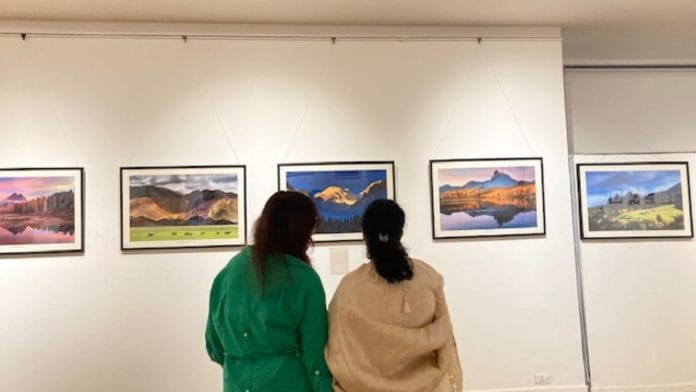


New Delhi: As the scorching sun over Delhi’s Lodhi Road mellowed ever so slightly, attendees at a photo exhibition were slipping into a lakeside at Nubra, Ladakh. It was the first image on display, next to a board: “Silence is where everything begins. In nature, it is never empty—it is alive, listening, waiting. Through these images, you are invited to enter that quiet space, to pause, to feel, and to simply be.”
The words introduced ‘Prakriti-Raga’ (A Melody of Nature), an exhibition of over 60 photos by Jhuma Datta. This is her sixth solo landscape photography show, which she describes as “a love affair with Mother Nature”.
The exhibition that opened on 19 May will be on display until 24 May at the India Habitat Centre (IHC). It is curated to reflect four segments: ‘Silence, Flow, Rhythm and Energy’. Among the highlights is a series from Kazakhstan, shot during Datta’s travels last year, which she calls her ‘showstopper’.
The photographs feature travel across geographies from Ladakh and Kashmir to Karnataka, and beyond India to Italy and Iceland.
Datta bought her first camera, a Canon 400D, right before a trip to Ladakh in 2018. Though she has never taken a photography course, she fondly recalls attending a workshop in Kolkata by Raghu Rai, whom she calls her mentor.
“He is my Guru, he is my mentor,” she said.
Datta added that it was Rai who inaugurated her last exhibition in Kolkata.
“I learned a lot from him. You can see the layers in his pictures. He teaches you how to see and capture them,” she said.
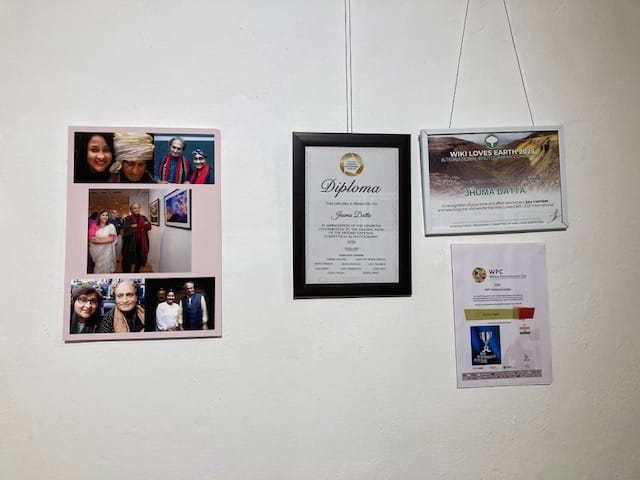
Some visitors walked into the hall in pairs and separated over the distance of photographs, slowing their pace to zoom in and return with questions. Sometimes, Datta would accompany them on a walk from Ladakh (photograph 1) to Gujarat (photograph 66), tracing anecdotes like the moonlit stars in her photographs.
Some visitors were busy taking pictures of the photos on display. Others reached out and touched the photos—almost as if they sought to reach the landscape within.
The deep blue waters of the Andaman prompted one visitor to ask: “Was this taken underwater?”
Datta was quick to correct the assumption—the photo was shot from a helicopter.
“From inside closed doors,” she added right after, smirking, accustomed to listeners imagining her dangling from the helicopter.
‘The science of photography’
A visitor completed a round of the space and stopped before the last photo—from Kutch, Gujarat.
“It is 360 exposures, each 30 seconds long, stacked to reveal the Earth’s rotation. The centre is polaris, the North Star,” read the description.
Sharing her own interest in astrophotography, the viewer enquired about Datta’s techniques.
“This isn’t a picture where you just click, and it’s done,” the photographer responded. “For this, you spend the whole night. One night may give you just one picture. That kind of time you have to devote.”
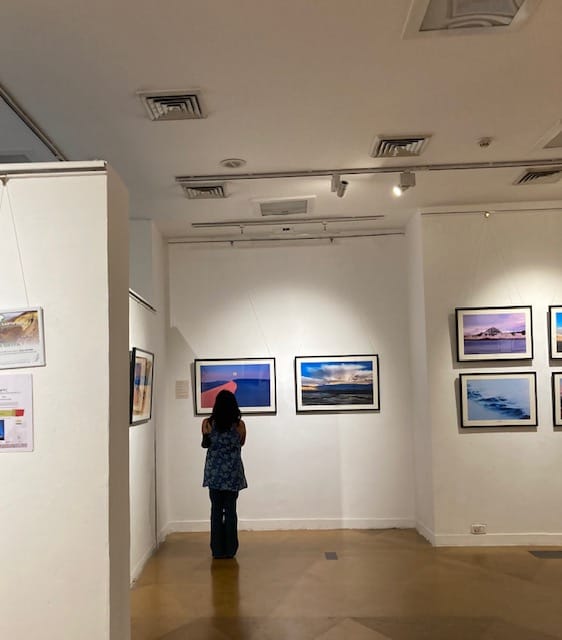
To her, photography is a science. Focusing on two similar photographs—one from Gujarat and the other from Kazakhstan—she explained, “We can see the stars in the sky and know the movement of the earth.”
She added that light pollution makes it difficult to photograph at night. Air pollution brings problems of its own.
“In nearby cities, you will not get good pictures—you have to go miles and miles away from big cities, ” she said.
Also read: Silent protest to slogans—why Cottage Emporium workers are angrier even after Rs 81 cr relief
Annoyance with AI art
Datta’s discussions with visitors about the techniques she uses often lead to questions about editing and the use of props such as flashlights. But recently, an unexpected question has begun creeping into these conversations.
“People are asking me if these photos are AI-generated. I do not use AI. They (people) want to see the real nature, they don’t want to see AI, so I am very strict about it,” she said.
Datta does use a tool for her images, Photoshop, but limits it to “20 per cent” of the work that goes into a photo.
“Because it is a raw image, some work has to be done. But I try very hard that 80 per cent comes from my camera. Otherwise, there is no honesty.”
(Edited by Prasanna Bachchhav)