


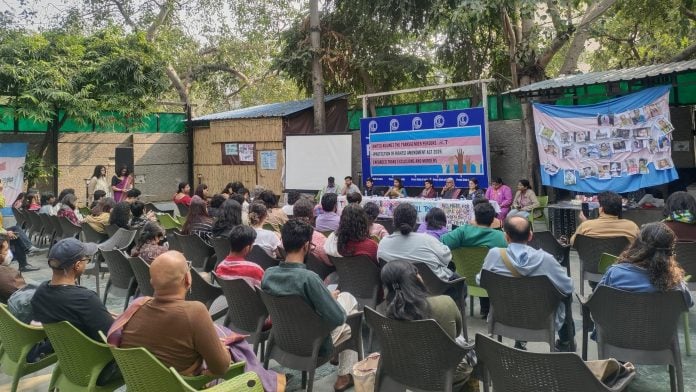
New Delhi: A courtyard listened in silence as 11 hijra and thirunangai women talked about their dead friends. The audio clip played at the Press Club of India was a string of sobs and anguish.
One of the transgender women in the clip, a thirunangai, described preparing her friend’s body for the last rites. Writer-activist Katyayani Saksham read out an English translation of the original Tamil to the 50-odd people gathered at the club on Sunday.
“According to our customs, we dressed her in a sari, applied turmeric and sandalwood, put kumkum on her forehead, decorated her with flowers, and dressed her up beautifully,” Saksham read aloud, her voice shaking.
But the woman’s parents refused to grant her agency even in death.
“They cleared everything off and dressed her in a veshti, a white shawl, and all those things, the way they would dress a boy. We couldn’t even bear to watch… As time passes, we keep asking ourselves, ‘Is this what awaits us too?’” Saksham read from the woman’s account of her friend’s ordeal.
Other stories recounted instances of cruelty by family members, moments of tenderness between friends, and the dashed hopes of seven lives. One woman imagined her friend as a successful writer; another saw her companion as a theatre actor. One woman, who lives with schizophrenia, said she still meets her dead friend from time to time.
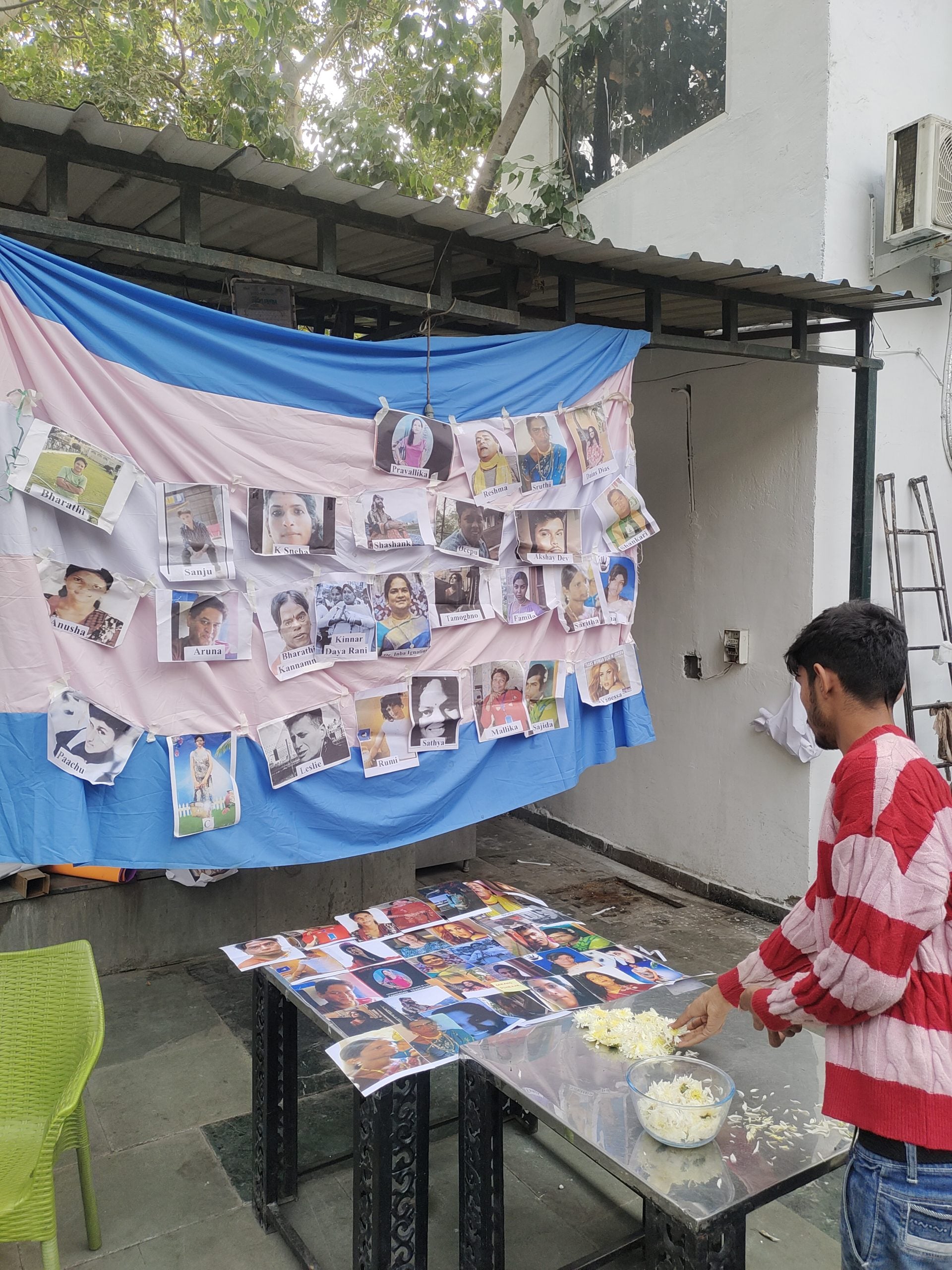
At the Transgender Day of Remembrance (TDOR) memorial and press conference on 22 November, community members said the day not only honoured trans people who had died but also raised questions about the lives of those still living.
“How can trans people live a life of dignity? If all the means of life—the way that we exist, celebrate, reproduce—if all of that is barricaded, when the State aggressively cracks down upon any possibility of life, then how is death not imminent?” asked Krishanu, who coordinated the event.
The panel included advocate Raghavi Shukla; Manjit Rathi, a member of the All India Democratic Women’s Association (AIDWA); Annie Raja, a member of the Communist Party of India and the National Federation of Indian Women (NFIW); activist Anjali Bhardwaj; and PhD research scholar Pratyay Malakar. Community members Gautam and Sarvagya were also part of the discussion.
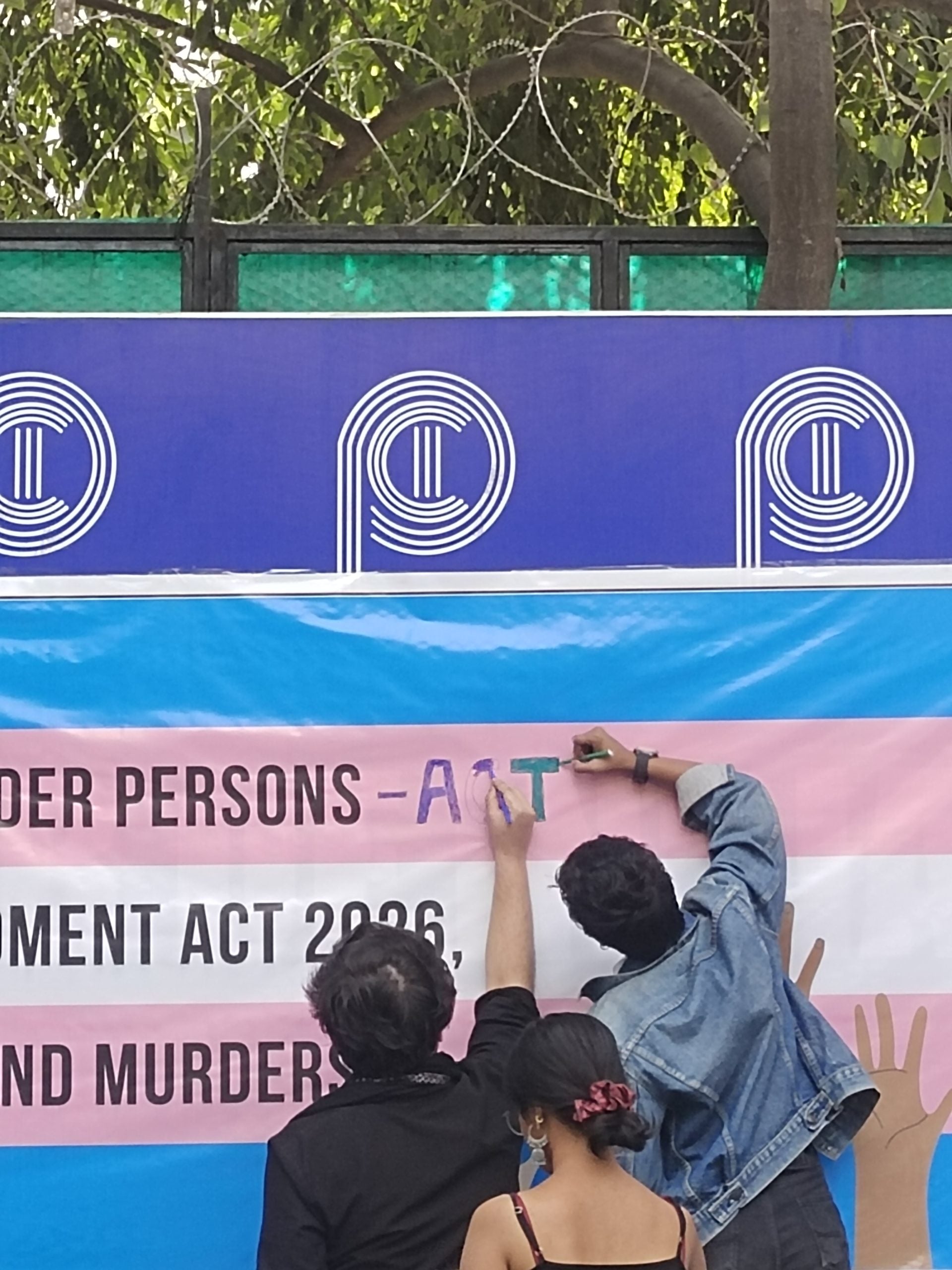
The Transgender Amendment Act, passed in March 2026, has been widely criticised by members of the community for rolling back the right to self-identification, narrowing the legal definition of ‘transgender’ to socio-cultural identities such as hijra, kinnar and jogta, and increasing State and medical scrutiny.
The erasure of trans men and trans voters
Last week, an analysis published in The Wire found that the Special Intensive Revision (SIR) had disproportionately affected transgender voters.
“Across the 12 states and union territories examined, registered transgender electors declined by approximately 30.84%, compared to an overall decline of 11.92%. The decline for transgender electors was more than 2.5 times the overall rate,” read the article by Vaivab Das, a PhD scholar at IIT Delhi. The findings featured prominently in Sunday’s discussion.
Bhardwaj, who works on issues related to the SIR, described the exercise as a ‘crisis of documentation’ that robbed citizens of political equality.
“The numbers clarify that the exercise is more exclusionary the more marginalised you are. That’s the crushing of your vote, your voice,” she said.
Krishanu connected these findings with the Transgender Amendment Act.
“Interestingly, intergenerational trans communities such as hijra gharanas have been kept inside the Trans Act, but have been very conveniently removed through SIR,” she said.
Together, the two mechanisms were seen as further reducing the already limited political power of transgender people. Gautam added that the Act had “deleted” the identity of trans men.
“After 2014, transmasculine people had begun to gather courage. Patriarchy plays a big role here—you’re born as a girl, you’re always suppressed—but after the amendment of 2026, so many people have called me, asking what they were going to do with their lives,” he said.
He compared the government to Thanos, the antagonist in the Avengers films.
“You are erasing people. At least Thanos killed 50 per cent of the population entirely; you’re telling living people they don’t exist,” he said.
The deeper plight of Indian trans men, he added, was the absence of data on the harm they face. While violence against trans feminine persons is at least acknowledged, violence against trans men is documented only in scattered accounts of “forced confinement, forced marriages, and corrective rape”.
Trans rights and the feminist movement
The organisers chose to hold a press conference this year, instead of the more sombre vigil usually held on TDOR, to protest against the Act, highlight the exclusion of trans voters during the SIR, and challenge a recent petition in the Supreme Court seeking a reconsideration of the landmark NALSA judgment. Beleaguered by the State and anti-trans forces, one of the organisers said, the community was being forced to show its tears to the camera.
Last month, the India chapter of Women’s Declaration International (WDI), a UK-based organisation, filed a Public Interest Litigation (PIL) in the Supreme Court challenging the Trans Act. But the petition did not argue that the legislation had taken away rights from trans people. Instead, it contended that the Act, even after the recent amendment, conferred too many rights on them.
Shukla offered a chronology of events, arguing that the petition had been misrepresented in media reports as seeking greater rights for ‘biological women’.
“WDI registered themselves in India only a few days before filing the petition. They haven’t done any work in India; they just registered themselves for this petition,” Raghavi said.
She argued that expanding the ambit of the law to include trans women would offer them greater protection without infringing on the rights of cis women, contrary to what the PIL claims.
“If you look at that petition, it only talks about snatching rights. It’s an evil petition. Just look at their prayers… They ask that laws like the Domestic Violence Act should not be applied on trans women,” Shukla said.
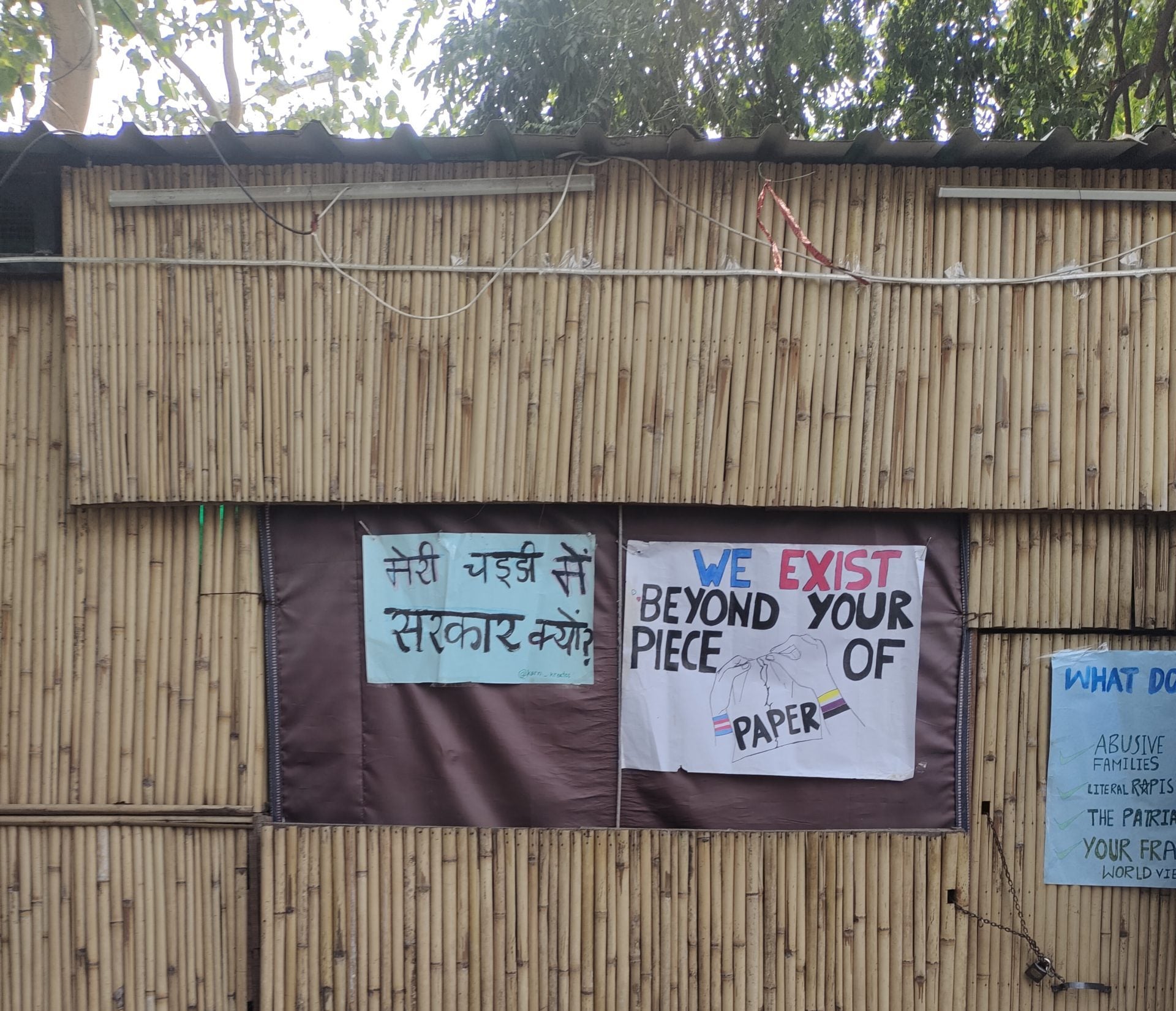
Rathi, an English professor and AIDWA representative at the event, criticised WDI’s position as an instance of biological essentialism.
“The women’s movement holds that not only is there no conflict between the trans struggle and the feminist one, but that we both strengthen each other,” she added.
She said diversity was a cornerstone of the women’s movement.
“If we ignore gender identity, we cannot fight against patriarchy, against orthodoxy, or the subordination of women,” Rathi said.
(Edited by Prashant Dixit)