







New Delhi: When conservationist and author Neha Sinha took some of her friends birdwatching in Mangar Bani, Haryana, they saw a looming mountain in the distance and paused in admiration of what they assumed was a part of the ancient Aravallis. But it was not a hill. They were staring at the Bandhwari garbage landfill.
“That, in a nutshell, shows us how dispensable these extremely precious places still can be for our planning processes. We look at nature as something we can afford to look away from,” said Sinha addressing a thin crowd of about 50 people at the India International Centre. They had gathered on a Monday evening to discuss Mangar Bani, a forest and archeological landscape nestled in the ancient Aravalli hills along the Delhi-Haryana border.
“But a place like Mangar is cursed by its proximity to Delhi,” said Sinha.
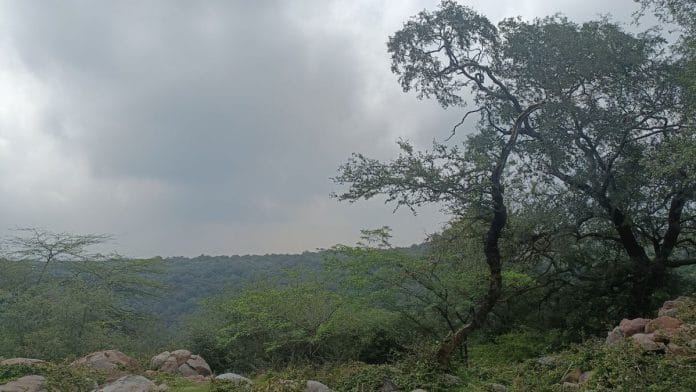
Mangar Bani’s rocky hills and ancient dhau trees fall along the Central Asian Flyway, welcoming hundreds of migratory birds every year. It is also home to several prehistoric remains such as rock art and petroglyphs. For centuries, the local communities considered the forest sacred. The legend says that Gudraiyadas Baba meditated for 500 years in a cave in that forest and attained enlightenment.
Yet, over the past few decades, Mangar’s survival has been threatened by Delhi-NCR’s appetite.
“Illegal mining, encroachment and dumping are breaking this continuous forest into fragments. The area is not covered by any notification. It still has no official protected status,” said Sunil Harsana, researcher, conservationist, and the evening’s main speaker. He is also a resident of Mangar village.
Harsana began as an activist to oppose mining, encroachment, and the expanding real-estate demand. But eventually, his work evolved into documenting the ecology of Mangar. His team conducted surveys, set up camera traps, and found that Mangar was far more than just a green patch in the Aravallis.
“We have seen over 20 mammals—leopards, striped hyenas, nilgai, the rusty spotted cat, and recently even the Asiatic wildcat,” said Harsana. His presentation on the screen highlighted that leopards and hyenas travelled freely within over 80 per cent of the forest.
Also read: An accidental discovery can change the course of Bihar’s Rs 3,000 crore makhana industry
Conservation challenges
As Harsana played videos of interviews with local communities, he let the audience glimpse the complex relationship between villagers and the wildlife that surrounded them. In one of the interviews, a villager said, “If these animals don’t live in the forest, where will they stay? Have you ever seen animals living in a village?”
Yet, despite its ecological value, the government has offered no official protection to the forest. Nearly 90 per cent of the area has suffered the consequences of mining. There is no redemption in the fact that abandoned quarries have turned into lakes.
Parts of Mangar are not included in forest notifications, allowing debates about what actually is a forest, who the land really belongs to, and what kind of development can be done there. This challenge is not unique to Mangar.
“Cities are not going to go away. But how do we make our cities livable? Just adding parks and green gardens in cities is not enough. We need spaces where nature can grow without human interference,” said former civil servant and nature enthusiast Amit Yadav. He highlighted that natural resources like land, forests, water systems were the lifelines of cities.
As the speakers opened the floor for questions, several audience members stepped toward the mic. Most of them belonged to an older generation that had seen the transformation of Delhi into the polluted metropolis it has become today. They asked why Mangar had not received stronger legal protection. They questioned whether economic policies and financial incentives could help conservation.
As Sinha, Harsana, and Yadav responded, they painted a picture of how challenging conservation really is.
“The laws exist. The challenge is in implementing them and ensuring that these landscapes are properly identified and protected,” said Yadav.
Sinha argued that ecological taxes could never match the value of a forest. She said that no amount of compensation could make up for the lakes that have dried up, for the trees that have been chopped, the farmhouses that have encroached upon the land, for the way a forest has been “commodified and commercialised”.
“Mangar shows us what is possible if we protect the Aravallis. And unless we aggressively begin to see this as wealth and not just mining and farmhouses, there’s no way out for us.”
(Edited by Aamaan Alam Khan)