





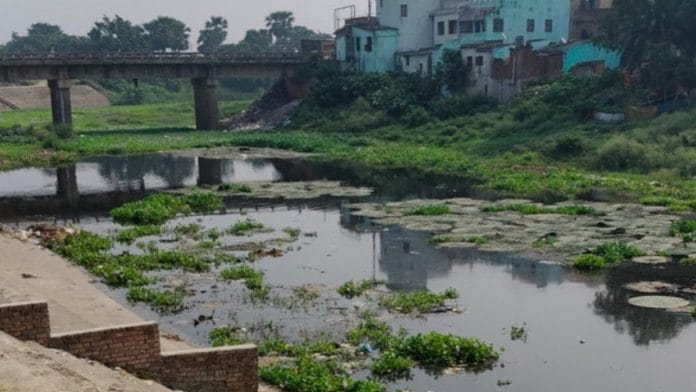

New Delhi: For years, Bihar’s makhana scientists have wrestled to increase the area under cultivation. The crop remains confined to 35,000 hectares. Now, an accidental discovery along a derelict stretch of the Kamla river in Darbhanga has opened an unusual catchment for cultivation.
In the first week of June, Darbhanga-based professor Vidyanath Jha, a pioneer makhana researcher, first noticed patches of naturally-growing prickly water lily in the impounded waters in the Kamla river at Gausa Ghat in Darbhanga, where the Bihar government’s Water Resources Department is constructing a check dam. Makhana is the seed of the plant.
The crop can’t survive in flowing rivers, but the dam changed the conditions.
“This is the first time we have noticed naturally-growing makhana in the stagnant waters of a river system. The check dam has unintentionally created conditions suitable for makhana cultivation. It has shown us that abandoned river channels can potentially be used for growing the crop,” said Jha, considered one of Bihar’s foremost makhana experts and author of the 2003 book Makhana.
Bihar’s rivers, especially in the Mithila region, are notorious for changing their courses over centuries. As rivers shifted, they left behind dozens of abandoned channels that carry flowing water only during the monsoon and remain stagnant for much of the year.
This vast network of abandoned river channels and waterlogged stretches could now help break the crop’s long-standing acreage ceiling and advance the state’s ambitious plan to more than double the acreage to over 70,000 hectares and generate five lakh jobs in the next five years.
The Kamla river alone has around a dozen such channels, according to Jha. Eleven of them are effectively dead courses, holding shallow pools of water outside the monsoon season.
“These channels generally have low and stagnant water levels, conditions ideal for makhana cultivation. What we saw at Gausa Ghat is evidence that these forgotten river stretches can be brought into productive use,” said Jha.
The discovery comes at a crucial moment for Bihar’s Rs 3,000-crore makhana industry. Despite the crop’s growing popularity and rising exports, expansion has stalled. Between 2022 and 2025, the area under cultivation remained almost unchanged.
Scientists at Darbhanga’s Makhana Research Centre (MRC) say the abandoned river channels could provide exactly the kind of land the industry needs.
“If water remains available during the crop’s growing period and the depth is more than two feet, makhana can be cultivated. These stagnant river stretches present a major opportunity. They can help increase the cultivation area and provide additional income to farmers,” said Indu Shekhar Singh, head and principal scientist at the MRC.
Policymakers have looked at Bihar’s vast waterlogged landscape, estimated to be 9.12 lakh hectares, as an untapped resource. The Gausa Ghat experiment suggests that derelict river channels may be another overlooked asset.
However, the district administration is not aware of this development.
“We are not aware of this now. However, we are continuously working on expanding the cultivated area through government schemes such as giving subsidies to farmers. We will look into the Gausa Ghat incident,” said an official in the agriculture department in Darbhanga.
Also read: Bihar ready for new makhana millionaires. After GI tag, R&D and start-up boom
Beyond Bihar
The breakthrough emerged from a project that had nothing to do with agriculture.
The Water Resources Department initiated the check dam at Gausa Ghat primarily to retain water after the monsoon. But by slowing the river’s flow and creating a permanent pool of stagnant water, the structure ended up producing ideal conditions for the growth of prickly water lilies.
Experts now suggest similar interventions could be replicated across Mithila’s river systems.
“For decades, many of these channels have remained dry except during the monsoon. If check dams are built strategically to retain water, they can support makhana cultivation on a large scale,” said Jha.
The implications could extend beyond Bihar.
In this year’s Union Budget, the Narendra Modi government announced the formation of a National Makhana Board and 476 crore central sector scheme rolled out to promote the crop not only in Bihar but also in states such as Madhya Pradesh, Chhattisgarh, Manipur, Andhra Pradesh, Assam, West Bengal, Odisha, Jammu & Kashmir and Uttarakhand.
Jha said these states could draw lessons from Bihar’s accidental discovery.
“As demand for makhana grows, we need new ways to expand cultivation. The impounded waters of abandoned river channels may offer a solution that has been hiding in plain sight,” said Jha.
(Edited by Theres Sudeep)