



New Delhi: Gulabrai wielded enormous influence in 18th-century Marwar, becoming another jewel in the crown of Maharaja Vijay Singh. And so, according to court records, she was murdered by “society.” It may sound like a bit of an extreme reaction, but she was a concubine who rose up the ranks and became the Rajput king’s favourite.
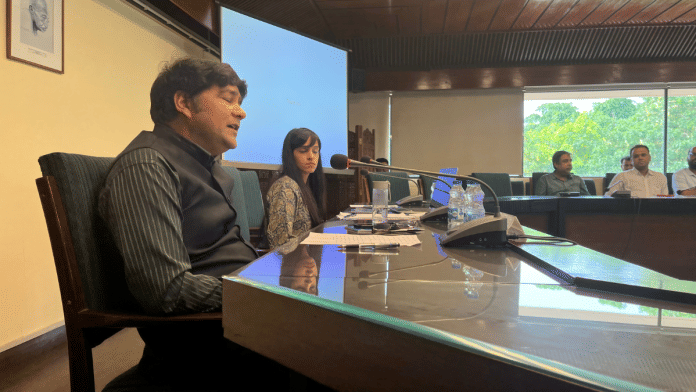
At a lecture aptly titled ‘Half-Wed Wives’ at Delhi’s Nehru Memorial Museum and Library (NMML) in July 2024, professor of history at GD Goenka University Priyanka Khanna opened doors to a world, which, despite being represented heavily in popular culture, is still unknown.
Khanna delved into the peculiar, contradictory role played by concubines in early-modern society. The women shared varying levels of intimacy with powerful rulers, had their children, advised their kings – but still, they were not queens. If looked through today’s prism, the stigma of the ‘other woman’ was their entire identity.
“Sex, service, and sentiment” was how Khanna described the lives of Marwar’s concubines.
“Their lives were marked by this personal relationship. They had regal appearances and simultaneously held status of elevation and subordination,” she said. “They had wife-like identities but ambiguity in their personal lives.”
Gulabrai, for one, was given privileges that mirrored those of a queen. She had a glorious estate, and her children were regarded as household progeny. Gulab Sagar, a lake and popular tourist destination in modern-day Jodhpur, is named after her. The benefits she received and the position she occupied in the eyes of Vijay Singh were too much to handle. This, in combination with her societally-prescribed ‘low status’, resulted in conflict with court officials.
Concubines were given different titles depending on the equation they shared with the ruler. Gulabrai was a paswan — essentially the highest grade of concubine. However, according to Khanna, there’s no word in historical records that is a direct translation and encompasses the role in its entirety.
Patal is commonly used, but it’s a wider term that also includes court performers — who belong to a different category. It’s also not a legal term and is used in more derogatory ways.
“We understand queens through marriage. But with concubines, there are words that are akin to concubinage, but don’t reflect what concubines are,” she said.
Also read: Personal is Political—Ex-IAS officer Aruna Roy wants to provoke conversations with her memoir
Half-wives, native alienation
Even their deaths were low-status. Self-immolation of queens was seen as the ultimate sacrifice, with sati understood to be an act of exaltation. With concubines, many of whom also self-immolated, the societal response was far milder. Their cremations took place away from compounds, and Khanna described them as being “cost-effective”; a far cry from the elaborate ceremonies and rituals conducted for queens.
“Native alienation was an integral aspect of their lives,” said Khanna.
However, if they chose not to end their lives, they had the option of remaining within the zanana, the jagir that was given to them, or the local palace — depending on their status.
The discussion descended into a series of questions, and several audience members were curious about the social and cultural status that was passed on by concubines.
The question “what came of their children?” echoed through the room.
While no child of a concubine could inherit the throne, there was still a spectrum of potential privileges. Certain children were married to queens of Jaipur, while other members of the community received benefits through education — and were able to escape the stigma.
The Ravana-Rajputs, a subsection of Rajputs, largely consist of the progeny of concubines. Initially, when the British first arrived, they faced difficulties in discerning their caste backgrounds. Genealogists were brought in, and then they began to be regarded as a separate caste.
Since then, the community has faced a great deal of caste discrimination, despite being “culturally similar” to the Rajputs. They’ve struggled since the early 19th century for a concrete identity, rights, and benefits befitting of their royal lineage.
The Ravana-Rajputs are worlds away from their previous avatars. But even then, there were limitations to how far they could go, including in the case of beloved Gulabrai. There’s no evidence to suggest that Vijay Singh wanted to make her queen. She was, after all, a half-wife.
(Edited by Humra Laeeq)