


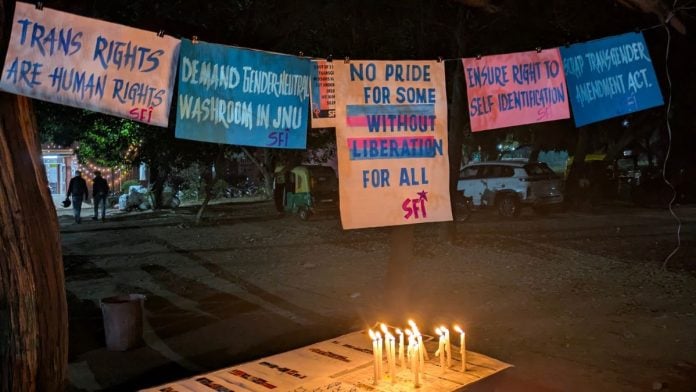
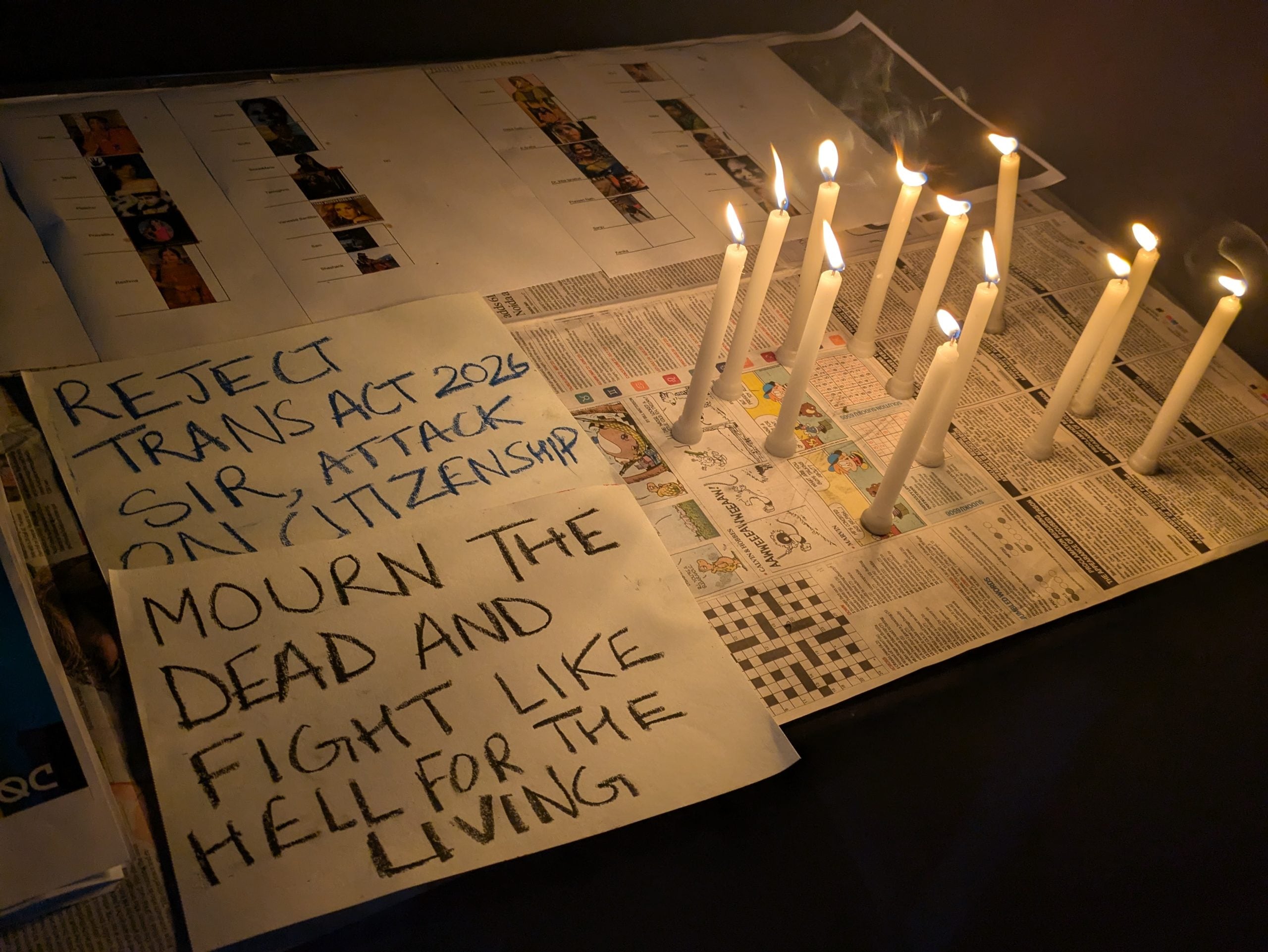
New Delhi: Transgender Day of Remembrance was marked with candlelight vigils across Delhi’s campuses on and around 20 November, as students and activists protested the recently enacted Trans Amendment Act.
Vigils were held at Delhi University’s (DU) Arts Faculty, the Karampura and Kashmere Gate campuses of Dr B.R. Ambedkar University (AUD), Jamia Millia Islamia (JMI) and Jawaharlal Nehru University (JNU). Across the campuses, students spoke of grief, their anger, and the collective action needed to safeguard trans and queer rights.
At one of the JNU vigils, Utsa Kar, a member of the Students’ Federation of India (SFI)’s JNU unit, said the day had arrived at a moment of “acute threat”. The Trans Amendment Act, she said, “directly attacks the hard-won gains of the transgender community” and strikes at bodily autonomy by changing the definition of who qualifies as a transgender under the law, on medical and legal grounds.
She cited official data to argue that the struggles and experiences of the community remain largely invisible in government records. Referring to the 2022 National Crime Records Bureau report, she said only five cases of kidnapping and abduction of trans people had been reported, while just 236 cases of violence against the community had been recorded overall.
“These numbers are not supposed to reassure us,” she said. “It is the systematic erasure of the community from the official data sources.”
She also cited a report showing a 30.84 per cent reduction in transgender voters in the Special Intensive Revision (SIR) of electoral rolls.
She pointed out that although more than 4.87 lakh transgender people exist in India, only around 10,000 hold the cards needed to access social security benefits.
Mehina Fathima, a Delhi University student who attended the vigil, said turnout for Transgender Day of Remembrance (TDOR) had long lagged behind that at pride marches, calling it “a depoliticisation within the community itself”.
Exclusion in universities
20 November is observed as TDOR to remember transgender and gender-diverse people killed by anti-trans violence across the world. The observance began in 1999, when activist Gwendolyn Ann Smith organised a vigil for Rita Hester, a transgender woman murdered in Massachusetts the previous year. It has since grown into a global day of mourning and political assertion.
Fathima said TDOR vigils were once held only at Jantar Mantar, but queer rights activists and collectives had gradually brought them into university campuses. Holding vigils in these spaces, she argued, also forces educational institutions to question their own record of inclusion and exclusion.
“How many transgender students are able to take admission in this campus?” she asked, pointing to the absence of horizontal reservation for transgender students at JNU, a demand she said the community has made for nearly a decade. Even after multiple high courts backed the demand, she noted, the universities have not yet taken it into consideration.
She also condemned the 2026 Trans Amendment Act.
“It is not just an amendment that inconveniences a community,” she said. “It is an amendment that is a death sentence.”
Also read: We’re seen as gods, but we don’t get jobs, says trans activist at Delhi film screening
‘Trans issues don’t exist in isolation’
Ash, who joined the vigil at JNU, noted that the amendment act’s criminalising provision was the “most immediate threat,” even more so than the changes to self-identification. Shelter, mutual aid and community care, Ash said, would all be affected if helping someone transition became a crime.
Ash also described the harassment, stalking, threats and surveillance queer students face on campuses, regardless of how progressive an institution claims to be.
“Trans issues don’t exist in isolation, and everything is a queer issue because we don’t exist in a void,” Ash said.
Ash also disagreed with the language of martyrdom towards the trans and queer lives lost, insisting that the people being mourned had had “lives that were taken away from them by violences of different kind.”
Recalling his friend, Sam, a trans-masculine person who was a 20-year-old psychology student at DU, Ash spoke about his death by suicide in 2022. He called it an “institutional murder”.
“Don’t remember or care about trans people after they’re dead. Care about them when they are alive,” Ash said.
Ash ended the address by reading two of Sam’s poems, bringing the vigil back to the lives and voices it had gathered to remember.
(Edited by Maryam Hassan)