





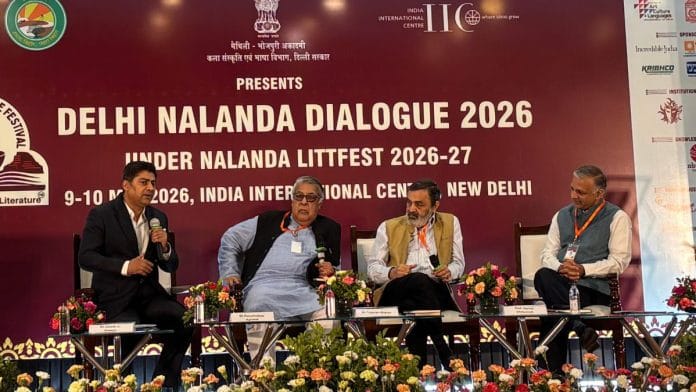


New Delhi: The Delhi-Nalanda Dialogue 2026 opened with a proactive question on Friday: Can the 800-year-old glory of Nalanda be revived again in the 21st century?
Day 1 of the Dialogue, organised as part of the Nalanda Literature Festival 2026-27 at Delhi’s India International Centre, was intellectually charged. And the first panel discussion delved into how the ancient university’s heritage continues to shape modern civilisation, cultural diplomacy and how its philosophy offers solutions to contemporary global challenges.
Nalanda was known for the tradition of shastraarth—the rigorous practice of structured debate and philosophical inquiry. It served as the primary gateway to the “age of knowledge”, ensuring that wisdom was not merely inherited but tested and refined through exchange.
“The idea, which is extremely important in today’s times, is to bring back this dialogue of shastraarth. This is the key solution to restoring Nalanda,” the Vice Chancellor of Nalanda, professor Sachin Chaturvedi, said.
He was joined on the panel by IAS officer Tripurari Sharan and writer Purushottam Agrawal. Titled ‘Governance and the Civilisation Wisdom’, the discussion was moderated by Gaurav Sawant, senior executive editor, India TV.
According to the panellists, Nalanda’s culture of rigorous engagement remains relevant in an age marked by polarisation and shrinking spaces for disagreement.
For Chaturvedi, Nalanda’s place in India’s future is not just one of historical memory, but as a blueprint for a modern intellectual renaissance.
“In the next 10 years, we have to decolonise the minds, so as we reach 2035, we need to get out of what Macaulay created,” he added, echoing Prime Minister Narendra Modi’s words.
According to Sharan, Nalanda offers an ideal for a healthy exchange of ideas.
“Nalanda’s power lay in persuasion, not dominance—it created a space where ideas competed without hostility and dialogue replaced hierarchy,” said Sharan.
Also read: Satyajit Ray beyond the visionary. Photo exhibition shows the labour behind iconic frames
‘Soft power can’t substitute the thing itself’
Another panel, which featured former IAS officer Sanjeev Chopra, writer Varsha Das and IFS officer Anju Ranjan, explored how literature, language and the arts function as instruments of cultural diplomacy. Titled ‘Culture, Diplomacy and India’s Soft Power’, it was moderated by IRS officer Ritu Sharma.
For Chopra, Bollywood is a key tool of cultural diplomacy for India.
“Much greater contributions have been made by Bollywood, by the Chopras and the Khans, than anybody else,” Chopra said.
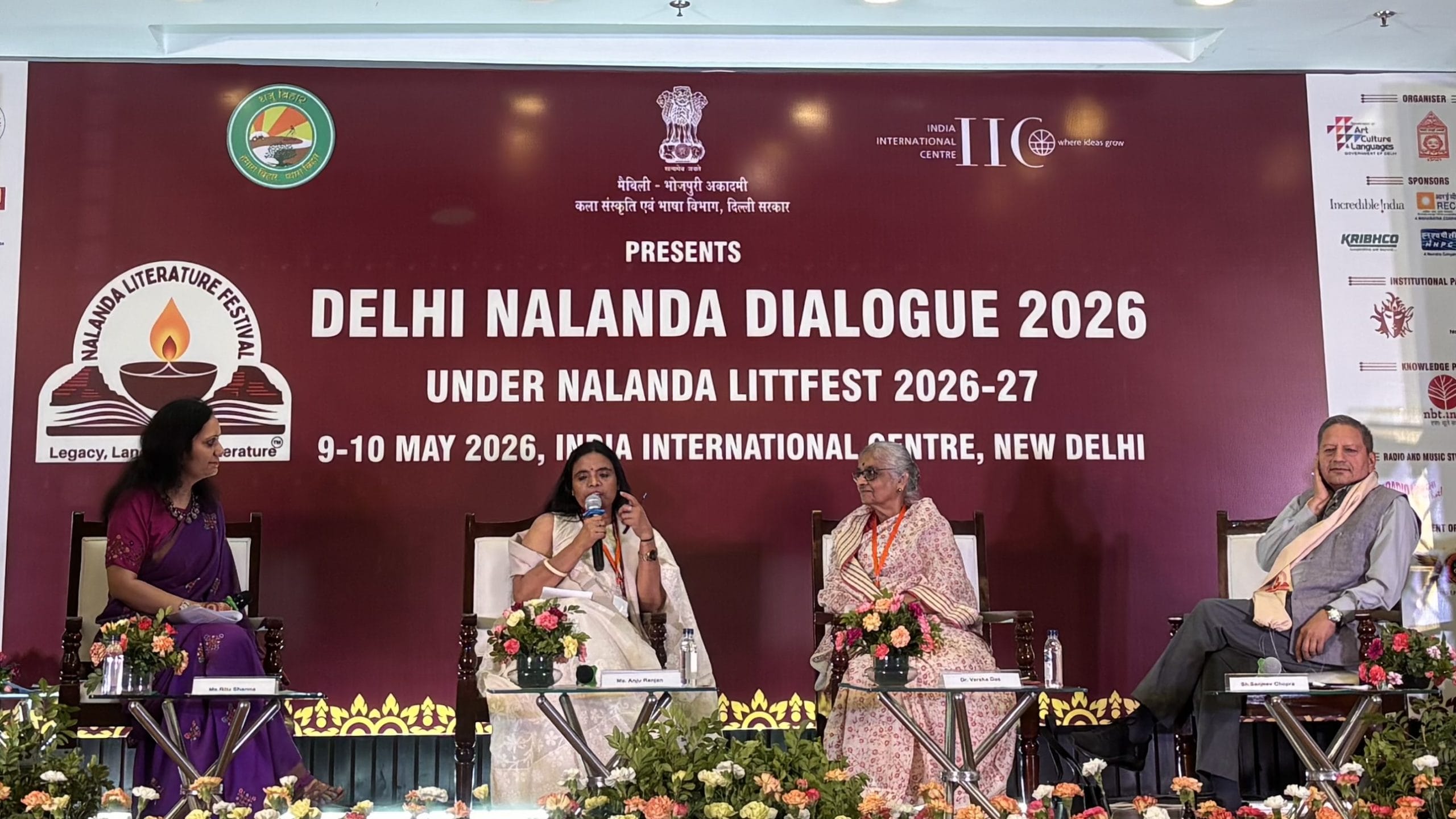
Along with Bollywood, OTT content, yoga, and regional languages also play an important role in reflecting India’s cultural presence.
“India’s strength lies not in uniformity but in its plurality. Our languages are not barriers but bridges that carry layered identities,” she said.
Chopra views the power of language differently. According to him, languages remain a key cultural asset, but expecting them to translate into a global power is just an “idealistic proposition”.
“Soft power means that, along with other powers, you must have this power also. But it is not a substitute for power itself,” he said, adding that real influence is rooted in economic and military strength. Cultural power can eventually emerge from them.
As the discussion drew to a close, an audience member posed a question in Bhojpuri.
“What is the administration doing to bring back the languages of Pali and Prakrit, which were used proficiently in Nalanda?” said Rakesh Kumar, assistant professor at Shyam Lal College, adding that he wanted an answer only in Maithili or Bhojpuri.
Festival Director Ganga Kumar chose to answer in a mix of both languages.
“Never let any language—be it Prakrit, Pali, or your mother tongue—remain just a dialect within four walls. Speak it with pride at home and present it to the world with knowledge and confidence, and then it will be recognised.”
(Edited by Prasanna Bachchhav)