







New Delhi: A thousand years after it was first composed, the Shahnameh or “The Book of Kings” refuses to sit on the shelf. In Iran today, its verses are recited in homes, invoked in protest slogans, echoed in political speeches, and turned to in moments of crisis and uncertainty. Across centuries and shifting empires, the work of poet Abul-Qasim Ferdowsi has continued to shape how people understand courage, morality, and nationhood.
“Even today, when they are facing war, they are studying Shahnameh, and Shahnameh is providing material to them to cope with such circumstances,” said Sharif Husain Qasemi, former Dean of the Faculty of Arts, University of Delhi. Recalling a recent protest he had seen online, he described an Iranian woman carrying a placard bearing a verse from the epic: “If we have to sacrifice ourselves for our country, it is better than surrendering the country to any enemy.”
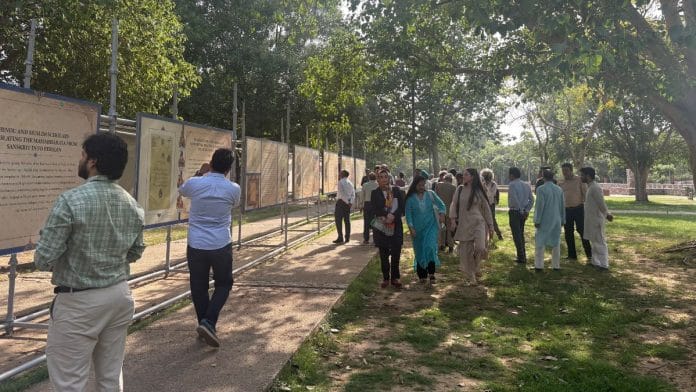
The evening began with a walkthrough of the exhibition Shared Epic World at the Garden Amphitheatre in Sunder Nursery, where manuscripts, paintings and visual interpretations from Ferdowsi’s Shahnameh traced centuries of Indo-Persian cultural exchange. The event, organised jointly by the Aga Khan Trust for Culture, the Noor International Microfilm Centre and the Iran Culture House in New Delhi, brought together diplomats, scholars, historians, and literary figures to reflect on the relevance of the Persian epic.
Among the speakers were Fathali, Ambassador of Iran, Fariduddin Farid Asr, Cultural Counsellor of Iran, Ratish Nanda, India CEO of the Aga Khan Trust for Culture, Syed Akhtar Hussain of the School of Language, Literature and Culture Studies at Jawaharlal Nehru University, SM Azizuddin Husain, former Head of the Department of History at Jamia Millia Islamia; writer and journalist Nasira Sharma, Shahab Khajeh Piri, Deputy Director of the Noor International Microfilm Centre, and Qasemi.
They all explored how the Persian epic has travelled across empires, languages, and centuries, shaping political thought, inspiring resistance, influencing Mughal India and continues to inform moral debates in contemporary society. Repeatedly, the discussion returned to one conclusion: the Shahnameh as a civilisational bridge between Iran and India.
Farid Asr argued that the epic survives because its questions are timeless rather than historical.
“These texts are not from the time of Ferdowsi himself,” he said. “These texts are universal. These texts are not limited to a particular region or a particular nation.”
He pointed to the story of Siyavash, the morally upright prince torn between political necessity and ethical duty, as an example of why the epic remains deeply contemporary.
“When two things are in front of us, one is our personal interest and the other is our moral duty, then who should we choose between the two? Even today, we get such guidance from this story,” Farid Asr said.
Between myth and morality
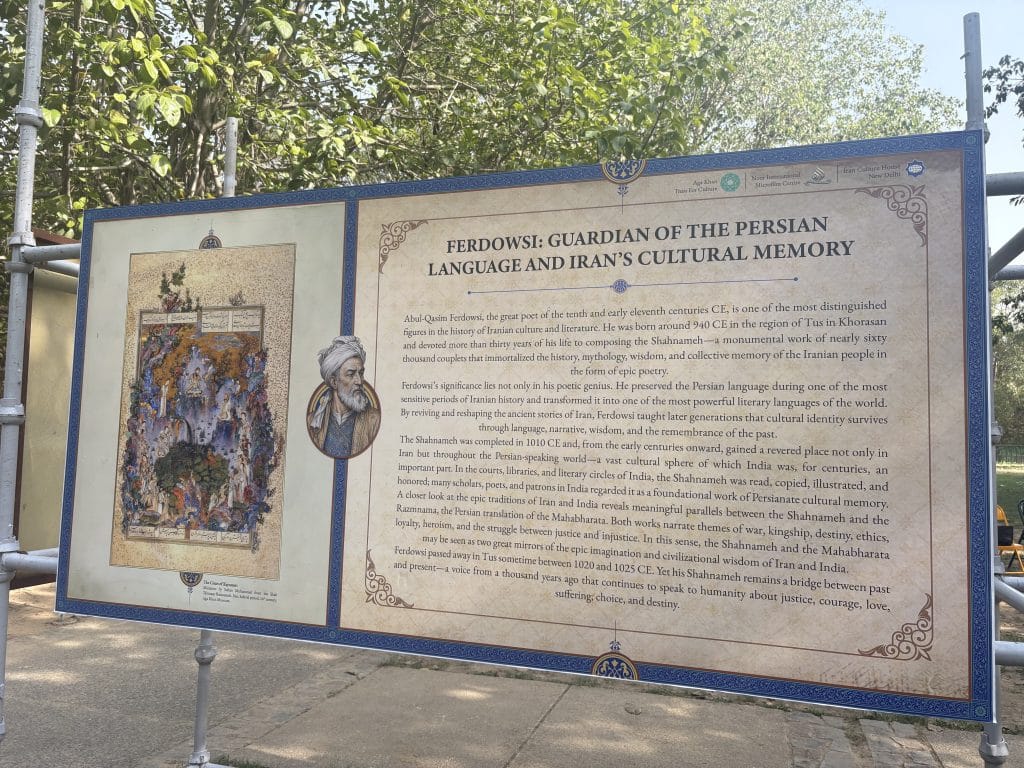
A thousand years ago, in the ancient city of Tus, Ferdowsi devoted his life to preserving the soul of Iran. For more than thirty years, he worked on the Shahnameh, an immense epic of kings, warriors, love, betrayal, and destiny.
At a time when Persian culture was under pressure due to the Muslim-Arab invasion, Ferdowsi transformed the Persian language into a timeless vessel of memory. Through nearly sixty thousand verses, he revived ancient legends and taught generations that a civilisation survives through its stories.
Centuries later, Shahnameh reached Mughal India. In the court of Emperor Akbar at Fatehpur Sikri, scholars from different faiths gathered in the famous Maktab Khana, the ‘House of Translation.’ Hindu pandits and Muslim scholars sat side by side, translating the Mahabharata into Persian as the Razmnama. Persian painters illustrated Indian epics, while Indian artists brought Iranian legends to life in Mughal manuscripts.
Among the greatest heroes of these traditions were Rustam and Arjuna. Both were unmatched warriors bound by duty and fate. Rustom crossed seven deadly trials to rescue his kin from demons, while Arjuna journeys across kingdoms guarding the sacred horse of the Ashvamedha ritual.
The epics also shared stories of heartbreak. Fathali argued that the emotional power of the epic lies precisely in its tragedies, especially in the moment when Rustam, the greatest Persian hero and the father of Sohrab, unknowingly kills his own son in battle. Rustam desperately sought the magical healing elixir Nush-Daru to save his son—but the king refused, and Sohrab died in his father’s arms. In the Mahabharata, Arjuna too faced his son in battle, yet there the miraculous Sanjivani herb restored life, turning tragedy into redemption.
“Imagine the story without that tragedy,” Fathali said. “Without the death of the son at the hands of the father, the story would appear insipid, boring, prosaic, and linear. The genius of Ferdowsi is that he introduces tragedy into the story, and that makes it unforgettable.”
Husain pointed out that the tragedy could easily have been avoided. Several characters in the story knew enough to reveal the truth before the fatal duel took place. Sohrab’s maternal uncle could have identified Rustam as his father, while Hujir, an Iranian warrior who hides Rustam’s identity from Sohrab when captured—deliberately concealed Rustam’s identity when asked to identify the Iranian heroes.
“But tragedy in literature is a sterling quality. We celebrate the Shahnameh because of these tragedies, even though we do not celebrate tragedy in our own lives,” he said.
Also read: ‘We are past Emergency stage’. Indira Jaising says Constitution faces an invisible threat
Epic beyond borders
Shahnameh has an extraordinary afterlife outside Iran, particularly in India, where Persians once flourished as a courtly and intellectual language. Speakers underlined how deeply the epic entered the cultural bloodstream of the subcontinent.
Husain recalled discovering nearly 200 manuscripts of the Shahnameh in India while preparing a descriptive catalogue of the text.
“Some of them are illustrated, and some are not illustrated,” he said. “This number of manuscripts shows that Shahnameh is popular in India.”
He especially mentioned Professor Hafiz Mahmood Khan Shirani of Punjab University Lahore, praising him for his pioneering research on how Ferdowsi composed the Shahnameh.
“He was the first scholar of Persian who told the Iranians which portion of Shahnameh was composed first by Ferdowsi,” Husain said.
Another recurring theme in the discussion was the Mughal fascination with Persian epic culture. Piri described the exhibition’s manuscripts bearing the seals of emperors such as Babur, Humayun, and Shah Jahan as historical witnesses to the Indo-Persian world that once flourished across royal courts and libraries.
He drew parallels between the Shahnameh and the Mahabharata, and framed them as two epics wrestling with similar human dilemmas.
“The Shahnameh and the Mahabharata belong to different civilisations, yet they share many deep concerns,” Piri said. “These include kinship, destiny, moral duty, war, justice, and the tragedy of the human soul.”
He also pointed to symbolic parallels between the Simurgh–the wise and protective mythical bird of Persian tradition–and Garuda, the powerful divine bird from Indian mythology, saying that “the imagination of Iran and India often speaks in a similar symbolic language.”
Reflecting on Humayun’s exile in Iran after being comprehensively defeated by the Afghan ruler Sher Shah Suri in two battles—Chausa (1539) and Kannauj (1540)—which caused him to lose control of his empire in northern India. He turned to the Safavid court in Iran, ruled by Shah Tahmasp I, who granted him asylum and later provided military support. This backing was crucial for Humayun’s eventual return to India and the recapture of Delhi in 1555.
Nanda described tracing the Mughal emperor’s journey across Iranian cities.
“There is a lot of cross-fertilisation of architectural ideas,” he said, pointing to ceramics, manuscripts and royal patronage.
“He received immense support before travelling across the country, visiting cities such as Shiraz, Kashan and Mashhad. That journey led to a remarkable exchange of architectural ideas, including the use of ceramic tiles,” Nanda said. “We are especially grateful to the Noor Microfilm Centre for helping us reproduce important historical documents, including the farman issued by Shah Tahmasp to his governors on how Humayun should be received. The order stated that, between the two daily prayers, 1,200 dishes were to be served to him. Nothing addresses the issue of Humayun being called a refugee in India better than this. Because which refugee gets this status?”
(Edited by Saptak Datta)