



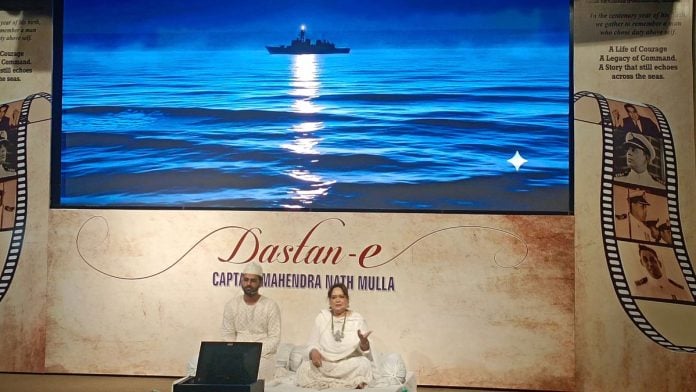
New Delhi: Stories of courage and sacrifice of those who serve in the armed forces often reach us through books, films, songs, photographs or the fading memories of those who knew them. But on Wednesday at the Manekshaw Centre Auditorium in Delhi, the story of an Indian naval officer found an unusual and evocative retelling through Dastangoi, the traditional Urdu-Persian art of oral storytelling.
For the first time, Dastangoi turned its gaze towards the life of a military officer with Dastan-e-Mahendra Nath Mulla, a performance centred on Captain Mahendra Nath Mulla, Maha Vir Chakra (Posthumous), the commanding officer of the Indian Navy warship INS Khukri during the Indo-Pakistani War of 1971.
At the centre of the white, cushion-lined stage, India’s first woman Dastango, Fouzia Dastango, sat in her signature white chikankari, with theatre artist Ritesh Yadav beside her. Together, they traced Captain Mulla’s journey from childhood to his final act of courage and sacrifice during the 1971 war, transforming the stage into an intimate mehfil where the story of a warship and its captain came alive.
In about forty minutes, an entire life was condensed into words, gestures, pauses and the musical rhythm of Urdu storytelling.
Before beginning the Dastan, Fouzia welcomed a packed auditorium of nearly 250 to 300 people, many of whom were friends and family of Captain Mulla, or serving and retired members of the Army and Navy. She started by discussing the form itself and what it meant to use it to tell the story of a soldier for the very first time.
“We have performed Dastan-e-Ram, Dastan-e-Mahabharat, Dastan-e-Meena Kumari, Dastan-e-Kabir and Dastan-e-Gurudutt. But today, and in the history of Dastangoi, for the first time, the story of a military officer is being told,” she said.
To compress an entire life of courage, duty and sacrifice into a performance, she added, was like “samandar ko kuze mein band karna” — trying to contain an ocean in a small vessel.
The story and narrative for the performance were written by Abbas Qamar. The production also incorporated audio-visual elements, including evocative renditions of Bollywood patriotic songs, created by Soumya Taneja and Yushraj Singh, adding another layer of emotion and resonance to the Dastan.
“The most difficult part of this performance was that we could not take any liberties with his story. We had to be extremely careful about what we included and what we left out. Condensing an entire life into a one-hour performance, while doing justice to every important moment, was the biggest challenge,” said Fouzia.
She added that the Dastan took more than three months to write, develop and prepare, making it the longest preparation period for any of her performances so far.
Beyond the Captain
The event was also a homecoming of sorts for a family whose personal memories have long lived alongside the larger national story of Captain Mulla.
In the welcome address, Mulla’s daughters, Dr. Ameeta Mulla Wattal and Anjali Mulla Kaul, spoke of him as a father, a family man and a human being beyond the medals, ranks and official histories.
For Dr. Ameeta Mulla Wattal, accepting that her father had passed away was almost impossible. She continued to hope that he would return, even years later.
“I never believed that my father had passed away and I was convinced that he would come back, perhaps when I was getting married, because I had seen a film in which a father returned to see his daughter married.
When Anjali Mulla Kaul took the microphone, the evening grew even more personal and emotional. She recalled playing Scrabble, chess and Snakes and Ladders with her father, and how he encouraged curiosity, learning and independent thinking. She also spoke of his love for books, his talent as a dancer and singer, and the warmth and joy he brought into their family life.
“My greatest privilege was that I knew the man behind the hero,” she said. “I knew a father whose greatest joy was spending time with his children.”
Also read: Amber Fort’s mural makeover — X-rays, UV light & Rs 2.32 cr to undo botched repairs
Tribute to who lived for the Nation
Dastan-e-Mahendra Nath Mulla begins with the story of a boy born in Gorakhpur in 1926 into a distinguished family of judges, lawyers, writers and poets, and journeys through his life to the fateful night of December 9, 1971, when Captain Mulla and the crew of INS Khukri were on patrol off the coast of Gujarat and the warship was struck by a torpedo fired by a Pakistani submarine.
As the ship began to sink, Mulla moved through the chaos, helping his men reach safety and giving his own life jacket to another officer. When it became clear that there was little more he could do, he refused to abandon the Khukri or the sailors under his command. He remained on the ship, taking his place in the captain’s chair as the vessel went down — choosing, in his final moments, to stay with his men.
Throughout the Dastan, several moments from his life were brought alive through specially created video and audio projections. They showed that Captain Mulla was not only a strict and disciplined commander, but also a warm colleague — someone who joked with his men, listened to them and helped them through their problems.
As the performance continued, on-screen graphics depicted footprints imprinted in the sand along the seashore, moving from the sandy shore towards the sea. The poignant visuals were accompanied by the soulful song “Ek Din Bik Jayega, Mati Ke Mol, Jag Mein Reh Jayega Pyare Tere Bol” from the 1975 film Dharam Karam.
The performance concluded with a poignant tribute to all those who have served in the Indian Armed Forces ending with the national anthem and the Indian flag on the screen.