



New Delhi: Prashant Chaudhary, 39, is using an unlikely combination of a student, a smartphone and Artificial Intelligence to bring software-building skills to rural India and challenge the idea that a child’s access to the digital economy should depend on the pin code they grow up in.
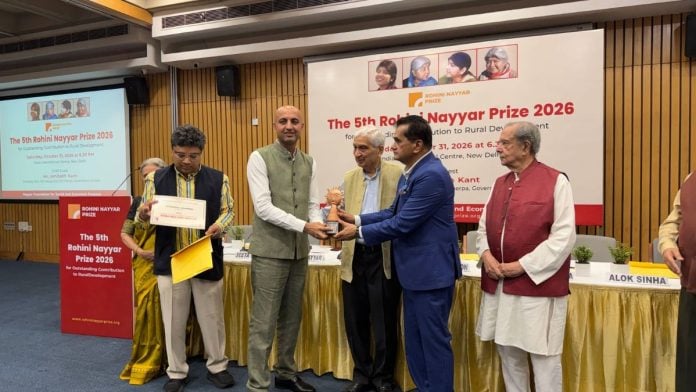
On Saturday, the founder of CodeYogi Foundation received the fifth Rohini Nayyar Prize for Outstanding Contribution to Rural Development for his work taking technology education beyond India’s conventional tech hubs.
Former NITI Aayog CEO Amitabh Kant presented the award to Chaudhary at the India International Centre with economists, policymakers and development practitioners in the audience.
“Our school students, who we don’t even expect to know how to use a computer, are pros at using code and Codex and building software with AI, and also use AI in other dimensions of their lives. We have always been looking at where the job opportunities are coming from, but now it is very tricky where the next set of jobs will be,” said Chaudhary.
Through CodeYogi, students learn coding and AI tools to develop software and solve practical problems. The model relies on smartphones and supports Indian languages. It reduces the need for computer laboratories and other infrastructure often missing in government schools.
Chaudhary described how the initiative had evolved alongside changes in technology. His team began preparing for a future in which AI tools would undertake much of the coding work, shifting its focus toward helping students use AI to build software.
“Whatever jobs will come in, AI fluency will be a basic requirement for that. And not just in jobs, even if you become a teacher or do anything, AI will be needed,” he added.
The next challenge, he added, would be to help young people become more adaptable and entrepreneurial as traditional job roles change.
“In this new world, which is changing extremely fast, one thing is that you have to be very agile,” Chaudhary said.
Prashant Chaudhary is an IIT Delhi alumnus and he was the first person from his village near Meerut to enter an IIT. He graduated in 2010. He began teaching coding in 2015 and scaled the initiative into CodeYogi. It was launched in 2020.
The computer laboratories proved a barrier for many students. The organisation shifted to a smartphone-based model that allows students to learn coding and AI in Indian languages without relying on computers or specialised labs.
By 2026, CodeYogi had reached more than 3.5 lakh students across nine states and 120 districts. The foundation was formally registered as a non-profit in 2025.
Also read: Who is NK Singh once the mask drops? An economist who loves Hindustani music
Rohini Nayyar’s legacy
Addressing the audience, Amitabh Kant said rural India could not be treated as a residual category in the country’s development story.
“The people who live in villages, farm its land, staff its schools and health centres, build its roads, care for its children and hold its panchayats together are not waiting at the edge of India’s future. They are making that future, often with limited resources and little public attention,” said Kant.
Rohini Nayyar devoted her life and work to rural poverty and translating the research into public policy. She served in the Planning Commission from 1987 to 2005, retiring as principal adviser for rural development.
“Dr Rohini Nayyar understood this long before it became fashionable to speak of last-mile delivery. Her research on district incomes, her work on backward areas and her faith in Panchayati Raj were all grounded in the same belief: people closest to the problem often understand it best,” said Kant.
The economist Deepak Nayyar, husband of Rohini Nayyar, said her understanding of poverty extended beyond conventional measures of income and economic growth.
“She believed that poverty was not simply about empty pockets; it was just as much about stomachs without food, minds without learning and lives without choices,” said Nayyar.
Rohini Nayyar’s work examined the connections between poverty, nutrition, landlessness, wages, women’s work and access to education and healthcare. She also helped shape India’s human development reporting and rural employment policy.
For her family, the prize is an attempt to carry that legacy forward by recognising people working with marginalised communities, often away from the public eye.
In his remarks, Rohini Nayyar’s son recalled her interest in young people and her ability to influence public policy without seeking the spotlight. He also spoke about her love for saris, including a collection of around 50 that has been donated to the Vimal Museum of Living Textiles in Bengaluru. An exhibition of the collection is planned in New Delhi in early 2027.
Kant, meanwhile, argued that rural development must move beyond welfare delivery toward creating local opportunities for production, innovation and enterprise. And that’s what Chaudhary has been working toward.
He called on bureaucrats, philanthropists and entrepreneurs to help take the model to more students, setting a target of reaching one million learners within nine months.
“There are a lot of bureaucrats who have seen our work and the impact, but now there is a sense of urgency. The world is moving very fast, and we need to keep pace with it. So it’s a call to action to the bureaucrats, to the philanthropists, to the entrepreneurs, social entrepreneurs, that we have a model that works,” said Chaudhary.
“Nair Foundation has done its due diligence before giving us this prize. You can do yours, but help us take it to the whole country.”
(Edited by Ratan Priya)