


New Delhi: It was December 1992. Photojournalist Prashant Panijar, then working with India Today, had been assigned to cover LK Advani. As Advani entered Ram Katha Kunj, roughly 100 metres from where the Ram Janmabhoomi temple now stands, a commotion erupted.
Journalists were attacked and their cameras smashed. But Panijar and his camera remained unscathed.
“Since I was at Ram Katha Kunj, covering Advani, who was giving speeches, they somehow thought I was with the VHP. That’s how I could photograph throughout,” Panijar said.
The photographs he took that winter have now found their way into his book, Ayodhya: Epicentre of a Divide. The book captures the transition of Ayodhya from the 1980s to 2026 through photographs. Over the years, Panjir visited Ayodhya and captured its ghats, akharas, Sufi shrines and Hanuman temples, as well as its barricades, barbed wire, laser shows and hoardings of the new temple town. The book also has an essay by journalist Valay Singh on how Ram became a political symbol.
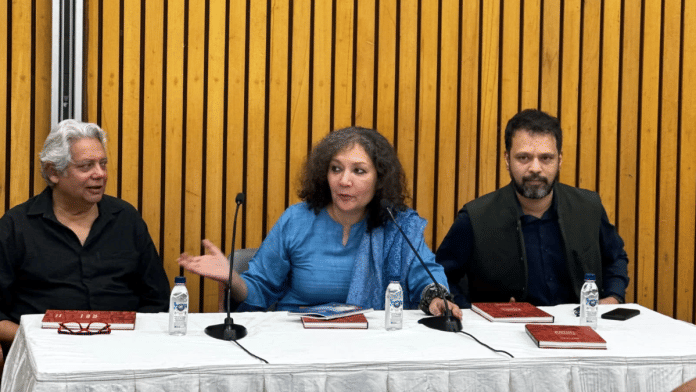
Journalists, historians and several others gathered at the India International Centre’s Kamala Devi Complex to hear Panjir and Singh speak on 1 November. Saba Naqvi moderated a panel discussion that followed.
“This book is a stunning account of contemporary Indian history. When I saw the photographs on my laptop, I was like, ‘wow’. In this age of AI, I was seeing beautiful old images, depicting the story of our country. It was beautiful to see what a masterful photographer can capture,” Naqvi said.
A shift in mood
The launch began with a presentation of black-and-white photographs of erstwhile Ayodhya. One shows men and women bowing before a shrine covered in flowers. Another captures devotees jostling to catch a glimpse of a deity inside a temple.
“Ayodhya was under siege even before the demolition in 1992; the barricading and security checks were stricter than in Kashmir,” said Ramavatar, a 65-year-old resident of the city, in the video.
Valay, who has been connected to Ayodhya since childhood, said the city’s atmosphere underwent a drastic change. He said that after the demolition of the Babri Masjid, it was hard not to notice how friendships changed and that there was a big fissure across society.
In that context, he calls the book an act of remembrance.
“Prashant’s work is an act of remembrance so that we do not forget what happened on 6 December, the Ayodhya movement and where we are today,” Valay said.
From Jai Siya Ram to Jai Shree Ram
Panijar not only captures the streets and the architecture of Ayodhya that became wider and bolder over time, especially during and after the construction of the Ram Temple. It also captures something very crucial and intricate to the city and modern Hindu identity. The transition from Jai Siya Ram to Jai Shree Ram.
Panijar calls it a process that led to the construction of the temple.
“In that process, there was a removal of a feminine and adherence to the masculine with the imagery of Ram and the removal of Sita’s name,” the journalist said.
He recalled how he used to live in Delhi when the movement had started. That’s when VHP people came to his house.
“They put stickers on our door saying, ‘Ram Ram Chordho. Jai Shri Ram Bolo,” Panijar said.
And the photographs capture that shift. It shows how the faith was practised earlier. Children dressing up as Ram and Sita. People from different backgrounds and religions would give treats to these dressed-up children and pray.
“So, it was a tradition that was inclusive and plural, and now, we see polarisation and politicisation of that imagery,” he said, as many in the audience nodded in agreement.
(Edited by Insha Jalil Waziri)