



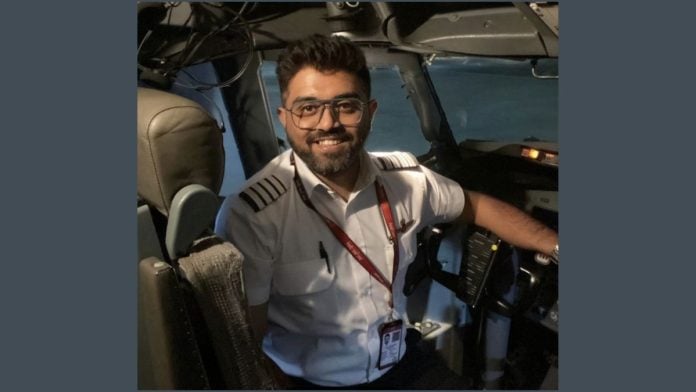
New Delhi: As Captain Smit Machchhar is being hailed as a hero, for saving 180 lives after he was stabbed by his co-pilot on the flydubai Dubai-Tel Aviv flight, an unusual question regarding his identity has begun to dominate the conversation.
Despite being injured, Captain Machchhar managed to open the cockpit door mid-flight, allowing onboard passengers and crew to overpower the attacker.
On social media, people celebrated his courage and even demanded that he be honoured with an award for his valour. Several social media users, however, began to ask questions about his identity — what does his surname, Machchhar, mean? Where does he come from?
While some claimed that he is a Nagar Brahmin from the Saurashtra region in Gujarat, others claimed he belonged to the neighbouring Kutch region. Machchhar may be an uncommon surname for most of India and the world. But in Gujarat, it sits alongside surnames such as Hathi, Mankdi, Bakri and Popat.
What does Machchhar mean?
Nilkanth Vinodini, in her book Gujarati Atakono Itihas, traced surnames to their origins. One of them was Machchhar, Captain Smit’s last name. In her book, she said Machchhar could be an evolved version of Gujarati word “matsar,” which meaning jealousy.
Vinodini also argued that the Machchhar community resided in an area that has a lot of mosquitoes. Machchhar is the Hindi word for mosquitoes. And it was believed that in the area where there are more mosquitoes, people are known for it.
Gaurang Jani, retired professor of sociology at Gujarat University, told ThePrint that in Gujarat, people with longer noses carry the surname Popat. There are similar surnames in the Saurashtra belt such as Hathi (Elephant), Mankdi (bugs), Bakri (Goat) and more.
Vinodini pointed to a third possibility — the surname may have been given to someone jokingly. A mosquito is tiny and easily dismissed.
In Gujarat, the surnames are often used in word play. It involves witty remarks.
In the 1960s, former member of parliament Jaisukhlal Lalshankar Hathi was felicitated by a person whose last name was Machchhar. When the story was told through the generations, it was recounted as, “What a time we are living in. A Machchhar is felicitating a Hathi.”
Lohana or Nagar
The surname Machcchar is found among the Nagar Brahim and Lohana communities of Gujarat. The Nagars belonged to the Brahmin community of Saurashtra, while Lohanas are native to Kutch — their historical and cultural homelands.
Although the communities had the same surname, their work was different.
Lohana Machchhars are fewer in number. In the 19th century, they migrated to Mumbai in Maharashtra. Lohanas are a business community, who owned shops and businesses. They came from Sindh in Pakistan. In fact, Karachi houses a Machar Colony, which is also referred to as the Fisherman Colony because of its ties to Karachi’s fishing industry.
However, the Nagar community were teachers, educators and mostly worked with the government. In Gujarati literature, there are a lot of contributions of the Nagar people.
“Mostly, writers and authors belong to this community. Even in India’s freedom movement, they played an important role. A lot of them were influenced by Gandhi,” Jani told ThePrint.
Even women writers, who wrote against tradition, caste, and worked for women’s rights and education, were mostly from the Nagar community in the 19th century.
Nagars have also worked in the court of Mughals as well as for the British rulers as Munshis or writers and scribes.
“This community considers themselves above the Brahmins, akin to the Kayasth community of Madhya Pradesh, who also traditionally worked as a writer, an accountant, or in the administration”, said Jani. Nagars dominated education and literature but not economy and politics.
(Edited by Aakriti Handa)
Please verify your source and do some research. This is wrong info.
मच्छर सरनेम लोहाना में नहीं आती। लोहाना पंजाबी ओरीजीन की जाति है जो सिंध पर राज करके गुजरात आई है। लोहाने कभी मछली का व्यापार नहीं करते। मुहम्मद अली के दादा को ऐसी गलती करने पर लोहाना समाज ने नातबहार कर दीया था।
He is from Brahmakshatriya community