





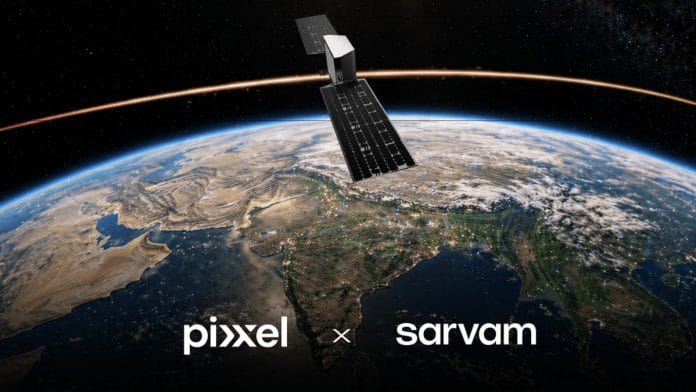


New Delhi: Pixxel, a US-Indian private space technology company, has partnered with Sarvam to develop and build Pathfinder, India’s first orbital data centre satellite. While satellites have so far collected data for later analysis on Earth, the 200-kg Pathfinder, a ‘computer in space’, will not only observe the blue planet but analyse data in real time and transmit insights back.
The move comes at a time when the growing demand for AI, data, and ground-based data centres is facing increasing constraints around energy, land, regulation, and scale. As the current model of heavy computation becomes harder to sustain environmentally, orbital data centres offer a solar-powered alternative.
“Orbital data centres open up a new frontier, where compute can be powered by abundant solar energy, operate closer to space-based data, and move beyond some of the limits faced on Earth,” said Pixxel CEO Awais Ahmed in a statement.
Pixxel will design and build Pathfinder, while Sarvam will provide the AI backbone, including the core Large Language Model (LLM) and the technical infrastructure to capture and process data aboard the satellite. Not only will Pathfinder be equipped with Pixxel’s hyperspectral imaging camera, it will also host the same generation of GPUs that are used in on-ground data centres that power AI training.
Pathfinder will be developed at Gigapixxel, Pixxel’s upcoming facility in Bengaluru. The facility is designed to produce 100 satellites per year, strengthening the company’s ability to build and deploy next-generation space infrastructure from India.
With this collaboration, observing Earth may soon become a faster and far less laborious process.
Also Read: This Bengaluru startup just launched world’s first OptoSAR satellite. It started at IIT Madras
What will Pathfinder change?
So far, satellites have sent large volumes of data and raw imagery back to Earth for processing. However, the journey from that first ‘click’ in space to an insightful analysis on Earth will be much faster now that Pathfinder will identify patterns, detect changes, and generate insights in real time. A press release by Pixxel highlighted that this will enable faster responses across environmental monitoring, resource management, and critical infrastructure tracking.
Pathfinder opens the door for satellites that can ‘think’ for themselves and deliver conclusions.
“Having India-built models running in orbit aboard an India-built satellite is exactly the kind of foundational capability that the country needs,” said Pratyush Kumar, CEO, Sarvam. “The goal has always been to make intelligence accessible to everyone, everywhere. Now, everywhere includes space.”
While Pathfinder will be a milestone for India, the concept of AI infrastructure in space is hardly new. In late 2025 Elon Musk had floated the idea of data centres in space using SpaceX’s Starlink satellite. In addition, Google too has explored the idea of using solar energy in orbit to power compute systems in space.
However, the latest advancement in the field came when Axiom Space launched the first ever data centre nodes for low-earth orbit on January 11, 2026, to test whether they would be capable of cloud computing, storage, and analysis.
(Edited by Asavari Singh)