



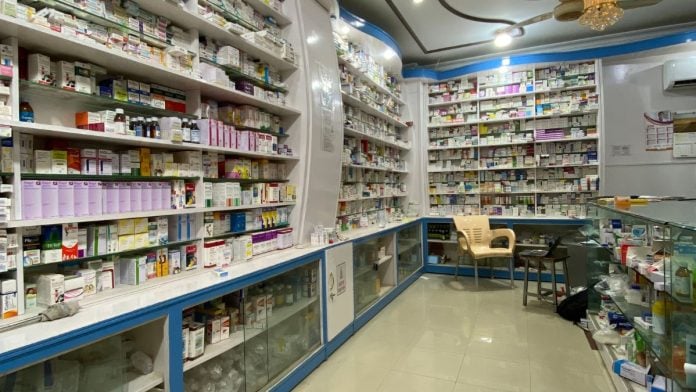
New Delhi: The government’s draft mandating CCTVs at medical stores comes as a survey unearthed that 64 per cent of consumers were never or rarely asked for a doctor’s prescription before selling medicines. The survey also highlighted that only 15 per cent of consumers were asked by chemists for a prescription.
When asked the consumers how often they received prescriptions, “34 per cent said never and 30 per cent said very rarely. Another 18 per cent said sometimes and 11 per cent said most of the time. In effect, 64 per cent of consumers surveyed say their chemist never or rarely insisted on a prescription, and only 15 per cent say the chemist mostly or always did,” states the survey.
The survey, conducted by LocalCircles, was published on Thursday. It had 1,06,000 responses from consumers across 327 districts, with 63 per cent men and 37 per cent women.
The survey indicates that only 31 per cent of consumers can regularly access assistance from a qualified pharmacist, while 13 per cent of respondents reported receiving help from unqualified personnel, highlighting concerns regarding professional supervision in retail pharmacies.
Counterfeit menace
The survey also highlights that 86 per cent of consumers primarily bought medicines from local chemists over the past 12 months, confirming that the neighbourhood pharmacy is the dominant choice for healthcare retail in India.
“(At least) 70 per cent said they received a printed GST bill or invoice and 3 per cent received a GST bill made manually. Another 9 per cent said they got only a handwritten estimate slip, paper or medicine envelope with the total written on it. A further 2 per cent said the total was shared on WhatsApp, by phone or at delivery with no GST bill, and 15 per cent said they received no bill at all,” states the survey.
Additionally, 15 per cent of the consumers said that they were sold counterfeit medicines in the last 12 months. The Central Drugs Standard Control Organisation (CDSCO) and State drug controllers found 282 and 245 spurious drug samples in FY 2023-24 and 2024-25, respectively.
“States, including Karnataka, Haryana and Uttar Pradesh account for the largest number of documented cases, with Bihar, West Bengal and Telangana among those in the next tier, and cases recorded across northern, eastern, western and southern India alike,” states the survey.
Also read: India’s Tier-2, 3 cities see a 95% rise in IT jobs. Hiring is shifting beyond metros
‘Improve transparency in supply chain’
The Union health ministry Thursday proposed mandatory CCTV surveillance in all retail pharmacies and medical stores across India to clamp down on the unauthorised over-the-counter sale of prescription drugs. The draft notification, which proposes an amendment to Rule 65 of the Drugs Rules, 1945, was issued to tighten the regulatory oversight of highly regulated and habit-forming medicines.
“The stated intent is to strengthen oversight of Schedule H, H1 and X drugs and curb their sale without valid prescriptions, and to improve transparency and accountability across the pharmaceutical supply chain,” states the survey.
The draft notification states that retail pharmacies need to preserve CCTV recordings for at least three months. This retained footage must be made available to regulatory authorities upon request to verify compliance and cross-reference sales.