


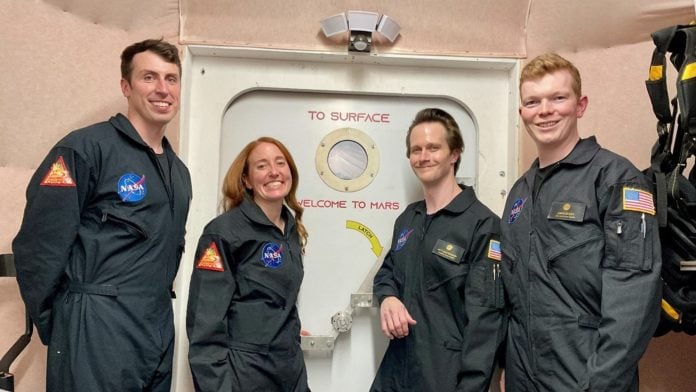
New Delhi: Four NASA research volunteers have emerged from a simulated Martian habitat after spending 378 days in isolation, completing an experiment designed to help researchers understand the challenges astronauts could face during future missions to Mars.
The crew, comprising Ross Elder, Ellen Ellis, James Spicer and Matthew Montgomery, exited the Mars Dune Alpha habitat at NASA’s Johnson Space Center in Houston, Texas, on 31 October.
They entered the 158-square-metre, 3D-printed facility on 19 October 2025 as part of NASA’s second Crew Health and Performance Exploration Analog (CHAPEA) mission.
Living on a simulated Mars
The experiment recreated some of the restrictions astronauts could face on Mars, including limited resources, prolonged isolation and communication delays of 13 to 22 minutes each way.
The crew also underwent a planned two-week communications blackout, simulating a period when the Sun obstructs radio transmissions between Earth and Mars.
“We spent about a month preparing for the blackout,” Montgomery, the mission’s science officer, told Nature in an interview. The crew reviewed emergency procedures and coordinated their schedules with ground teams before the blackout began.
Montgomery also helped grow crops and conduct geological experiments. He said growing vegetables offered psychological benefits, describing how “just interacting with Earth-based things like plant life” helped the crew.
Before entering isolation, the volunteers underwent extensive training, including a winter camping expedition in Wyoming, where they encountered a blizzard.
Montgomery credited this preparation with helping the crew work together, saying that “conflict was very minimal”.
Teamwork during isolation
Despite spending more than a year away from the outside world, medical officer Ellen Ellis told NASA that she rarely felt isolated.
“I have three teammates that I rely on every day to get through the mission,” she said.
Flight engineer James Spicer also praised his colleagues, saying they had made the experience “not a chore, but a joy”.
Commander Ross Elder described the group as “one of the finest teams I’ve ever been a part of”.
Montgomery said the crew’s different backgrounds and experiences had also helped them overcome challenges.
“It’s really the people that make exploration possible,” he said.
NASA collected data on the crew’s health, performance and ability to work together under restricted conditions. The findings will help researchers understand how astronauts can remain healthy and productive during lengthy missions.
The experiment could not reproduce every physical condition on Mars, including reduced gravity and radiation exposure. However, researchers hope the findings will help prepare future crews for missions beyond Earth.
(Edited By Raunaq Lekhi)