



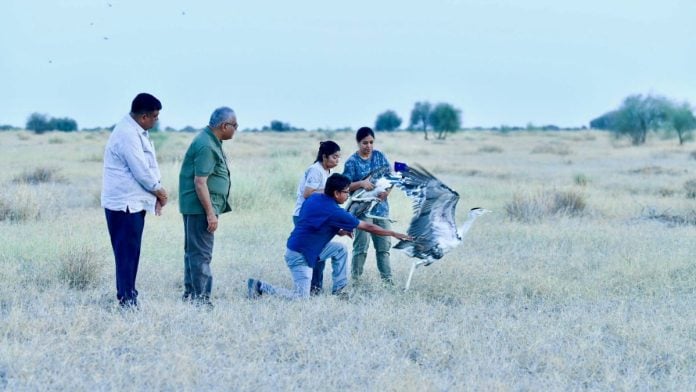
New Delhi: Two male Great Indian Bustards, or GIBs, were released into the wild at Sam Desert National Park in Jaisalmer, Rajasthan, on Sunday, marking a new phase in India’s effort to save one of the world’s most threatened birds. These are captive-bred GIBs, and their release is the first major step from breeding the species under human care to trying to return it to its natural habitat.
Union Environment, Forest and Climate Change Minister Bhupender Yadav initiated the release.
“In a milestone move, (we) released two male Great Indian Bustards in Sam Desert National Park, Jaisalmer, today morning. This landmark success has been made possible by the nearly decade-long unwavering dedication of our scientists, researchers and ground staff who have spent years to ensure GIB reclaims the deserts of Rajasthan,” he had posted on X.
The government describes the project as a transition from building a viable conservation-breeding population to releasing the species in the wild.
From breeding to rewilding
The Indian government kicked off the GIB recovery programme in 2016 with the Union environment ministry, the Rajasthan Forest Department and the Wildlife Institute of India (WII). It focused on conservation breeding alongside habitat restoration and threat mitigation. The latest release is being treated as a pilot, with lessons from it expected to shape protocols for future releases.
“The release of captive-bred GIBs represents the next critical step in the species recovery programme and will provide important scientific learnings for progressively developing and refining protocols for reintroduction of captive-bred birds into their natural habitat,” the Union environment ministry said in a statement.
The captive-breeding facilities at Rajasthan’s Sam and Ramdevra currently house 97 GIBs. Forty originated from eggs collected from the wild, while 57 were bred in captivity. Of the total, 86 are being maintained for captive reproduction, and 11 have been earmarked for release. The programme produced 24 live chicks in 2025 and another 29 in 2026.
On Sunday, the birds were not abruptly released from captivity into the open desert. A new rewilding aviary at Ramdevra has been built to prepare captive-bred GIBs for life outside. The pillar-less design gives the birds unobstructed space to strengthen their flight muscles, adapt to natural conditions and develop natural behaviour.
The new facility acts as a transitionary environment—a soft-release system—specifically engineered to bridge the gap between captive life and the wild.
Also read: New York to have its first Muslim film festival. Women directors dominate nominations
Why GIBs remain vulnerable
GIBs are critically endangered birds and survive in fragmented open habitats, with the Thar Desert holding the largest remaining population. With just 50 to 249 individuals in the wild, the IUCN has marked a declining population of the species.
WII research has identified habitat degradation and human pressures as major concerns, while power lines are a particularly serious threat because collisions can kill the birds.
“Previous studies have shown that power lines are a key current threat for GIB and associated birds. Surveys conducted in 2017-2018 in the Thar landscape have estimated that about 88,000 birds die every year due to power line-related mortalities. Power lines span a distance of about 2,000 km in the landscape and have increased multifold in the last few years. More recently, power lines are being marked with bird flight diverters,” states a WII study.
Meanwhile, Rajasthan’s breeding programme has also tried a “jumpstart” approach, placing captive-laid eggs in wild GIB nests. According to the government, this has resulted in six chicks hatching in Rajasthan and two in Gujarat after the eggs “were accepted by the incubating females”.
For a decade, conservationists have been trying to ensure the GIB does not disappear from India’s grasslands. The harder task has now begun — seeing whether a bird bred by humans can learn to live in the wild again.