





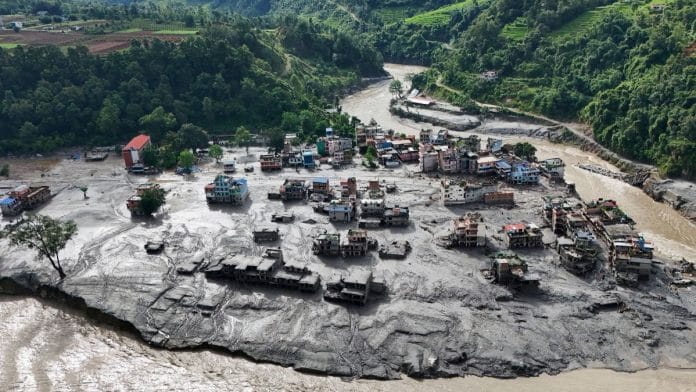

New Delhi: The devastating flash floods sweeping through Nepal’s Rasuwa district began high up in the Himalayas when a part of a glacier collapsed and crashed into the valley below.
This disaster is another reminder that the Himalayas are a dangerous terrain prone to such events. They are geologically young, tectonically active, and an ecosystem where rocks, rivers, ice, earthquakes, and weather constantly interact with each other.
Scientists studying the landscape have often highlighted this dynamic nature of the Himalayas. As the Indian and Eurasian tectonic plates push against one another, the mountains are simultaneously rising upwards while also being carved out by rivers and landslides. This creates the region’s steep slopes.
A 2012 Nature Geoscience study that mapped over 15,000 landslides in the eastern Himalayan region found a link between the region’s landslide erosion and the tectonic uplift.
“Small increases in mean hillslope angles beyond 30° translate into large and significant increases in landslide erosion,” the study reads.
In such a fragile landscape, the triggers for disasters are numerous — monsoon rainfall can leave the steep edges saturated with water, earthquakes can shake them apart, and the slow melt of glaciers can destabilise the high-altitude terrain.
In this mix, ice becomes yet another volatile component. As glaciers retreat slowly due to global warming, they leave behind glacial lakes held together by natural dams made of debris. When these dams fail, or something falls into the lake, disrupting the waters, they can lead to glacial lake outburst floods, or GLOFs.
“The Hindu Kush Himalayan (HKH) region is recognised as a “hotspot of risk” for hazards such as GLOFs,” reads a 2023 media advisory by the International Centre for Integrated Mountain Development (ICIMOD).
Also read: Nepal’s ruling party and opposition call for unity after deadly flash flood
‘Disasters today are governance failures’
According to the ICIMOD, nearly 7,000 people have lost their lives to GLOFs in the past 190 years.
“Over half (54 per cent) of GLOFs were triggered by mass movement such as avalanches, rock falls and landslides (such as in Sikkim in 2023), while 18 per cent were due to intense rainfall events. This points to a need for better forecasting of precipitation at altitude as well as mapping of an increasingly unstable cryosphere,” the ICIMOD statement added.
Adding to this is climate change. A 2026 Nature study, looking into landslides in the Himalayas, has linked climate change, rainfall, and the rise of landslides.
“Globally, rainfall-induced landslides have led to approximately 55,000 fatalities from the year 2004 to 2016. The risks related to landslides are expected to rise due to (an) increase in extreme rainfall events primarily due to climate change,” reads the study.
Y P Sundriyal, a geologist from Uttarakhand, agrees that while the Himalayas are an “active landscape”, another factor in their volatility is what geologists refer to as “anthropogenic interventions”.
“After the 7.5 earthquake in 1803, we haven’t had a really bad earthquake in Uttarakhand. We’ve seen smaller ones in Chamoli and Uttarkashi, but 6.5 is not that strong an earthquake. The disasters today are management and governance failures,” Sundriyal told ThePrint.
According to him, these human interventions are making matters much worse in an already fragile ecosystem.
“For them, development means wider roads, but development must be sustainable. We can’t cut down mountains and set up dams and not expect to face the consequences,” he added.
(Edited by Saptak Datta)