





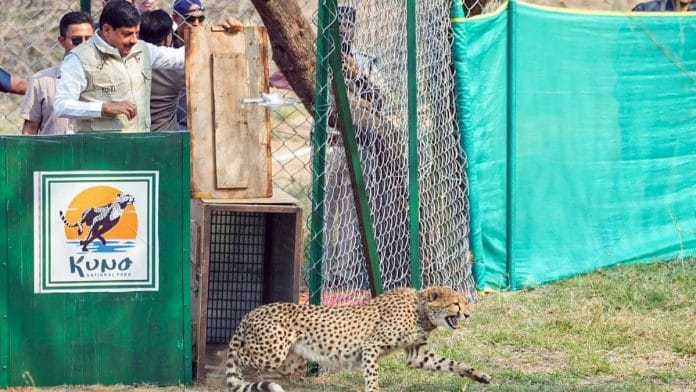


New Delhi: The first two cheetahs from Botswana were released into the wild in Kuno National Park on Monday, taking the number of free-ranging cheetahs to 17 in the park. Madhya Pradesh Chief Minister Mohan Yadav released the two females into the Palpur East Range of the park, which is also the designated tourism zone.
A total of nine cheetahs arrived from Botswana on 28 February. They’re part of the third contingent of big cats to arrive from Africa for India’s Cheetah Translocation Project. They were kept in quarantine for the first few weeks and released into soft enclosures or ‘bomas’ in early April.
“We’re doing a phased release of the Botswana cheetahs based on their health conditions and our observations,” said Uttam Kumar Sharma, Field Director, Kuno National Park, to ThePrint.
The remaining six male cheetahs and one female cheetah from Botswana are still in soft enclosures, with no set release date. According to Sharma, officials are still debating whether the cheetahs will be released in Kuno or the Gandhisagar Wildlife Sanctuary, which already houses three African cheetahs.
This year marks the fourth year of Project Cheetah. It began in September 2022 with the arrival of eight cheetahs from Namibia to the 750 sq km Kuno National Park. In February 2023, a group of 12 cheetahs arrived from South Africa. Now, with the big cats from Botswana, there are a total of 57 cheetahs in the country.
As the government plans to expand Project Cheetah to other parts of the country, including the Nauradehi Wildlife Sanctuary and the Banni grasslands in Gujarat, let’s take a look at how the translocation project has fared till now.
Also read: How Lucknow’s DNA lab is decoding Indian cheetah’s genetic history from 200-yr-old samples
Kuno’s cheetah history
Out of the 54 cheetahs in Kuno National Park, 17 are currently free-ranging in the wild; the other 37 cheetahs are kept in soft bomas, which are enclosures measuring 50-150 hectares that allows the cheetahs to acclimatise with the environment while also being protected from predators.
These soft bomas have been an essential part of Project Cheetah. After quarantine, all cheetahs are first released into bomas before being released into the wild. Even now, some female cheetahs and their cubs, as well as injured or sick cheetahs, are brought to the bomas to recover and stay safe from predators.
Since its inception, India’s cheetah project has seen its share of highs and lows—out of the 20 founding cheetahs from South Africa and Namibia, nine died due to various causes. The first litter of Indian-born cheetah cubs were born in March 2023, but three out of four of them died soon after because of health reasons.
The cheetah project has also seen controversies, such as cheetahs travelling beyond Kuno National Park toward Uttar Pradesh and Rajasthan. Cheetahs like Pavan, Agni, and Asha have been repeatedly spotted beyond the park’s boundaries, and have had to be tranquilised and brought back to Kuno. According to experts, repeated tranquilisation is not safe for the cheetahs’ health.
However, there has also been a steady recovery of the cheetah population in Kuno National Park, with nine cubs being born in 2026. Some cheetahs, like Jwala, have given birth to three litters in the last three years.
The government is currently working on a long-term plan to create a cheetah landscape across Kuno-Gandhisagar-Nauradehi national parks. There are also discussions among forest officials to introduce cheetahs in other parts of India, such as the Banni grasslands in Gujarat.
Cheetahs became extinct in India in 1952, due to endless hunting and anthropogenic pressures on their habitat. Some of the last few cheetahs were seen in Gujarat’s Junagarh province, and the state has been attempting to bring them back since then.
(Edited by Theres Sudeep)