





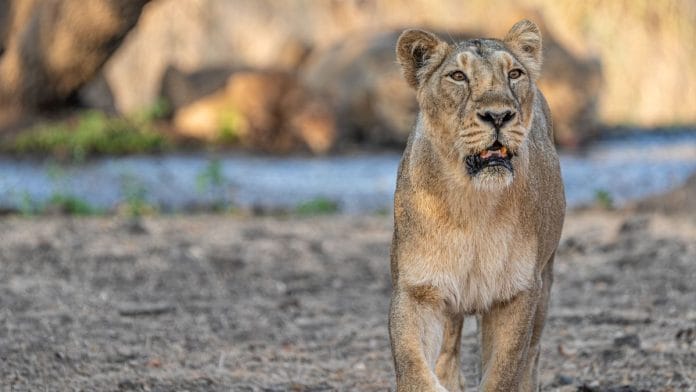


New Delhi: Three Asiatic lion cubs were born on 7 July at Delhi’s National Zoological Park. They were born to Mahagauri and Maheshwar who had also given birth to two healthy cubs last year in April.
“The lioness and her three newborn cubs are presently housed in a secure maternity enclosure, where they are being provided with a calm and undisturbed environment essential for the early stages of development,” read a press note by the Delhi Zoo Authorities. The zoo’s veterinary and animal care teams are closely monitoring the cubs through a CCTV surveillance system.
The pair gave birth to Karni and Kartik on 27 April 2025, both of whom are currently healthy. The zoo houses six adult Asiatic lions including three males — Sundaram, Maheshwar, and Kartik — and three females — Mahagauri, Shailja, and Karni.
Also read: Indian origin NASA astronaut Anil Menon heads to space for the first time
The return of an endangered species
According to the press note, Maheshwar and Mahagauri’s breeding success is due to the Delhi zoo’s conservation breeding programmes for the endangered Asiatic lion or Panthera leo leo.
These charismatic large cats, close relatives of the African lions, once used to roam the grasslands and deciduous forests of India. Excessive hunting by the British shrank their population in the 19th century until only a dozen were left. The remaining few could be found at the Gir Forest in Gujarat which is now a national park and wildlife sanctuary but was once a private hunting ground.
The Asiatic lion was classified as endangered in the International Union for Conservation of Nature (IUCN), and as per a census conducted in 2015 there were only 523 of them left at the time.
At the International Big Cat Alliance (IBCA) Summit in 2026, Bhupendar Yadav, the union minister for environment, forest, and climate change, said that lions are apex predators and play a vital ecological role in regulating herbivore populations, maintaining ecosystem balance, and shaping biodiversity and inter-species dynamics.
Highlighting the success of India’s conservation programmes, Yadav added that an estimated 891 lions were noted in 2025 in the greater Gir Landscape, marking a 32 per cent increase since 2020.