





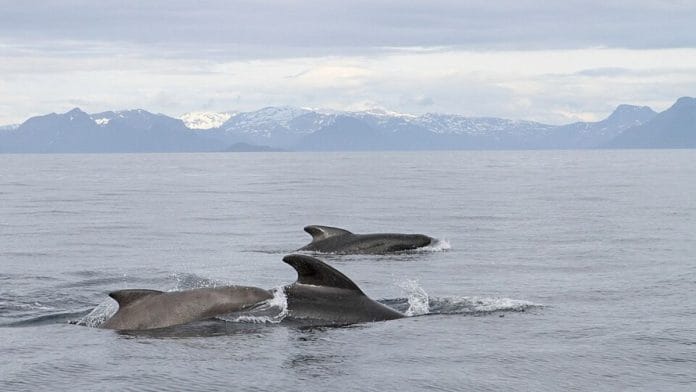


New Delhi: The Strait of Gibraltar—a vital shipping route, a military chokepoint, and the maritime gateway connecting the Atlantic Ocean to the Mediterranean Sea—was first home to the long-finned pilot whale. And the animal is now struggling to be heard.
Noise pollution in the Strait of Gibraltar, owing to the sound of hundreds of ships passing through, is causing pilot whales to shout louder just to hear each other, found a recent study published in the Journal of Experimental Biology.
The study was led by researchers Milou Hegeman and Frants Havmand from Aarhus University in Denmark. Between 2012 and 2015, their team travelled to the Strait of Gibraltar several times to collaborate with a nonprofit organisation, CIRCE, which is involved in several acoustic monitoring studies.
“Such noise pollution is a silent killer. We don’t understand how important it is. Just imagine your voice getting muffled in a crowded area. These whales have to keep shouting until they eventually hear each other,” marine biologist Chinmaya Ghanekar told ThePrint.
A social creature struggles to communicate
Despite their name, pilot whales are actually oceanic dolphins. These social creatures got the title ‘pilot’ since it was believed that each group, or pod, had a leader. Not only are they chatty creatures, but their high-frequency communication is also important for navigation, finding mates, and relocating each other when they dive deep into the ocean in search of food.
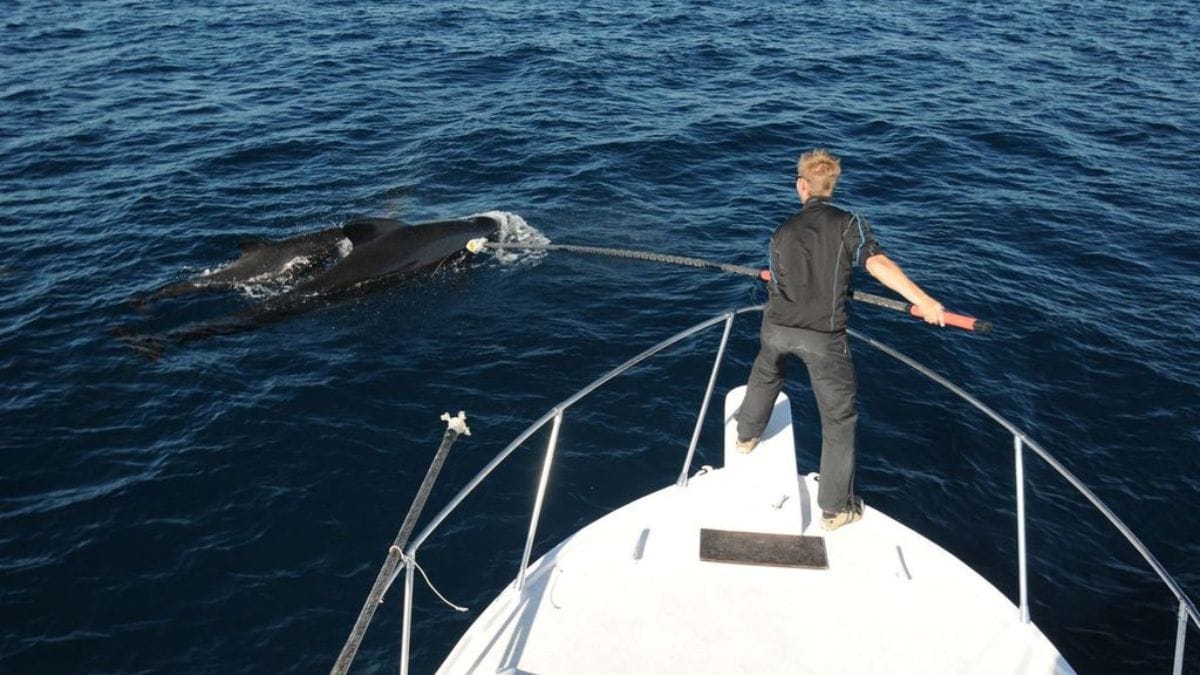
The scientists used 6–metre poles to attach suction cups and tags onto the animals. The tags would remain in place for nearly 24 hours and then float up to the surface, where researchers could collect them.
They then analysed calls from nearly 23 different individuals and found that during the peak hours of shipping activity, the calls grew scarce. However, they also found that the whales were adapting to their noisy surroundings by increasing the pitch of their calls.
According to some studies, noise pollution is also behind the higher number of strandings among pilot whales. High-intensity sonar and ship noise can damage the inner ear of whales and dolphins, causing them to be disoriented and get stranded ashore.
“A reduced communication range could mean that a calf and mother, as well as other group members, may lose acoustic contact more easily. It is harder to understand effects on social bonding,” Hegeman said.
Also read: PCOS to PMOS. What the name change mean for patients
The danger of noisy seas
According to Ghanekar, who is a scientist at the Wildlife Institute of India, underwater noise pollution is as significant as other marine threats. The physiological impact on pilot whales having to ‘shout louder’ may not have been studied yet, but it is known to impact their overall energy.
“Communicating constantly in such high frequencies makes them tired. They then have to find more prey, and it upsets the balance of their health,” said Ghanekar. Amid the noise, the study also noted that pilot whales struggle to find mates, relocate their pods, and communicate with their young ones.
An important question to ask is also whether there is a threshold above which pilot whales can no longer make themselves heard.
“We didn’t identify a threshold in our study, but every animal has a ceiling on how loud it can call, set by physical limits. We saw hints of this in our data. Two-component calls, which were already the loudest call type on average, showed essentially no response to the external noise.They appear to already be near that ceiling, leaving little room to compensate further regardless of how noisy it gets,” said Hegeman.
Pilot whales are not the only victims of marine noise pollution. Whether it is the Galapagos turtles or Gangetic dolphins, marine life has suffered due to human cacophony.
“It is not just ships. Sonar mechanisms, war ships, sub marines, underwater missile testing, oil drilling—we’re producing all kinds of frequencies,” said Ghanekar. Species that communicate through high frequencies are raising those frequencies, and bigger creatures that communicate through lower frequencies are going quiet.
The recent blockade around the Strait of Hormuz has highlighted that changes in shipping routes can have cascading impacts for economies worldwide. While shipping activity on the Strait of Gibraltar cannot be reduced, silencers for engines could be an easier solution.
Mapping key marine habitats and redesigning shipping routes to avoid them could offer some relief for pilot whales, Ghanekar added. Military or navy stations could also be selected after verifying a lack of sensitive marine populations in the area.
(Edited by Prasanna Bachchhav)