





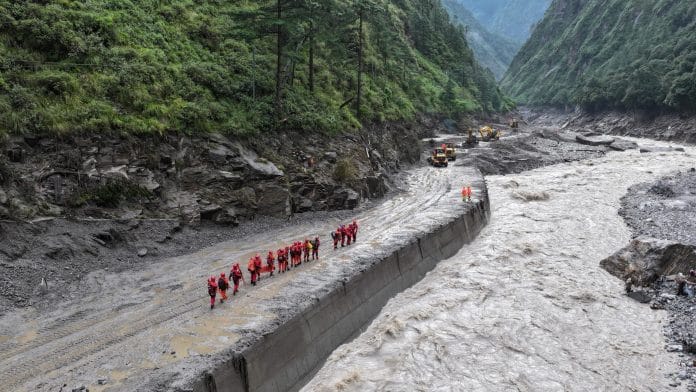

New Delhi: A new flood warning has been issued for Tibet and Nepal as water levels flowing toward Tibet suddenly increased again. The latest warning from the local police comes days after the devastating flash floods in the Rasuwa district.
“Information has been received that the water level/flow toward Tibet has suddenly increased again. All security personnel, rescue and relief workers involved in rescue and relief operations, as well as the general public, are requested to remain alert immediately and move/inform others towards safer locations,” read the alert issued by the Nepal Police at 11:30 am on Friday.
An official with the Rasuwa district administration office told ThePrint during a phone conversation that the new flood warning was issued via a message from the Chinese side early Friday.
“The information is that there might be a lake outburst, but we have not been able to confirm this from our side,” the official said.
The official added that the next 72 hours will be critical for evacuation and rescue operations.
On Thursday afternoon, the Chinese Ministry of Water Resources issued an alert to Nepal warning that the volume of a lake at the Chhochen Khola-Purepu Tsangpo confluence near the Nepal border was nearly 2 million cubic metres as of Thursday morning. They said it was expected to reach about 3 million cubic metres in the next two to three days.
These two rivers originate in Tibet and merge before entering Nepal, where they are called the Bhotekoshi.
“Taking this situation into account, residents of downstream areas along the Bhotekoshi River, travellers, rescue personnel deployed in rescue operations, and all relevant stakeholders are requested to exercise special vigilance and move to safe locations away from riverbanks and high-risk zones until the next notice is issued,” read a special notice by the flood forecasting division of Nepal’s Department of Hydrology and Meteorology.
On 26 August, a portion of a glacier collapsed from the upper reaches of the Himalayas, at an elevation of roughly 5,200 metres, falling about 1,200 metres into the valley.
According to satellite images released by the Indian Space Research Organisation’s National Remote Sensing Centre, nearly two-thirds of the glacier collapsed, generating a massive flow of ice, rock and debris. This torrent rushed down the valley, destroying houses, roads, bridges and hydropower infrastructure in its path. At least 400 people are confirmed dead, and more than 1,000 are still missing across Nepal and Tibet.
(Edited by Insha Jalil Waziri)