





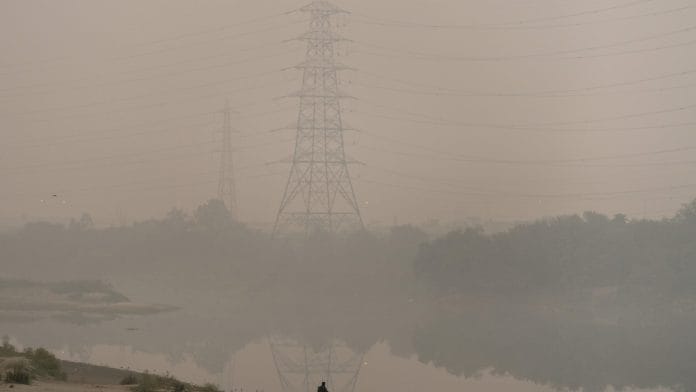



After the US retreat from action on climate change under President Donald Trump and a timid set of new goals from China, attention focused on India — the world’s third-largest polluter — to provide fresh momentum in global efforts to curb greenhouse gas emissions.
A revised green strategy through 2035, endorsed by Prime Minister Narendra Modi’s cabinet on Wednesday, instead outlines a more cautious approach to curbing pollution and reducing reliance on fossil fuels, limiting prospects for progress over the next decade among the three nations, which together account for almost half of all emissions.
India’s new plans extend the nation’s focus on lowering emissions intensity — the amount of pollution per unit of economic output — rather than prescribe absolute cuts in greenhouse gases, and set a new target to cut the metric by 47% from 2005 levels by 2035. A previous goal called for a 45% reduction by 2030. Demands to boost the share of clean power in India’s electricity mix, to 60% by 2035 from almost 53% now, are seen as similarly incremental.
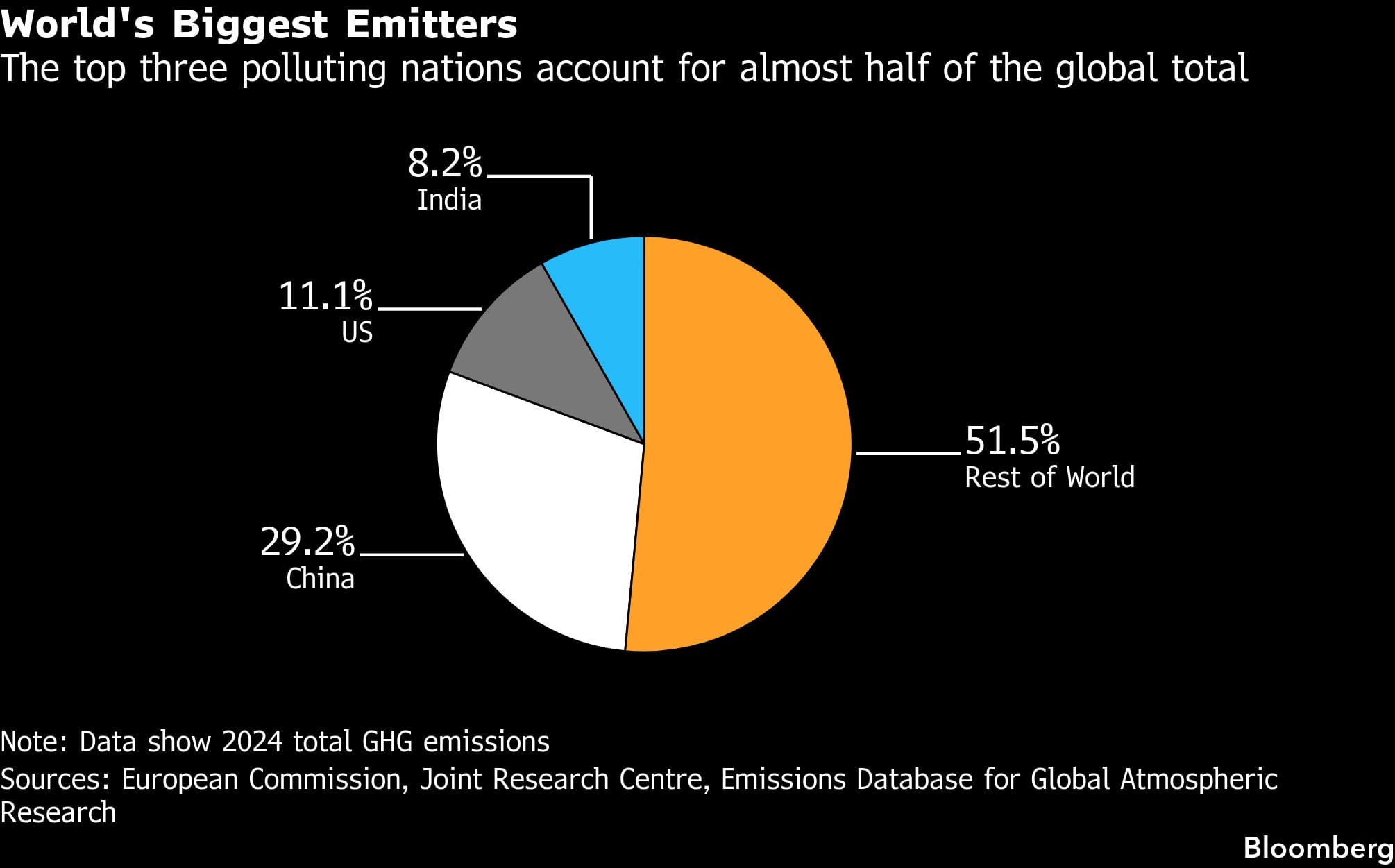
The targets demonstrate countries remain more focused on energy security than combatting global warming, and send a signal to other developing nations about the degree of ambition they should show, said Anne-Sophie Cerisola, a veteran climate diplomat.
“Whatever a country with 1.4 billion people does matters, and whatever one of the fastest-growing emerging economies in the world does matters,” said Cerisola, who’s currently a distinguished fellow at the think tank Strategic Perspectives.
Published unexpectedly and more than a year past an initial United Nations deadline, India’s strategy — known as a Nationally Determined Contribution, or NDC, and required under terms of the Paris Agreement — has already been criticized as underwhelming by some advocates of faster climate action. It’s also viewed as reflecting two current realities: uncertainty across energy markets as a result of the Iran war, and India’s wider challenge to balance ambitions for economic growth with its obligations to lower emissions.
The plans have been shaped by “a rapidly evolving global landscape marked by a rollback of climate policies in the global north, unilateral climate-linked trade measures, and a war in the Middle East,” said Vaibhav Chaturvedi, a senior fellow at New Delhi-based the Council on Energy, Environment and Water, a think tank. There’s a “growing understanding that energy security and prices cannot be taken for granted,” he said.
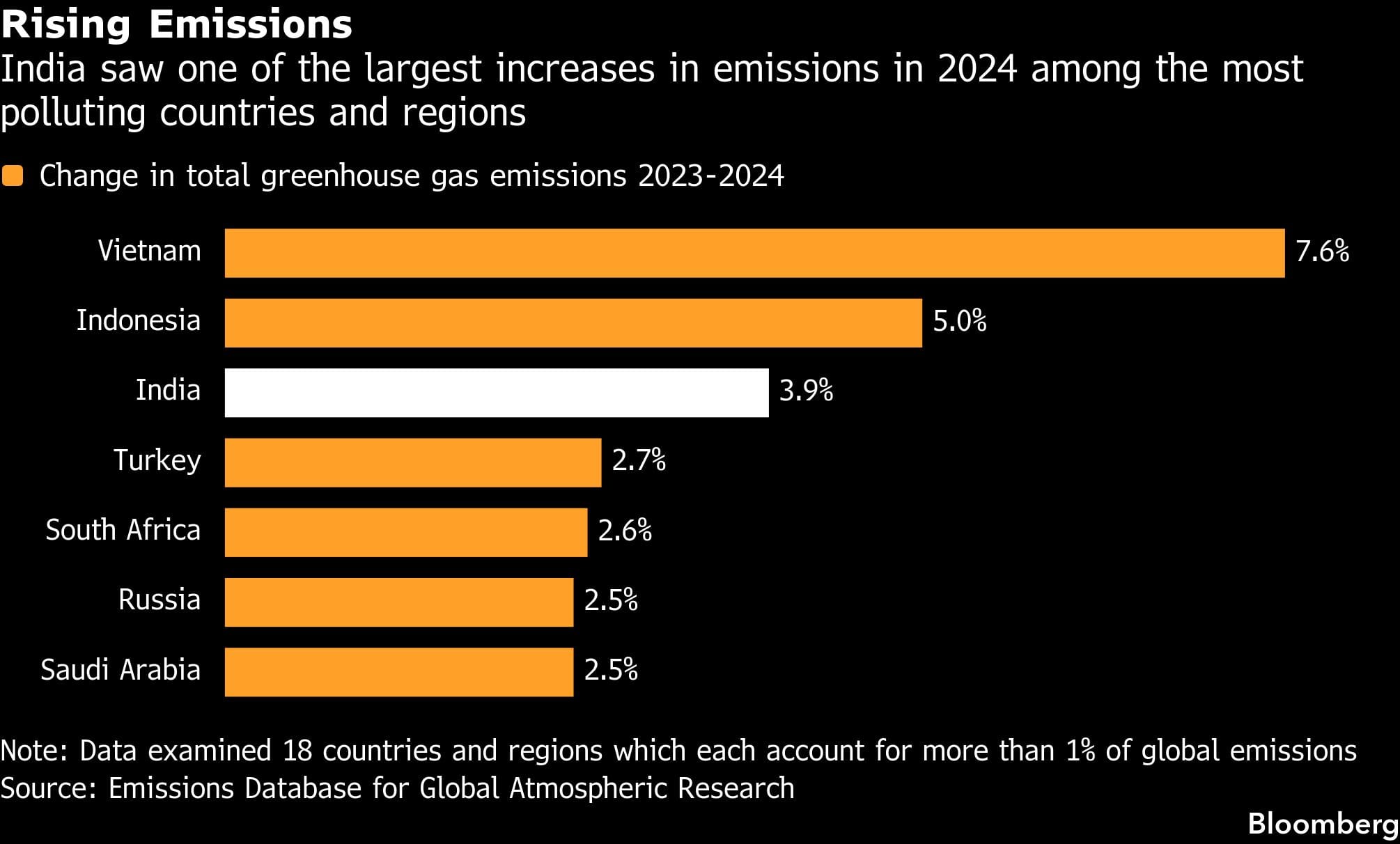
India has frequently called out richer nations over their weak climate commitments, and for failures to direct sufficient financing to help developing countries take action. A lack of financial aid was regarded as a constraint on India’s level of ambition as it developed its NDC, people familiar with the matter said last year.
Though the US initially submitted a new 2035 NDC under President Joe Biden, Trump has subsequently withdrawn the nation from the Paris accord process that requires national targets. Emissions in the nation edged up last year, according to an analysis by Rhodium Group. China’s latest strategy lodged with the UN pledged a 7% to 10% cut in total greenhouse emissions, a measure regarded as far too easily achievable.
“Global efforts have already been waning,” said Labanya Jena, director of the Climate and Sustainability Initiative. “So India seems to have committed in a cautious manner.”
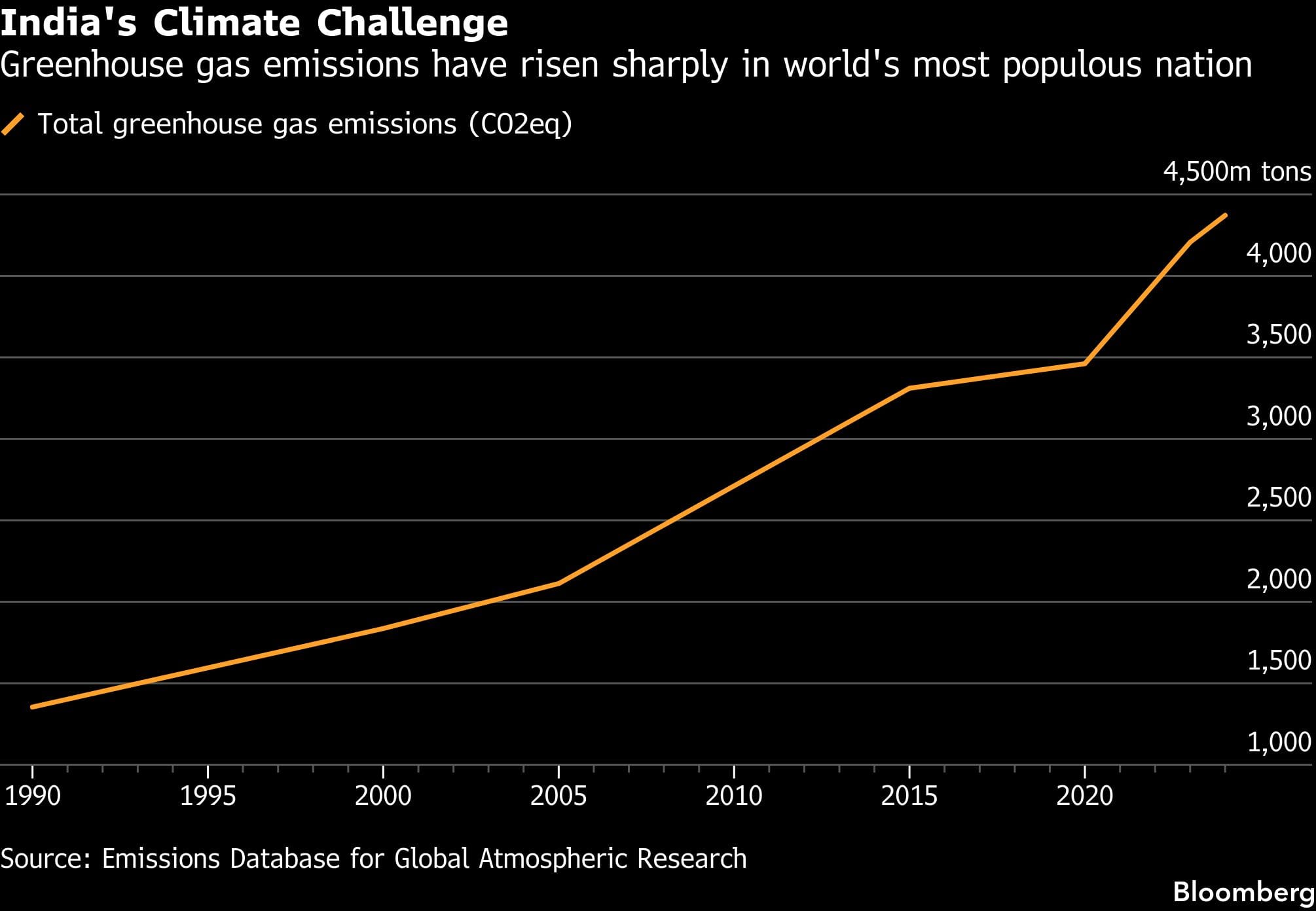
By addressing only emissions intensity, India is likely to continue to increase its absolute volume, adding to the total amount of greenhouse gases in the atmosphere that keep pushing temperatures higher. The new target “will allow emissions to continue rising and remain far from the level of ambition that India could achieve in practice,” Climate Action Tracker said in an initial analysis of the plan. The organization reviews national climate strategies.
None of the 40 governments that CAT analyzes have gone much beyond previous 2030 targets in their revised plans, according to Sarah Heck, a climate policy analyst with the organization. “Global climate ambition continues to stall,” she said.
The UN had already warned that the latest round of 2035 climate strategies are insufficient to meet hopes of limiting global warming this century to 1.5C. That prospect “will guarantee a human and economic trainwreck for every country, without exception,” Simon Stiell, executive secretary of the UN Framework Convention on Climate Change, said in October.
Modi’s government has insisted the latest climate targets represent a significant step toward the nation’s aim of reaching net zero emissions by 2070, yet that deadline is already a decade later than China and two decades after the European Union. The world’s most populous country remains heavily reliant on coal for electricity, imported oil to fuel its transport and imported gas for cooking and industry.
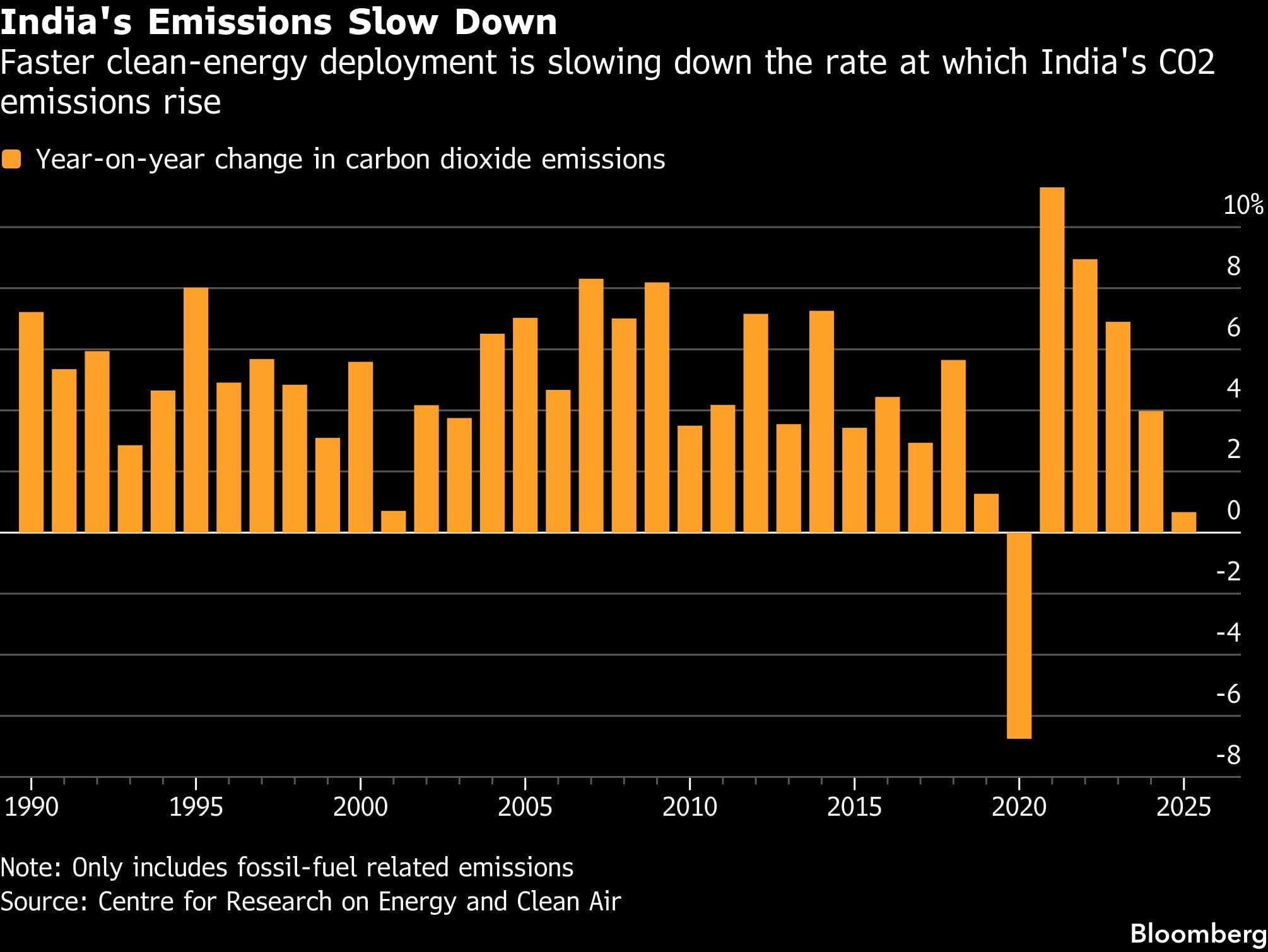
Even so, some analysts offered backing to the plans and a new calculation by the Centre for Research on Energy and Clean Air showed that the rate of growth in India’s carbon dioxide emissions has been slowing for the last few years as the influx of clean energy has accelerated.
“India’s approach stands out for its balance,” said Aarti Khosla, director of Climate Trends, a Delhi-based research group. “It prioritizes domestic capability, resilience and long-term sustainability, while continuing to advance its climate commitments.”
There is potential for India to use its position as chair of the BRICS group of nations to encourage stronger action this year among members and partner countries, Khosla said.
 “This new climate plan will deepen India’s economic advantage,” the UN’s Stiell said in a statement. “The sooner India meets and exceeds its targets, the more jobs, prosperity and national economic strength it will create.”
Greater policy certainty could boost energy transition investments in India, which reached $67.9 billion in 2025, according to BloombergNEF data.
“Businesses and investors appreciate stability,” said Jane Ho, head of stewardship Asia Pacific at BNP Paribas Asset Management. “Investment opportunities will increase for energy storage as non-fossil capacity extends, whilst green hydrogen will be another area that expands as hard-to-abate sectors such as steel and cement undergo transition.”
–With assistance from Ishika Mookerjee.
Disclaimer: This report is auto generated from the Bloomberg news service. ThePrint holds no responsibility for its content.
Also read: Have pollution policies helped Delhi AQI? What the decade’s data shows