



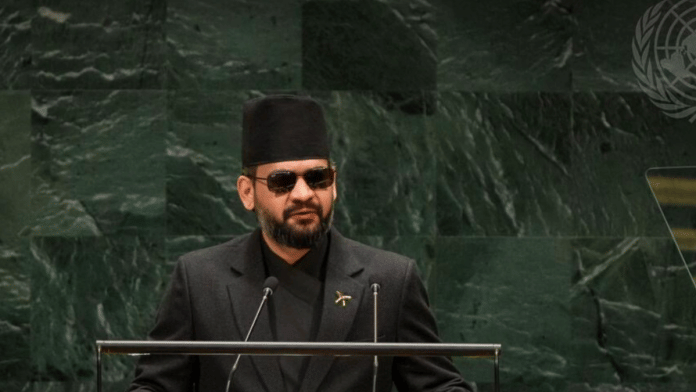
New Delhi: Nepalese Prime Minister Balen Shah proposed a Himalayan Climate Resilience Mechanism led by India, Nepal and China, in his first address at the United Nations General Assembly, a month after the 26 August floods in his country.
Speaking in New York on Friday morning, the Himalayan leader urged countries to act on the principles of common but differentiated responsibilities and help Nepal recover from the disaster that led to over 1,400 deaths and over 6,000 people missing.
“Climate justice cannot just remain a beautiful phrase in a United Nations document. People of our country should be allowed to build their future instead of constantly rebuilding their past,” said Shah in his speech.
On 26 August, a glacial rock collapse in the Lhende Khola River in Tibet caused flash floods at the Tibet-Nepal border, surging through the Bhotekoshi River in Nepal’s Rasuwa district. The devastation and destruction were instant, with the two neighbours still recovering from the natural disaster. While the communities living in the Rasuwa and Nuwakot districts were heavily affected, the floods also impacted hundreds of international pilgrims, including Indians travelling to Rasuwa for the Kailash Mansarovar Yatra.
Additionally, the floods destroyed roads, bridges, and trade and customs points between Nepal and Tibet, and initial recovery costs were estimated at $5 billion. A new study by the World Weather Attribution later estimated losses closer to $20 billion.
According to Shah, physical damages are estimated at 10 per cent of Nepal’s GDP, as the floods destroyed everything from roads and bridges to clean energy infrastructure and farms.
Shah, leading a small Nepalese delegation, arrived for the UNGA set to bring global attention to the floods, while also warning about climate-change-related disasters in general. He echoed UN Secretary-General Antonio Guterres’ speech from Nepal in 2023, calling it a “cry from the rooftops of the world.”
In the aftermath of the disaster, Nepal has also appealed to the global Loss and Damage Fund to secure $20 billion for its reconstruction and recovery efforts. Operationalised in 2023 at COP28, the L&D fund is a climate finance mechanism for developing countries to recover “loss and damage” for suffering the consequences of climate change-related disasters, with the expectation that developed, industrialised nations will fund it.
Speaking about these efforts, Shah stressed that Nepal was not responsible for the climate crisis yet was paying for it.
“Nepal contributes less than 0.1 per cent of global greenhouse-gas emissions. We did not create this crisis. Yet we are paying a colossal price for it. For Nepal, climate catastrophe is also a development emergency,” said Shah.
The PM further thanked the countries that came to Nepal’s aid in the aftermath of the disaster, including India and China. Shah made it clear that Nepal should not be borrowing money to repair the damage caused by climate change-related disasters, and asked for grant-based support from the UN.
Pointing to the bureaucratic puzzles of the Loss and Damage Fund and the Global Environment Facility, he also said that these institutions are grossly inadequate for the support required for Nepal.
“When the house is burning, we do not ask the family to complete fifty forms. We act,” he stressed.
Greater Himalayan cooperation
Beyond Nepal’s immediate needs, Shah also spoke about the larger Himalayan ecosystem, as the country is nestled within the highest mountain range. He asked for greater cooperation between Himalayan countries and an urgent need to protect the Hindu Kush mountains, which are home to over 2 billion people.
“As an urgent first step, we propose that we establish a Himalayan Climate Resilience Mechanism, led by Nepal, India and China,” he said at the global forum.
This mechanism, according to Shah, would be to coordinate satellite data sharing, monitor dangerous glacial lakes, strengthen early-warning systems and cooperate during disasters.
“Climate change does not recognise borders. Glaciers and floods do not travel with stamps and passports,” said Shah.