








New Delhi: There are 264 districts in India that don’t have a single air quality monitoring station, according to a new report by Airvoice Global, an international air quality solutions company. Released on Tuesday, the report, titled Air Quality Data Accessibility in India, looks at how air quality is measured and data collected across India.
Maharashtra, Uttar Pradesh, and West Bengal have the highest number of air quality monitoring stations — both manual and real-time — in their states, with each operating more than 100 stations in different districts. However, overall, the study found that air quality monitors are concentrated in large metropolitan areas, and most mid-tier cities and towns, even with millions of people, barely have one or two stations.
“India has made monumental strides in building its monitoring infrastructure, establishing itself as a leader in the Global South,” said Vitalii Matiunin, CEO of Airvoice, in a press release. “However, we see a critical gap: automated monitoring remains unavailable in several states, and even where infrastructure exists, significant data is lost due to technical downtime,” she added.
The study looked at the three main types of air quality monitoring stations — manual stations under the National Air Quality Monitoring Programme (NAMP), automated, real-time stations under the Continuous Ambient Air Quality Monitoring (CAAQM), and the latest System of Air Quality and Weather Forecasting And Research (SAFAR) automated stations.
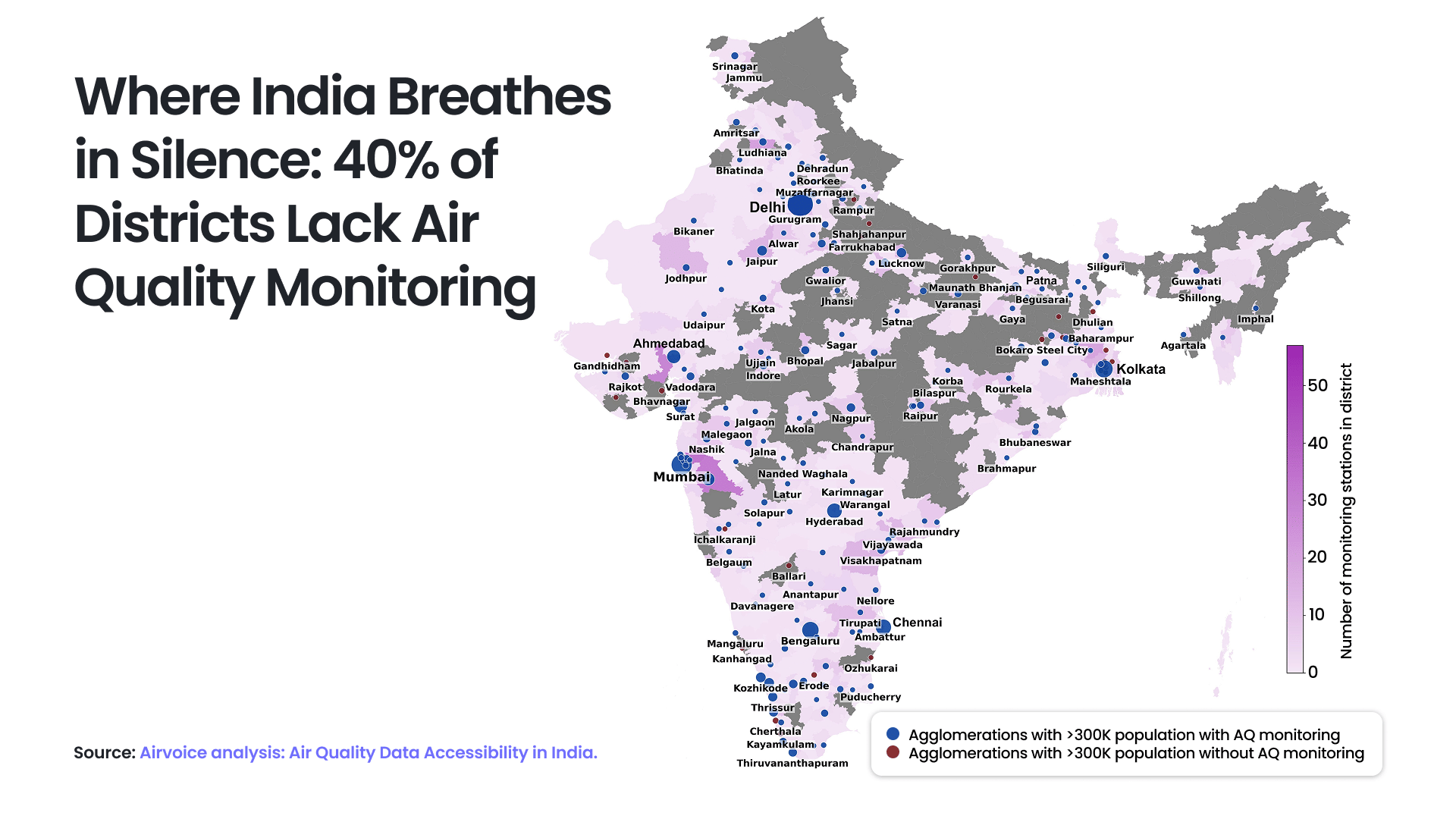
In total, India has 992 NAMP stations, 562 CAAQMS stations, and 42 SAFAR network sites. However, the distribution of these stations is extremely uneven, with some places like Delhi-NCR having the highest density of stations while some other districts don’t even have a single station. The air pollution network also does not correspond with population density, found the study,
For example, Thane with 9.4 million people has 34 air quality stations, but East Champaran with a population of 6.5 million has just one.
Even in 2025, states and Union Territories like Ladakh, Lakshadweep, Goa, and Dadra and Nagar Haveli and Daman and Diu still don’t have a single continuous monitoring station, relying solely on manual stations, which do not provide real-time information to the public, said the study.
Airvoice Global also found that just having monitoring stations is not enough — only 50 per cent, or 270 of the 562 stations, were seen to provide consistently stable air quality data in 2025, while the others were flickering, had data gaps or frequent interruptions. In fact, 58 out of the total 562 CAAQM stations were qualified as ‘unstable’, meaning in one year, the stations had so many interruptions and gaps that the data is strongly incomplete.
This phenomenon was also discovered in ThePrint’s investigation in October 2025, which found that there were hundreds of hours of data missing from Delhi’s 39 air quality monitoring stations, skewing averages and overall estimates of PM2.5 presence in the air.
Also read: Cabinet clears India’s 2035 climate targets—47% emissions cut, 60% non-fossil power goal
Challenges of air quality monitoring
The study looked at the growth of different real-time and manual air quality monitoring stations in India, since the first NAMP stations began coming up in the mid-1980s. By 2010, there were over 400 manual NAMP stations in the country, and around 21 continuous stations had begun coming up under CAAQM.
It was after 2015 that continuous stations really took off, going from 56 stations in 2016 to 264 stations in 2020. The biggest jump in CAAQMs was in 2023, with over 100 new stations added that year. Major metropolitan areas like Delhi, Mumbai, Chennai, Kolkata, Bengaluru, and Hyderabad increased their coverage in this period, with over a dozen stations in each city.
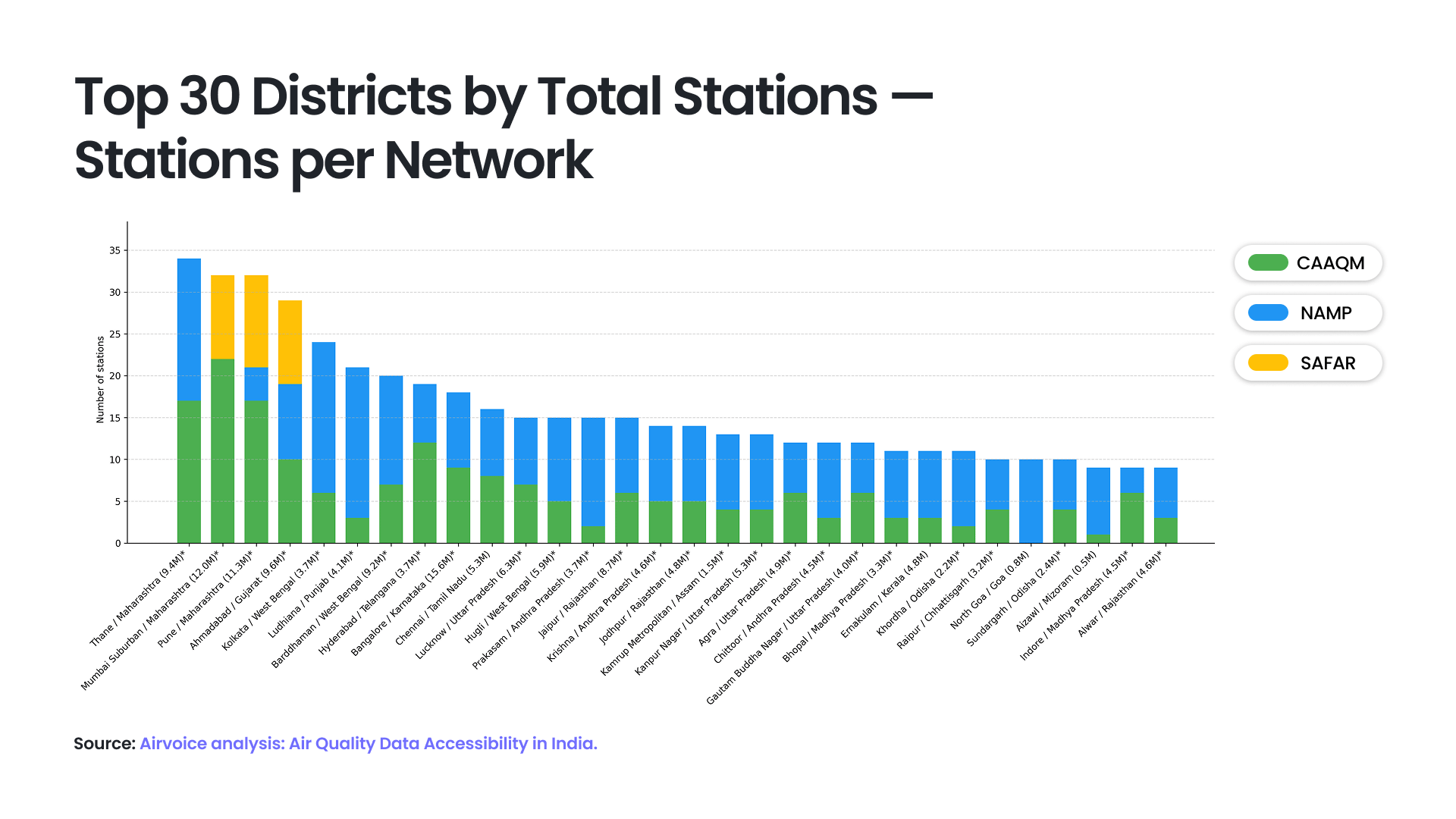
But many districts and states continue to have no real-time monitoring stations, relying only on manual NAMP stations whose data isn’t readily available for the citizens. NAMP stations also do not measure pollutants and gases continuously, instead collecting eight samples over a 24-hour period, twice a week. This means that in a year, NAMP stations only collect 108 observations and provide data based on that.
In some regions like Ladakh, the remote, hilly terrain poses a challenge for establishing air quality stations. But in other growing urban clusters like Surat, Jaipur, Patna, and Nagpur, CAAQM penetration is still between 5-7 stations.
The state of Uttar Pradesh too presents a unique contrast — while it is one of the top 3 states with air quality monitoring systems, it also has a large number of districts with no stations at all. This is because most of the monitoring network is clustered in the National Capital Region and big cities like Lucknow. Out of the top 30 most populated districts with zero air quality monitoring stations, 20 of them are in Uttar Pradesh.
One of the main issues with the unequal spread of pollution monitoring systems is the lack of information about the spread of pollutants from one place to another.
“Such localisation of networks allows detailed tracking of pollution hotspots but provides little information about regional transport and diffusion of pollutants,” read the study. “(That is) a key factor for assessing the broader impact of urban emissions.”
(Edited by Aamaan Alam Khan)