



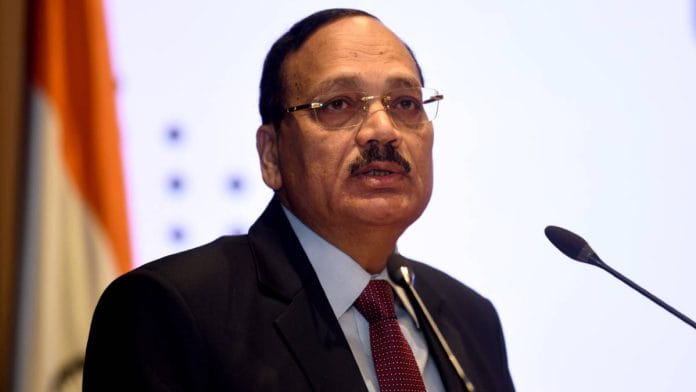

New Delhi: Environmental cooperation between India and Sri Lanka is not a matter of charity or diplomacy, but of survival, Supreme Court judge Justice Surya Kant asserted in Colombo Wednesday.
Justice Kant, who is slated to become the Chief Justice of India next month, was speaking at the Indo-Sri Lanka Policy Dialogue on the topic ‘Advancing Environmental Sustainability and Regional Cooperation’, organised by University of Colombo’s Faculty of law.
Recalling his first visit to the picturesque beaches of Sri Lanka, the judge said that while watching the brilliant turquoise-hued waters of the Palk Strait, a narrow ribbon of sea separating Tamil Nadu and northern Sri Lanka, he was awestruck and mesmerised.
“Yet, sadly beneath these calm waters lie stories of ecological fragility—oil spills drifting from one shore to another, coral reefs bleaching under common warming currents, and fishing communities whose livelihoods depend on decisions made in two capitals,” he said.
Referring to the close ties between India and Sri Lanka, Justice Kant said the two countries share not just culture but have also been connected by trade and the ecology of the Indian Ocean itself.
Underlining the problem of environmental degradation, the judge added that “our shared geography imposes a collective responsibility” on us and discussions between the two countries should focus on how to evolve fast enough to meet the transboundary challenges that threaten both nations.
“The Palk Bay and Gulf of Mannar are biodiversity hotspots, home to coral reefs, seagrass meadows and endangered species. Yet these regions are under severe stress,” the Supreme Court judge said, pointing to overfishing, destructive trawling practices and unregulated coastal construction, which can cause the ecosystem to collapse in several parts of the marine environment.
The routine confrontation between Indian trawlers and Sri Lankan fishers epitomises a deeper ecological tragedy—a competition for an exhausted resource base, Justice Kant said, adding that climate change and consequently rising sea levels have been threatening coastal zones, both in Tamil Nadu and northern Sri Lanka.
Drawing attention to some immediate effects of this, such as saltwater intrusion and unpredictable monsoons, the judge said that as a result, fishery work has been disrupted and microplastics and oil residue from shipping lanes has accumulated.
“Without joint monitoring and data sharing, these problems have remained scattered and untracked,” he underlined.
He pointed out that, from the 2004 tsunami to recurring cyclones faced by both countries, environmental disasters have transcended political borders. He said that such phenomena do not recognise national boundaries, and lead to greater cooperation in disaster management.
According to Justice Kant, ecological restoration remains fragmented and there is a lack of an integrated transboundary environmental governance mechanism, which is a result of multiple factors like inconsistent data collection.
Speaking of solutions, Justice Kant said that Article 21 of the Constitution, which recognises the right to a healthy environment as part of the right to life, has reinforced important environmental principles like “polluter pays” or even sustainable development.
Similarly, he mentioned Article 27(14) of the Sri Lankan Constitution, which requires the state to protect and preserve the environment and its resources. It was enshrined in the Eppawala case in the Sri Lankan Supreme Court, where the court spoke of the public trust doctrine and intergenerational equity while halting a mining project which endangered natural resources.
Asserting that judicial pronouncements influence executive behaviour, compel environmental reporting, and often drive policy reform, the judge finally said that the potential for structured judicial dialogue could formalise the exchange between India and Sri Lanka and strengthen the normative coherence of environmental law between the two.
(Edited by Nida Fatima Siddiqui)
Also Read: Fishing disputes a rough wave in India-Lanka ties. Requires sensitive handling, says PM Amarasuriya