





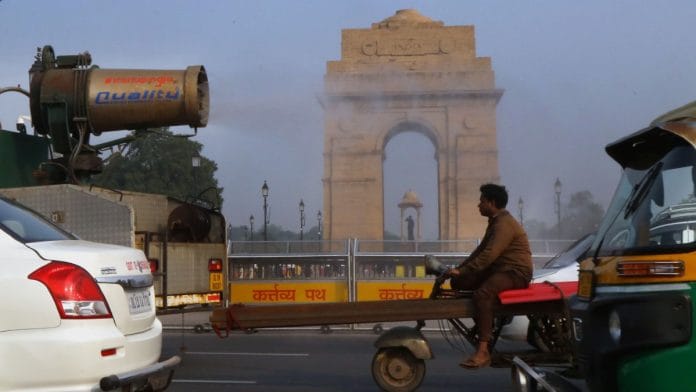



New Delhi: As Delhi and large parts of northern India remain cloaked in toxic haze, the Commission for Air Quality Management (CAQM) has said that a new source apportionment study is underway to assess what causes pollution in the capital.
A member of CAQM, an expert body that decides on actions to be taken when air quality in Delhi-NCR plummets, told ThePrint Tuesday it is adding new components to the source apportionment study, though no release date was shared.
Source apportionment studies are scientific analyses of different pollution sources and their contribution to overall air quality in an area.
This will be the sixth such study conducted in Delhi since 2010. The latest source apportionment study, conducted in 2023 by IIT Kanpur and five other institutions, has not been approved by the Delhi government.
The development comes a week after the National Green Tribunal (NGT) was informed that Delhi’s pollution action plans rely on emission source data from seven years ago.
A submission by amicus curiae Sanjay Upadhyay, uploaded on 26 November, said that pollution measures in Delhi are based on source apportionment data from before 2018 and have not been updated despite new studies being conducted since then.
“The NCT of Delhi has not revised their State (Clean Air) Action Plan since 2018, despite conducting the Source Apportionment Study in 2023,” the submission read.
Upadhyay summed up the situation: “I asked a simple question—if there are new source apportionment studies after 2018, have they been incorporated into the pollution action plan? The answer is no.”
Also Read: A 40-year legal battle for clean air: Why Delhi breathes poison despite steadfast judicial crusade
Previous pollution studies
The Union Ministry of Environment, Forests and Climate Change (MoEFCC) and the Central Pollution Control Board (CPCB) mandated source apportionment studies in 2019 for 131 cities under the National Clean Air Programme (NCAP), launched the same year.
“Understanding the air pollution sources is important to control and prevent PM2.5 emissions. This requires the identification and contribution of the sources (source apportionment) at ambient air breathing level air quality in space and time,” Delhi Pollution Control Committee (DPCC) said in a 2023 report on source apportionment study.
Given the various sources of air pollution—dust, construction, transport, power generation, stubble burning—these studies enable states and cities to prioritise their interventions.
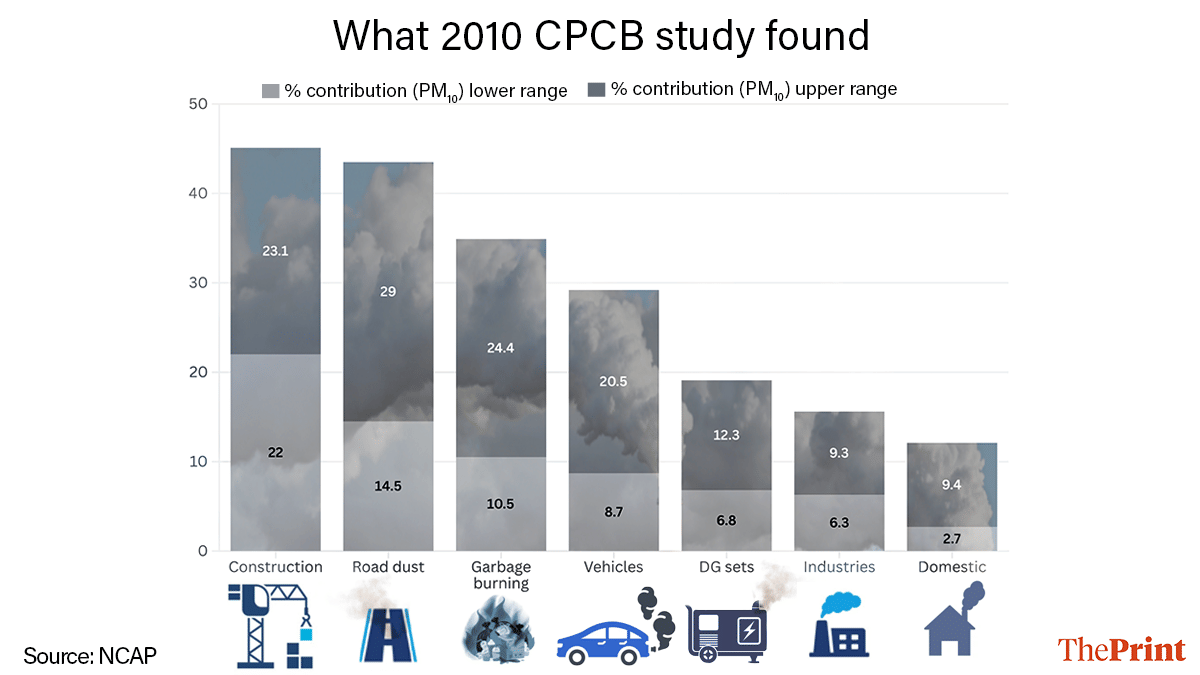
Delhi’s first source apportionment study was conducted in 2010 by the National Environmental Engineering Research Institute (NEERI) and was ordered by CPCB for six cities: Kanpur, Bengaluru, Mumbai, Delhi, Pune and Chennai. But the study focused largely on particulate matter less than 10 micrometres (PM10) in diametres, which was the main pollutant being recorded at the time.
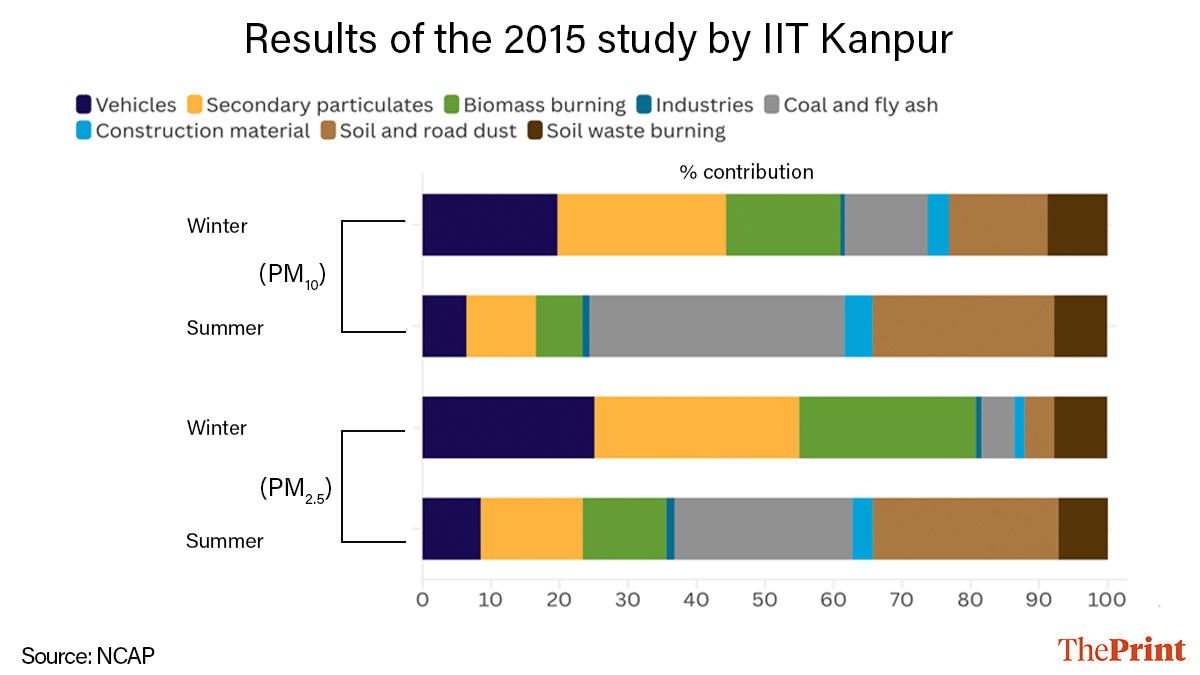
As measurements improved and international research highlighted PM2.5 as more harmful than PM10, the government revised its approach. Between 2015 and 2016, IIT Kanpur conducted a comprehensive source apportionment and emissions inventory study for the Delhi government, including in its assessment PM2.5 and other pollutants.
“The IIT Kanpur study was very holistic, and continues to be the most quoted source apportionment study for Delhi,” said Mohan George, clean air consultant for think-tank Centre for Science and Environment (CSE).
“But even after that, there were other studies done that are equally good,” he added.
In 2017, the Delhi Pollution Control Committee, along with IIT Madras and IIT Delhi, published a winter pollution source apportionment study. The following year, The Energy and Resources Institute (TERI) published a report on both PM2.5 and PM10 source apportionment. “All these studies have contributed to the Delhi government’s pollution protocols and measures, because they have all advanced each other’s work. The methods, data and analysis got better every year,” George said.
Why regular updates matter
Source apportionment studies need to be conducted regularly at short intervals, experts say. The NCAP document published in 2019 explains how source contributions to pollution vary within a city across different seasons, time periods and years. Experts recommend conducting these studies every two to three years.
The variations can be significant. The 2010 NEERI study found construction contributed 20-23 percent of PM10 pollution, while the 2015 IIT Kanpur study estimated it at just 3-5 percent.
An air quality expert, who wished to remain anonymous, said source apportionment studies also help assess whether government measures are effective. “If you did one source apportionment, and you decided to tackle the sources mentioned in that, you should do another study in a few years to check whether you’ve been successful or not. If the sources you tackled are actually reducing, then you know you’re on the right track. Or else, you need to course correct,” the expert said.
With measures such as the introduction of BS-VI (emission standard) vehicles and electric vehicle (EV) rollouts taken over the last decade, Delhi’s air pollution landscape has changed significantly.
This was the point that the amicus curiae emphasised in his NGT submission, noting that Delhi’s current air quality measures are based on sources identified up to 2018. The action plan, devised by the now-defunct Air Quality Monitoring Committee, includes initiatives such as the Graded Response Action Plan (GRAP), which are emergency measures currently implemented in Delhi-NCR as air pollution increases. Among these are temporary bans on construction work and open waste-burning.
In his submission, Upadhyay also said that some cities like Noida and Faridabad have not even completed their source apportionment studies, and others like Delhi have not updated theirs. He noted that air pollution management in Delhi suffers from a “lack of synergy” because different institutions handle different measures.
The 2023 real-time study
The 2023 study marked a significant change in methodology. DPCC, IIT Kanpur and a consortium of organisations, including IIT Delhi, conducted a real-time source apportionment study for the capital.
Previous studies used air quality samples collected over extended periods, which was labour-intensive and required lengthy data analysis. The 2023 study used real-time data, which was collected and analysed instantly through the country’s first ‘supersite’—an air pollution monitoring station that also identified sources simultaneously.
A draft of this study accessed by ThePrint shows that the highest contribution towards air pollution comes from secondary inorganic aerosols (SIA). These are particles not emitted by a single source but formed through chemical reactions when multiple gases mix in the air and interact with sunlight. Gases such as sulphur dioxide and nitric oxide are examples of SIAs that are formed from emissions by factories and power plants.
But the Delhi government, in a note submitted to NGT this October, said the 2023 source apportionment study has “not been approved”, and its findings are not used to guide measures to reduce pollution.
DPCC and the Delhi government’s environment department did not respond to requests for comment till Tuesday evening.
Call for urgent action
The amicus curiae told NGT there was a need to update city action plans for air pollution and conduct source apportionment studies at the earliest. He flagged that it was not just state authorities, but also the CPCB and state pollution control committees that have a “complacent attitude”.
“CPCB and MoEF&CC may be directed to take appropriate actions against such defaulting cities, as the current air quality situation is so severe that mere letters to ensure compliance are not sufficient,” the note read.
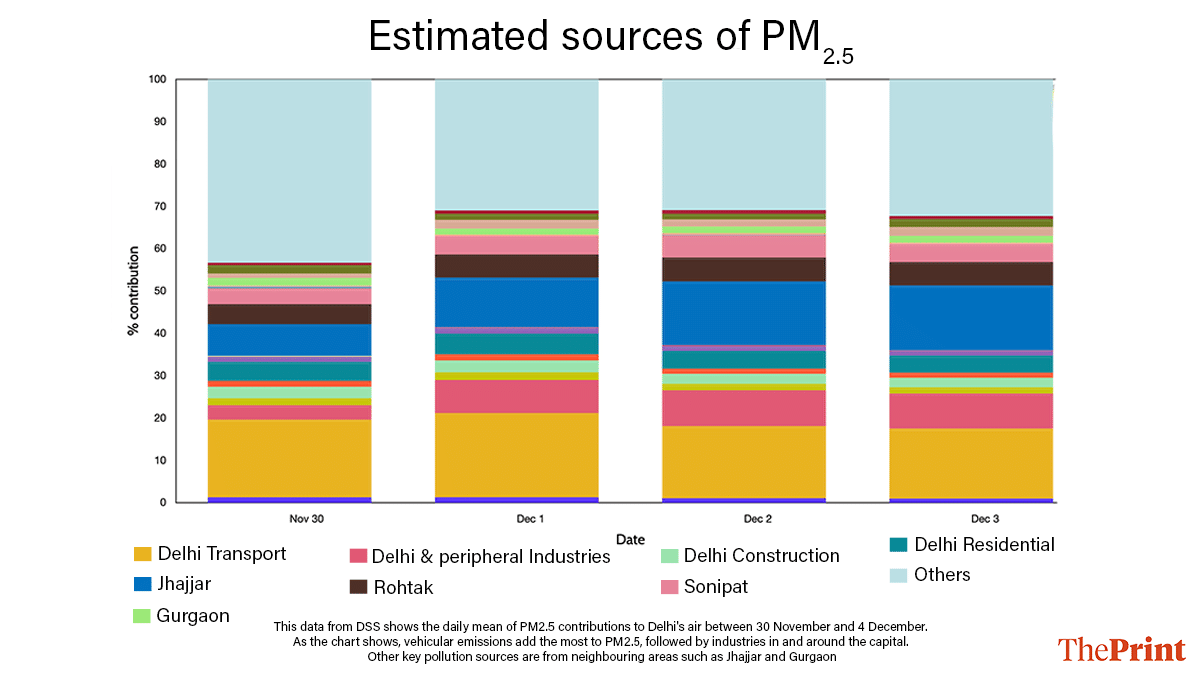
The lack of source apportionment studies has wider implications. The Decision Support System portal, a real-time source-based pollution tracker managed by the Ministry of Earth Sciences and IITM Pune, uses emissions inventory developed in the 2018 study. If there are newer studies and additions to the list of air pollution sources, the DSS will need updating too.
But, some experts argue that alongside new studies, the government should focus on tackling known major emitters. “It is a good thing that they are planning a new study, but after all this while, we are aware of the main pollutants—road dust, construction, biomass burning,” George said, adding: “Why not work on tackling those first, and then do other studies?”
Delhi’s average air quality index (AQI) ranged between 250 and 350, in the ‘very poor’ category, for most of November. Long exposure to hazardous air, doctors say, exacerbates respiratory and cardiac ailments, with children and the elderly considered most vulnerable.
(Edited by Prerna Madan)
Also Read: Delhi’s air pollution is of its own making. Stubble burning not the main culprit, says CSE